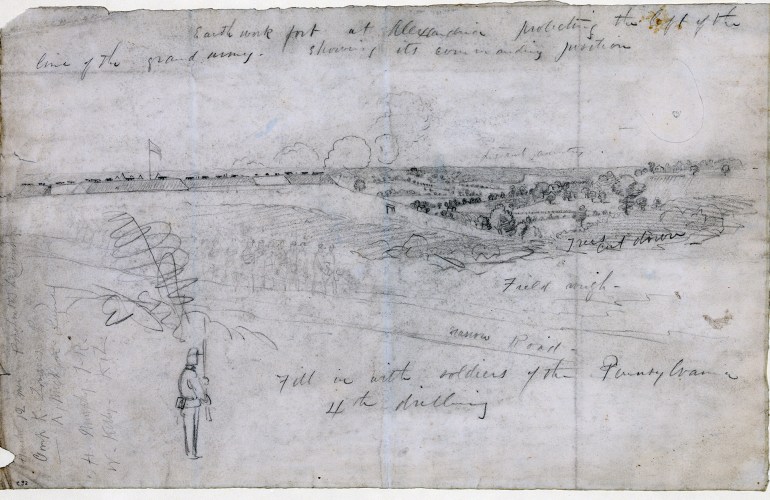
Earthwork Fort at Alexandria Protecting the Left of the Line of the Grand Army

This unfinished pencil drawing by famed artist Alfred Rudolph Waud (1828-1891) depicts Fort Ellsworth on Shuter’s (or Shooter’s) Hill, west of Alexandria in late June / early July 1861. Illustration has been enhanced to show details. Library of Congress Prints and Photographs Division. Click on the image to expand. The illustration is titled, Earthwork fort…

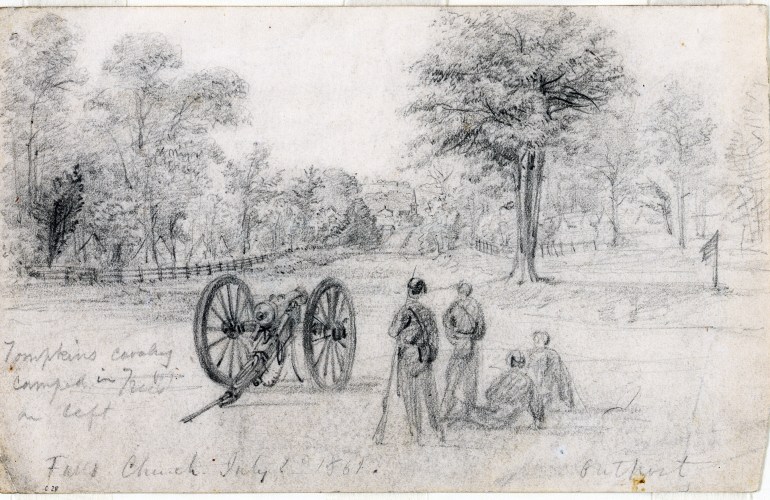
Outpost Watching Falls Church, Virginia, 1861

This pencil drawing by famed artist Alfred Rudolph Waud (1828-1891) depicts a Union artillery piece and camp of 2nd United States Cavalry, Company B, led by Lieutenant Charles H. Tompkins, near Falls Church, Virginia on July 1, 1861. Exactly one month earlier, Tompkins led a chaotic reconnaissance on Fairfax Court House, in which several of…

The Fate of Burdsall’s Men

On Friday, July 19, 1861, a seven-man patrol from Captain Henry W. Burdsall's Independent Company of Ohio Cavalry was ambushed along the West Fork of the Greenbrier River, near present-day Durbin, West Virginia, in Pocahontas County. Confederate reports claimed that all but one of the men were killed, but the reality was different. One man…

Clash at Red House: Friendly Fire or Something More?

The incident near Red House not only serves as a lesson in the hazards of nineteenth-century warfare but also underscores the importance for historians of cross-referencing newspaper reports with multiple sources. It was shortly after sundown on July 14, 1861. The Ohio longshoremen and steamboat crewmen of the 1st Kentucky Infantry Regiment (U.S.) were packed…

Artifact: Traitors in Wheeling

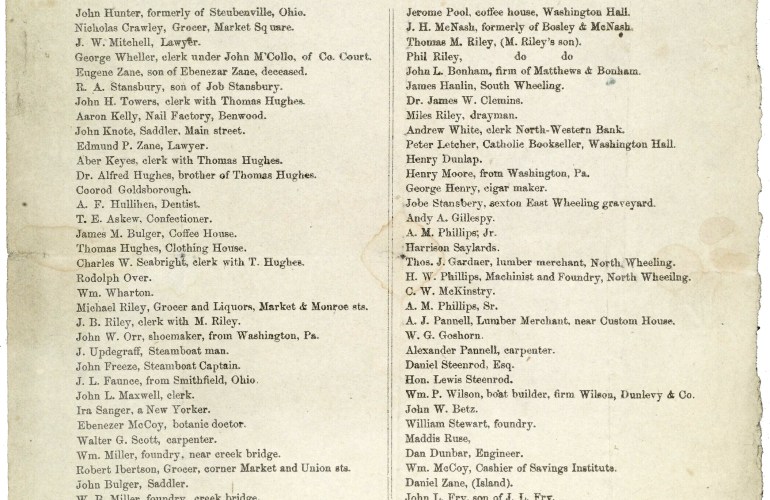
The town of Wheeling, located along the Ohio River in what was then the Virginia panhandle (today, West Virginia), was Virginia’s fourth largest city in 1860. Sandwiched between the free states of Ohio and Pennsylvania, it was largely populated by German immigrants with no affinity for Virginia’s Anglo-American planter class. When the Secession Convention in…

Big Bethel by the Numbers – Union

Based on a careful analysis, it’s reasonable to conclude that the Union force had approximately 4,518 men on the field that day. The Battle of Big Bethel, June 10, 1861, on the Virginia Peninsula was unequivocally the first pitched battle of any magnitude in the American Civil War. Approximately 6,000 Union and Confederate soldiers participated,…

Illustration of James H. Ward

Connecticut-born James Harmon Ward (1806-1861) was a dyed in the wool Yankee steeped in his region's maritime tradition. He graduated from the American Literary Scientific and Military Academy at Norwich, Vermont in 1823 and entered the U.S. Navy as a midshipman. His varied naval career included interdicting illegal slave traders off the African coast and…

Union Troops in Patterson’s Creek Skirmish

A few days ago, I posted an accounting of all Confederate soldiers involved in the Patterson's Creek / Kelley’s Island Skirmish. Having the names of all participants on the Confederate side only tells half the story, however, but I recently came across a contemporary newspaper article that sheds light on the Union troops involved. The…

Illustration of Lewis “Lew” Wallace

Lewis "Lew" Wallace (1827-1905) was born on April 10, 1827 in Brookville, Indiana to a prominent family. His father, David Wallace, was a West Point graduate, U.S. Congressman, and 6th governor of Indiana. Wallace was well-educated for the time, and showed a proficiency for writing. He went on to publish the influential novel Ben Hur…

First Personality Pages Published

This encyclopedia will not only feature information about the battles of 1861, but also the personalities who fought them. Quality images of many of these individuals are hard to come by, since some died early in the war and others had lackluster military careers and were overlooked. So I've commissioned unique illustrations for each profile.…