Wednesday, June 12, 1861
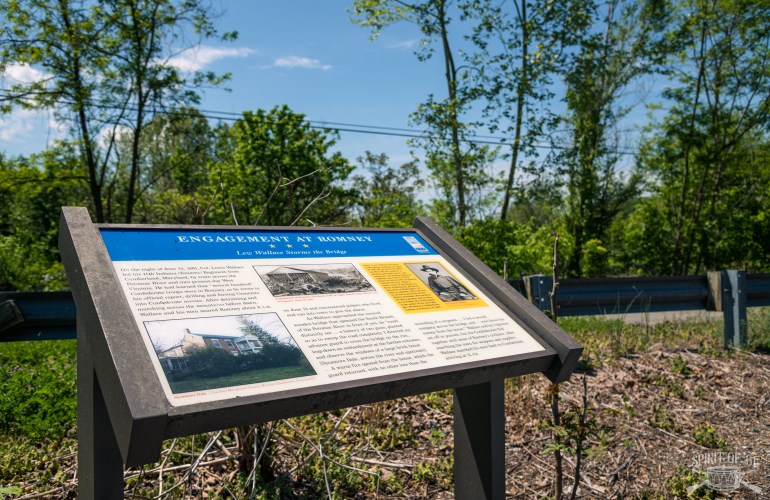
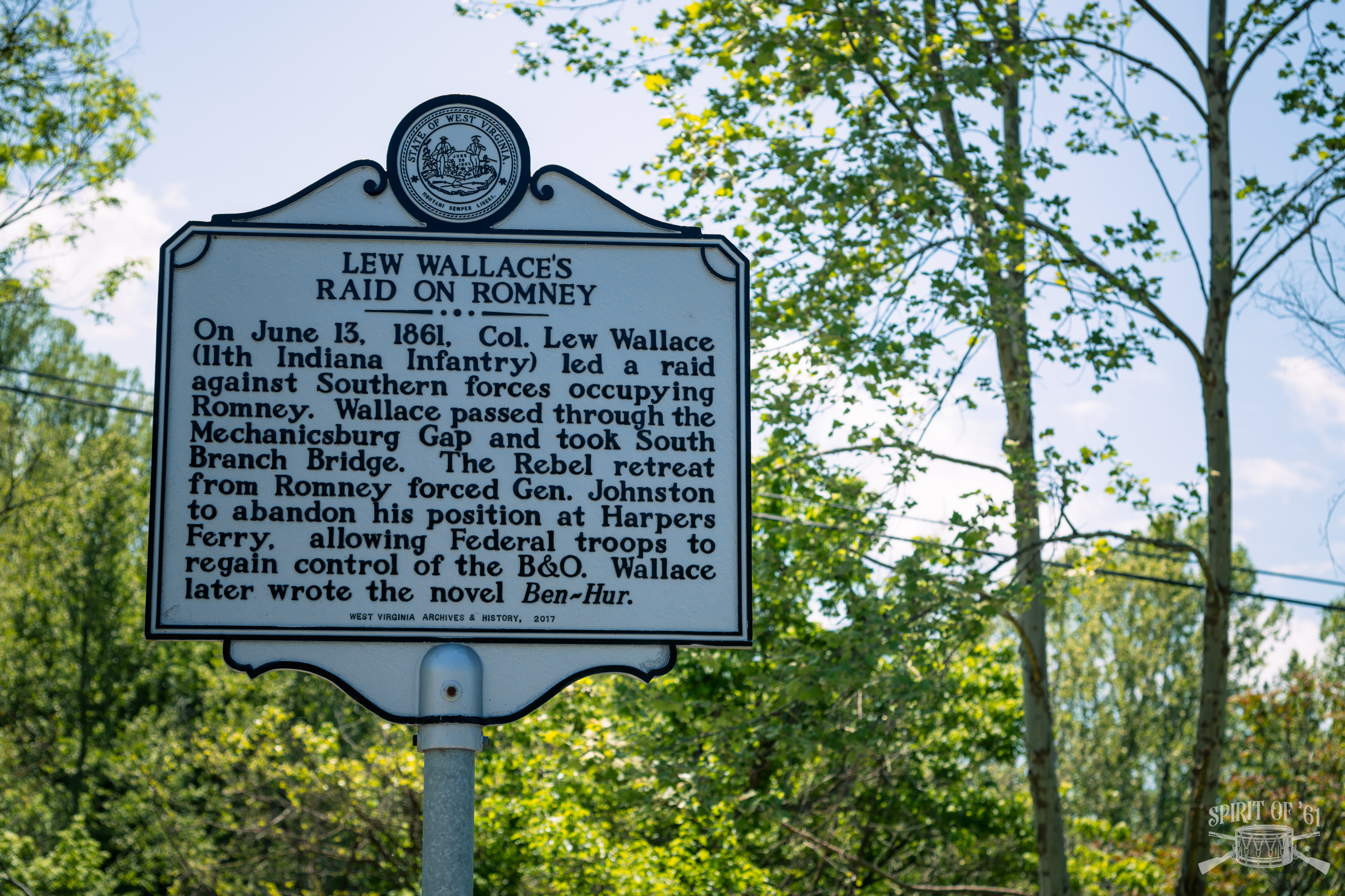
In June 1861, Lew Wallace and the 11th Indiana launched a grueling overnight march from Cumberland, Maryland, to surprise Confederate troops at Romney, Virginia, in one of the Civil War’s earliest actions. The resulting skirmish sent Confederate defenders fleeing, left Romney briefly in Union hands, and helped convince Gen. Joseph E. Johnston to abandon Harpers Ferry for Winchester.
Narrative
The Skirmish at Romney was fought on Wednesday, June 12, 1861 between Union forces commanded by Col. Lewis “Lew” Wallace and Confederate forces commanded by Col. Arthur C. Cummings in Hampshire County, West Virginia. The nearly bloodless victory for the Indiana Zouaves made future author Lew Wallace a household name.
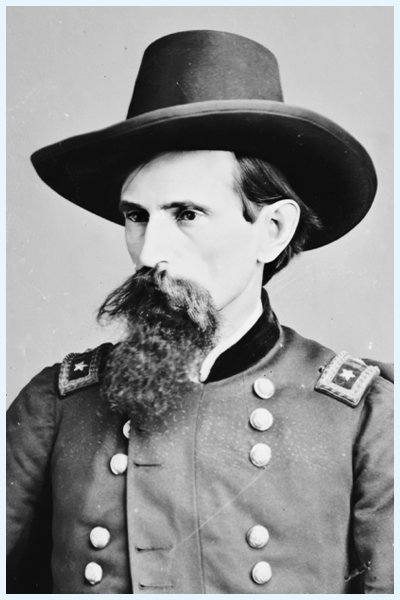
Library of Congress, Prints and Photographs Division.
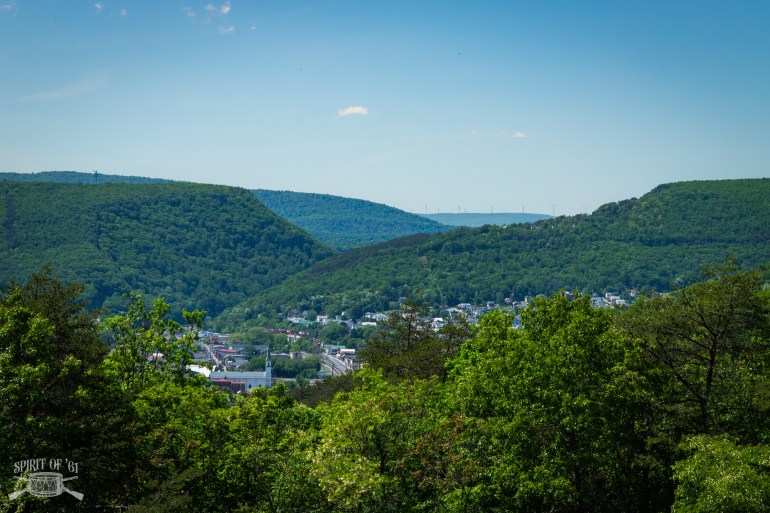
As early as May 24, 1861, Winfield Scott, commanding general of the U.S. Army, telegraphed Maj. Gen. Robert Patterson in Philadelphia, urging him to move troops into western Maryland and occupy Frederick, Hagerstown, and Cumberland. Cumberland, at the tip of a finger formed by the Potomac River, was a vital transportation hub and an important station on the Baltimore & Ohio (B&O) Railroad. Coal, iron, and other raw materials flowed through town from western Maryland and Virginia to cities along the eastern seaboard. Patterson’s attention, however, remained fixed on Harpers Ferry and Martinsburg in Virginia’s Shenandoah Valley.
Patterson turned to Lewis “Lew” Wallace, a friend of Indiana Governor Oliver P. Morton and the state’s adjutant general. After organizing Indiana’s 90-day volunteers, Wallace assumed command of the 11th Indiana Infantry Regiment. He outfitted the regiment in gray, French-inspired Zouave jackets and drilled its men in French colonial tactics. Initially stationed at Evansville, Indiana, to inspect traffic on the Ohio River, the regiment soon received orders directly from Winfield Scott to join Patterson’s command.
On or about June 6, while en route along the B&O Railroad, Wallace and the 11th Indiana received new orders to halt at Cumberland, secure the area’s Potomac River bridges, and await further instructions. Patterson also directed them to win the confidence of the local population and gave Wallace broad authority to “capture or rout” armed insurgents in the region—an order he was more than eager to carry out. Before reaching Cumberland, Wallace learned that secessionist troops occupied Romney, 27 miles to the south, and resolved to confront them at the earliest opportunity.
The regiment arrived in Cumberland on the mist-shrouded morning of Monday, June 10, but its stay was brief. After detouring to pursue a false report, the men rolled into town again the following morning, where local citizens welcomed them enthusiastically. Following breakfast, the entire regiment marched in parade-like formation from the station to its campsite on Rose Hill, named Camp McGinnis (after Lt. Col. George F. McGinnis).
That night, Wallace left two companies behind while the remainder boarded train cars for New Creek Station, avoiding the direct route watched by Confederate cavalry. The detour turned the journey into a grueling, ten-hour, thirty-five-mile slog, much of it over a weather-beaten mountain road that crossed “high bluffs, and narrow passes.”
Unlike their neighbors across the state line, residents of Romney and Hampshire County, Virginia, favored secession, especially in the county’s eastern two-thirds. At the time, Hampshire County encompassed the areas that now comprise Hampshire and Mineral Counties. At Richmond’s secession convention, the county’s two delegates voted against secession twice before reversing themselves and signing the Ordinance of Secession.
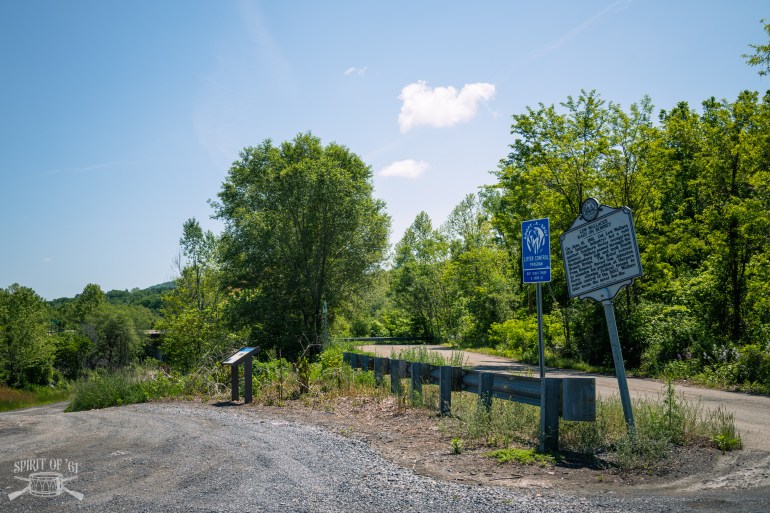
Laid out on a flat terrace overlooking the South Branch of the Potomac River, Romney was linked to Winchester by the Northwestern Turnpike, which continued west to Parkersburg on the Ohio River. The Confederate force in town included the Potomac Guards and Independent Greys, later Companies A and F of the 33rd Virginia Infantry Regiment. Their commander, Col. Arthur C. Cummings, was organizing the 33rd into a full regiment. Also present were the Hampshire Riflemen, led by Capt. George F. Sheetz, later Company F of the 7th Virginia Cavalry.
In the predawn darkness, midway between New Creek Depot and Romney, near the hamlet of Sheetz’s Mill (later Headsville) on Patterson Creek, a local civilian spotted Wallace’s passing Zouaves. The man set out on foot for Mechanicsburg Gap, where a friend loaned him a horse for the final three miles to Romney. He arrived shortly after sunrise and raised the alarm.
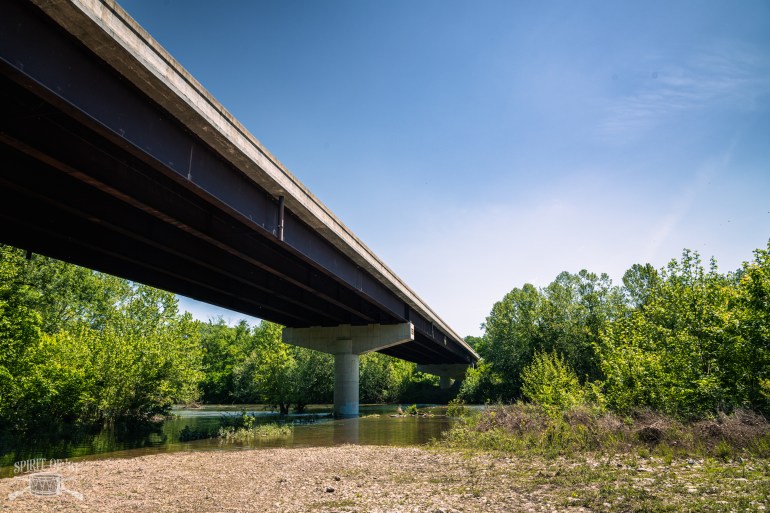
Colonel Cummings hastily formed his poorly armed men into a line of battle and marched them to the bluff overlooking the turnpike bridge across the South Branch of the Potomac, just west of town. There, he positioned two obsolete 4-pounder cannon, though whether they had ammunition remains uncertain. When Cummings saw Wallace’s column emerging from the gap, he realized he was badly outnumbered. There was little to do but order a retreat and join the stream of civilians fleeing eastward.
Sheetz’s Hampshire Riflemen served as the rearguard. While mounted riflemen exchanged shots with Wallace’s skirmishers near the bridge, others occupied Sycamore Dale, David Gibson’s two-story Greek Revival plantation house, and fired from its windows.
The Hoosiers pushed across the covered bridge and spread out in a semicircle around the house. During the exchange, a bullet ricocheted off the ground and struck 1st Sgt. Moses Grooms on his suspender buckle, leaving him with a bruised chest. He was the regiment’s only casualty. Wallace then personally led a detachment up the hill to the right to turn the enemy’s flank. He reported, “Hardly had my companies deployed and started forward, and got within rifle range, before the rebels limbered up [their artillery] and put off over the bluff in hottest haste.”
The Hoosiers pushed across the covered bridge and spread out in a semicircle around the house. Realizing they were about to be surrounded, the Confederates abandoned their position and fell back toward town, pausing occasionally to fire on their pursuers. An elderly resident named Busby was wounded.
Although Wallace pledged not to harass unarmed civilians, his men destroyed the printing press and offices of the South Branch Intelligencer, a newspaper that openly supported secession. He also ordered Sycamore Dale burned, but its owner persuaded him to spare the house. The soldiers nevertheless ransacked it. Lt. John M. Blue, later of Company D, 11th Virginia Cavalry, recalled, “Bureaus and wardrobes had been broken open and contents scattered over the floor and many things of value taken away.”
Romney was largely deserted, save for a handful of African Americans who appeared unfazed by the soldiers’ presence. The women prepared a generous home-cooked meal with what Wallace later described as “the famous old Virginia flavor,” ensuring that no one went hungry. That afternoon, the weary Hoosiers began the long march back to Cumberland, three wagons loaded with captured guns and equipment in tow and exhausted men dropping along the roadside whenever the column halted.
Though tactically insignificant, Wallace’s brief occupation of Romney, combined with the threat posed by Maj. Gen. George B. McClellan’s army advancing over the mountains from the west, convinced Confederate Brig. Gen. Joseph E. Johnston that his command risked envelopment. He withdrew his small Army of the Shenandoah from Harpers Ferry to Winchester, opening the way for Patterson’s advance. Romney, however, soon returned to Confederate hands.
Opposing Forces
Confederate
Col. Arthur C. Cummings, Commanding
| Unit | Commander(s) | Strength | Killed | Wounded | Captured |
|---|---|---|---|---|---|
| Potomac Guards (Co. A, 33 VA IN) | Capt. Philip T. Grace | 0 | 0 | 0 | |
| Independent Greys (Co. F, 33 VA IN) | Capt. Abraham Spengler | 0 | 0 | 0 | |
| Hampshire Riflemen (Co. F, 7 VA CAV) | Capt. George F. Sheetz | 16-17 | 0 | 0 | 0 |
Union
Col. Lewis Wallace, Commanding
| Unit | Commander(s) | Strength | Killed | Wounded | Captured |
|---|---|---|---|---|---|
| 11th Indiana Inf. Regiment | Col. Lewis Wallace | 500 | 0 | 1 | 0 |
Timeline
May 23, 1861: Virginia voters ratify their state’s Ordinance of Secession.
June 8-9, 1861: A small Confederate force assembles in Romney.
June 10, 1861: The 11th Indiana Infantry Regiment arrives in Cumberland, Maryland to guard the Baltimore & Ohio Railroad.
June 12-13, 1861: Col. Lewis “Lew” Wallace leads 500 men from the 11th Indiana on an 87-mile march by rail and foot to Romney.
Location
GPS Coordinates — 39.34204, -78.75668
Primary Sources
News Reports
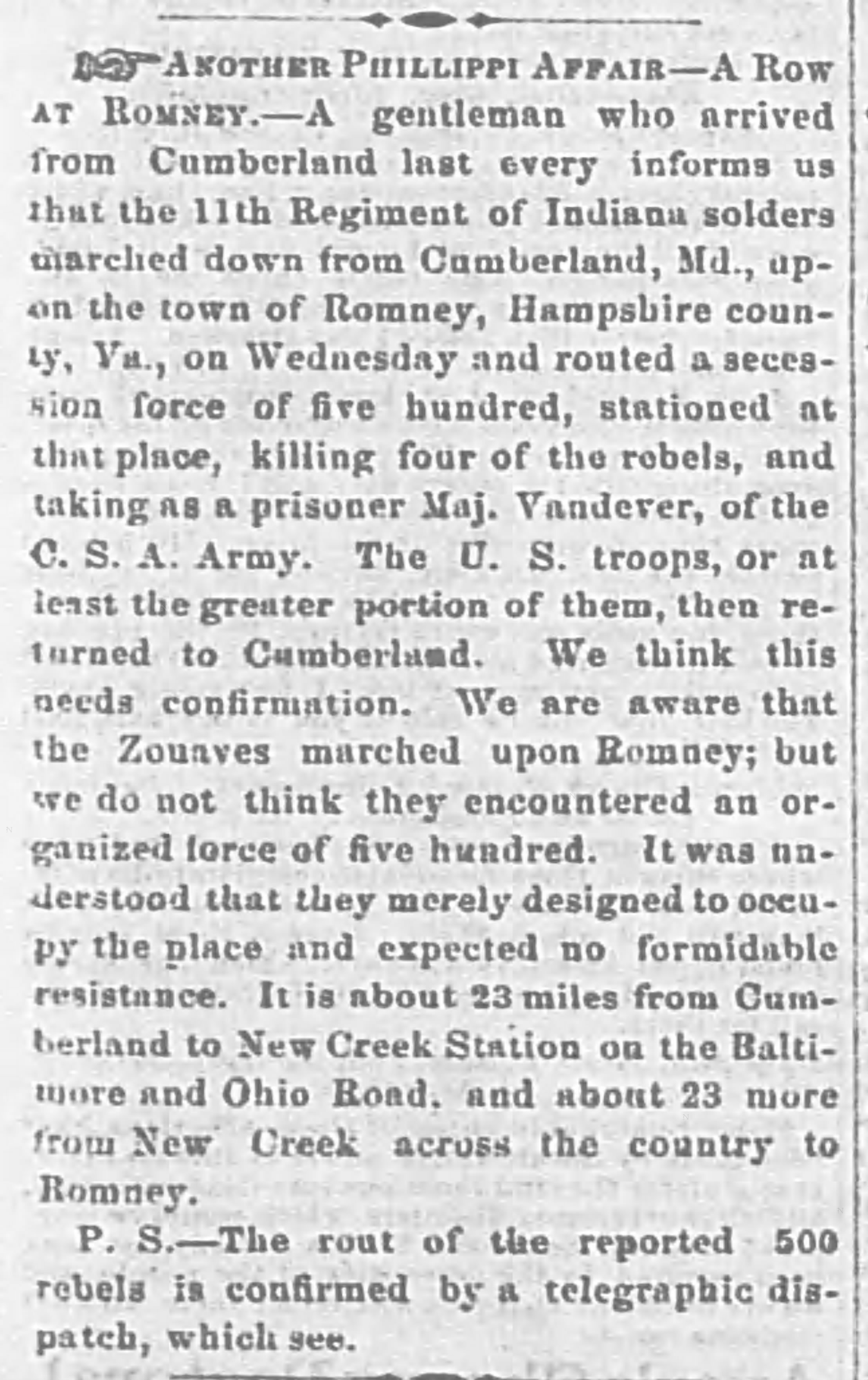
Wheeling Daily Intelligencer (Wheeling, VA) 14 June 1861.
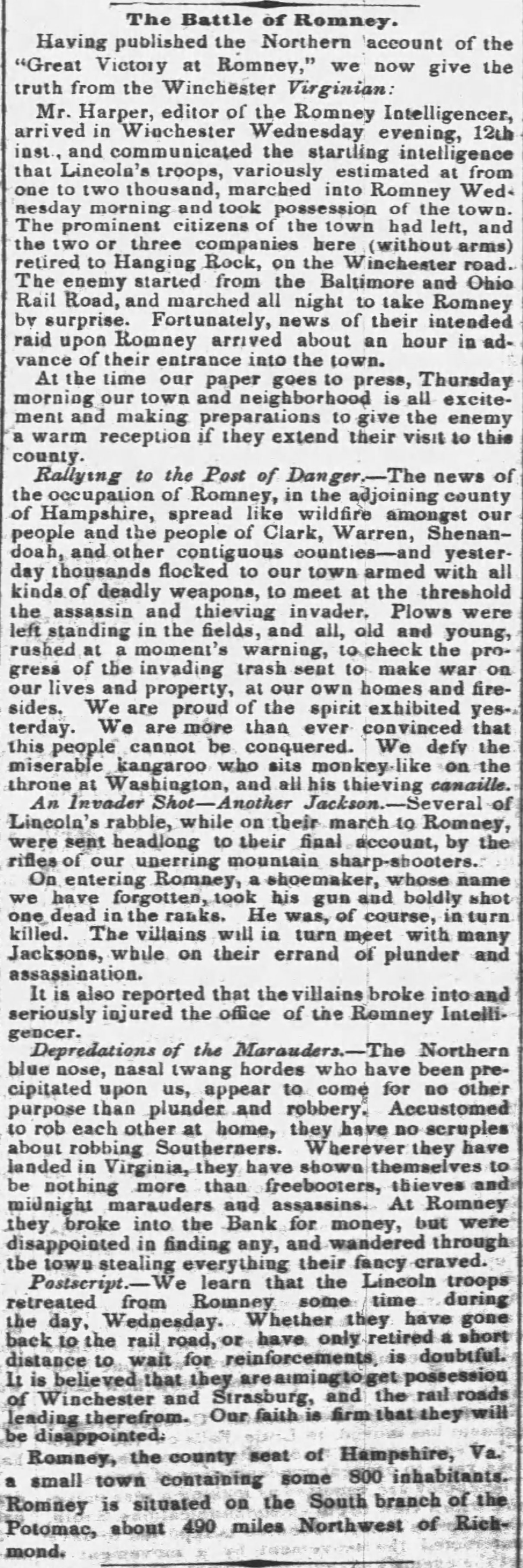
Charleston Daily Courier (Charleston, SC) 22 June 1861.
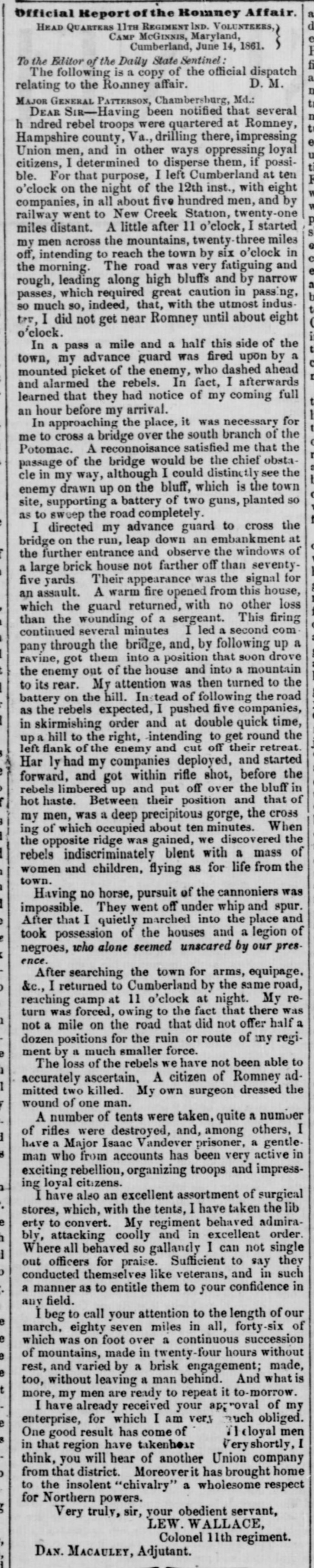
Indiana State Sentinel (Indianapolis, IN) 26 June 1861.

Indiana State Sentinel (Indianapolis, IN) 26 June 1861.
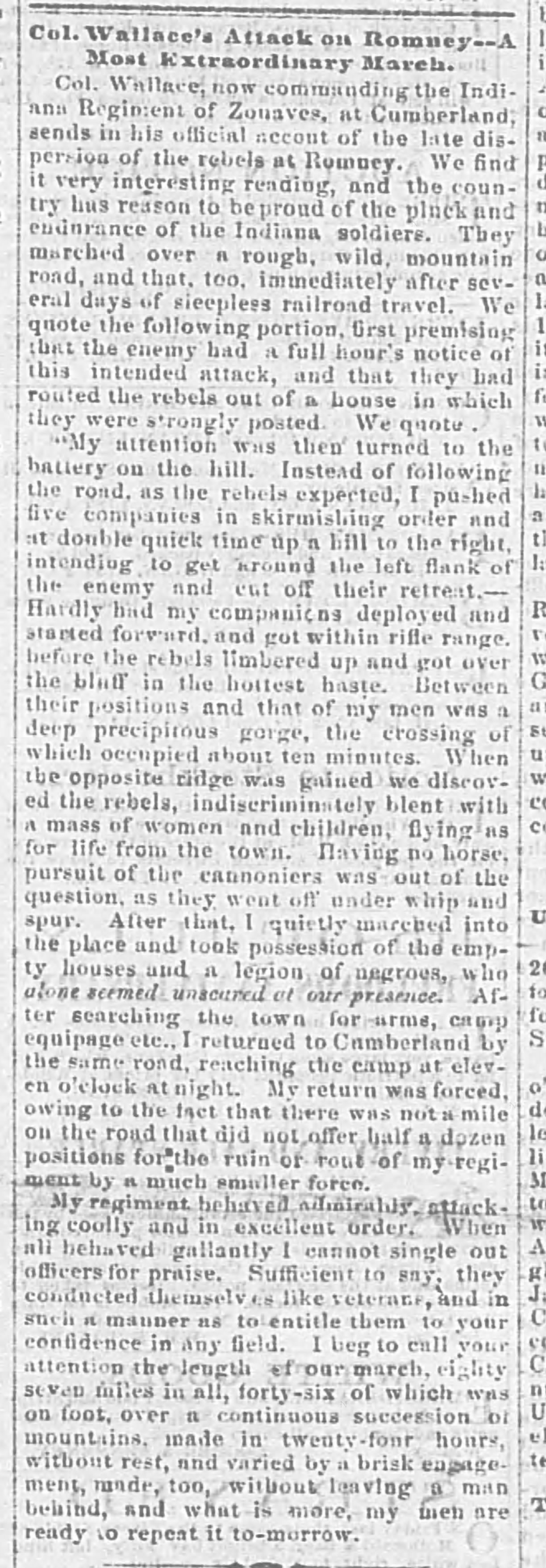
Wheeling Daily Intelligencer (Wheeling, VA) 29 June 1861.
Primary Sources
Reports and Letters
- June 6 Orders to Col. Lewis Wallace, 11th Indiana Infantry
- June 11 Report of Col. Lew Wallace, Eleventh Indiana Infantry
- June 12 Letter from Maj. Gen. Robert Patterson
- June 14 Report of Colonel Lew. Wallace, Eleventh Indiana Infantry
Diaries and Memoirs
Casler, John O. Four Years in the Stonewall Brigade. Guthrie: State Capital Print, Co., 1893.
Durham, Thomas Wise. Three Years with Wallace’s Zouaves: The Civil War Memoirs of Thomas Wise Durham. Jeffrey L. Patrick, Ed. Macon: Mercer University Press, 2003.
Oats, Dan, ed. Hanging Rock Rebel: Lt. John Blue’s War in West Virginia and the Shenandoah Valley. Shippensburg: Burd Street Press, 1994.
Wallace, Lewis. Lew Wallace: An Autobiography, Vol. I. New York: Harper & Brothers, 1906.
Secondary Sources
Haselberger, Fritz. “Wallace’s Raid on Romney in 1861.” West Virginia History 27 (January 1966): 97-110.
Merrill, Catharine. The Soldier of Indiana in the War for the Union. Indianapolis: Merrill and Company, 1866.
Stephens, Gail. Shadow of Shiloh: Major General Lew Wallace in the Civil War. Indianapolis: Indiana Historical Society Press, 2010.
Updated:
Created:
 Spirit of '61