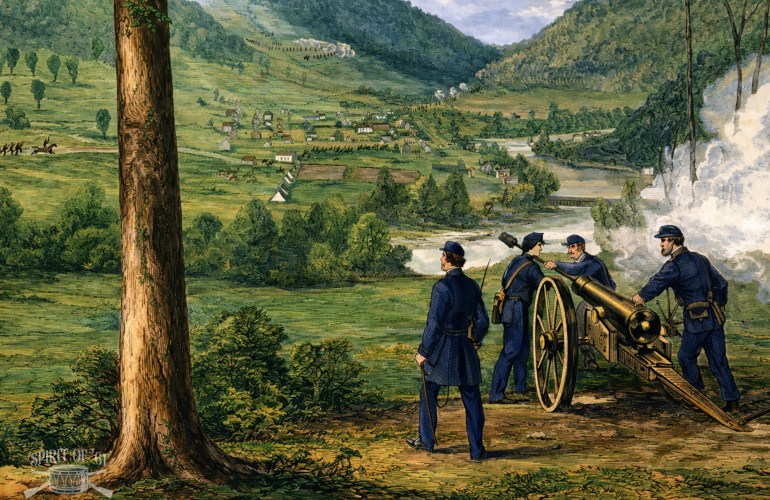
In a rain-soaked dawn attack at Philippi, Union columns under Benjamin Kelley and Ebenezer Dumont scattered Col. George A. Porterfield’s inexperienced command, sending it fleeing in what became known as the “Philippi Races.” The brief fight secured the B&O lifeline and shattered secessionist momentum in northwestern Virginia at the very outset of the war.
Events in northwestern Virginia in April and May 1861 had not gone well for the secession government in Richmond. As overall commander of Virginia’s provisional army, Maj. Gen. Robert E. Lee attempted to call out the militia to seize key points along the Baltimore & Ohio (B&O) Railroad at Wheeling and Grafton. Instead, the state’s antebellum militia fractured along ideological lines, with unionists and secessionists forming rival outfits. The secessionists were badly outnumbered.
Unionists, led by Congressman John S. Carlile, turned Wheeling Island into a recruiting and training ground. Volunteers from Virginia, Ohio, and Pennsylvania gathered there to form companies and regiments, armed and supplied by the federal government. Maj. Gen. George B. McClellan, commanding the Department of the Ohio, understood that fostering unionist sentiment in northwestern Virginia would be critical to any future operation in the region.
When Col. George A. Porterfield arrived at Grafton, where the B&O met the Northwestern Virginia Railroad, to take command of the state’s secessionist volunteers, he found only a few hundred poorly armed recruits scattered through the surrounding communities. He shifted his headquarters to nearby Fetterman, where promised arms and ammunition never came. Robert E. Lee eventually agreed to send a small number of reinforcements from the Shenandoah Valley and Potomac Highlands. Maj. Michael G. Harman, quartermaster at Staunton, armed and equipped these companies and dispatched Rudolph Turk, sheriff of Augusta County, to lead them over the mountains to Beverly in Randolph County.
Statewide, voters overwhelmingly approved the secession ordinance on May 23, but in northwestern Virginia the result was the opposite. Monongalia and Preston counties held mass Union meetings, and their militia pledged to fight only for the Union. The Union Home Guard seized control of Clarksburg, Congressman Carlile’s hometown. In Wheeling, the First Virginia Infantry Regiment (U.S.), under Col. Benjamin F. Kelley, mustered into federal service for a 90-day term.
On the 25th, after the local Union volunteers left for Wheeling, Porterfield moved his entire force of several hundred infantry and cavalry into Grafton. Fearing an invasion by overwhelming numbers from Ohio, he ordered Col. William J. Willey to target bridges along the B&O Railroad. That evening, Willey partially carried out the order with a small squad, destroying two bridges over Buffalo Creek between Farmington and Mannington. Porterfield also dispatched Monongalia County attorney Jonathan McGee Heck to Richmond to explain the dire situation they faced.
In response to the bridge burnings, McClellan ordered a multi-pronged advance to secure and repair the railroads in the region and seize the key junction at Grafton. He directed the First Virginia Infantry (U.S.) and the 16th Ohio Infantry to move out from Wheeling along the B&O, while the 14th Ohio advanced from Parkersburg on the Northwestern Virginia Railroad, with the 18th Ohio in support.
“Sever the connection that binds you to traitors,” McClellan urged. “Proclaim to the world that the faith and loyalty so long boasted by the Old Dominion are still preserved in Western Virginia, and that you remain true to the Stars and Stripes.”
The next day, the First Virginia (U.S.) and 16th Ohio reached Mannington, where they found the burned bridges along the B&O and began repairs. Porterfield sent another expedition to destroy bridges between Clarksburg and Parkersburg on the Northwestern Virginia Railroad. The spans at Simpson’s Creek, Goose Creek, and the North Fork of the Hughes River were burned. This delayed Col. James B. Steedman and the 14th Ohio from reaching Clarksburg until the 30th.
Realizing he was trapped, Porterfield evacuated Grafton on May 28 and moved his headquarters 15.5 miles south to Philippi, a town in Barbour County with strong secessionist sentiment. En route, he was joined by the Upshur Grays, an infantry company possessing tents but no guns or ammunition.
Although reinforcements grew Porterfield’s force to a nominal strength of 780 infantry and 220 cavalry, the raw recruits fostered a carnival-like atmosphere where bravado was abundant and discipline was scarce. This overconfidence was embodied by “Count” Daniel A. Stofer, who, known for his bellicose speeches, boasted, “I can chase Mr. Lincoln’s invaders off the soil of Virginia with the limb of a peach tree.”
The First Virginia (U.S.) and 16th Ohio regiments rolled into Grafton by train on May 30. In under a week, McClellan’s expeditionary force had secured roughly 200 miles of track, meeting almost no opposition. When Brig. Gen. Thomas A. Morris, quartermaster general of the Indiana state militia, arrived in Grafton to assume command, he discovered that Col. Benjamin Kelley had already planned an advance on Philippi.
The plan called for two columns to converge on Philippi from different directions. The first, led by Col. Ebenezer Dumont, consisted of approximately 1,600 infantrymen. It included eight companies of the 7th Indiana Infantry, portions of the 14th Ohio and 6th Indiana regiments, and two cannons from the 1st Ohio Light Artillery. They were to meet at Webster and proceed directly south to Philippi. Colonel Frederick W. Lander, a volunteer aide to McClellan, accompanied the artillery.
A second column of approximately 1,800 men, commanded by Col. Kelley, would first feint a movement east along the B&O Railroad toward Harper’s Ferry. Then, at the town of Thornton, they would turn south to envelop Philippi from behind, cutting off the Confederate line of retreat. This column was composed of portions of the First Virginia (U.S.), 9th Indiana, and 16th Ohio infantry regiments.
In Philippi, Colonel Porterfield’s command consisted of ten infantry and four cavalry companies, with his headquarters at the Capito Hotel. He had already received reports of a planned federal advance when two women from Fairmont, Abbie Kerr and Mollie McLeod, frantically rode into town reporting they had seen hundreds of soldiers boarding trains. Porterfield’s captains held a council of war and unanimously agreed to retreat. Wagons were readied for departure, and cavalry patrols and pickets were dispatched to watch the roads.
A driving rainstorm suddenly upended everyone’s plans. Porterfield, convinced no one would advance in such a downpour, let his men rest, and the pickets scattered for shelter. Someone later accused Captain Stofer, the officer of the watch, of being drunk.
The weather turned the Federals’ march into a dark, muddy ordeal. The civilian scout leading Kelley’s column took a wrong road, bringing them into Philippi from the east rather than the south and leaving a corridor open for the secessionists to escape. Meanwhile, the rain delayed Dumont’s column until nearly sunrise, more than an hour after the time Morris had set for their arrival.
As the artillery unlimbered on Talbott’s Hill, Matilda Humphreys, whose eldest son served with the Barbour Grays, placed her youngest on a horse and sent him to warn the men encamped below. The Federals seized the boy, and in the struggle Matilda fired her pistol. Colonel Lander, with the artillery, took the shot as the signal to open fire. The boom of the cannon alerted the men below to the danger.
Chaos followed. Porterfield’s men abandoned what little they had and fled, some firing parting shots as they went. Porterfield tried in vain to rally them. As Dumont’s column descended the hill toward the covered bridge over the Tygart Valley River, Col. Kelley finally appeared on the road into town. Realizing something had gone wrong, he pushed forward with Companies B and C of his regiment against the retreating enemy.
Seeing Kelley, Colonel Lander spurred his horse and rode straight down the hill, arriving just as Kelley’s detachment exchanged fire with Porterfield’s rear guard. Assistant Quartermaster Thomas E. Sims fired a pistol and struck Kelley in the chest. Lander quickly captured Sims, and both he and Kelley had to restrain their men from taking revenge. The wound was serious, but Kelley would recover. Only a handful of others were wounded that morning on either side. Col. William Willey, sick in bed, was captured.
Despite failing to capture Porterfield’s entire command, the federal attack at Philippi was a success. It dealt a blow to secessionist morale in the northwest from which they never fully recovered. Though a military court of inquiry later cleared Porterfield, and his outnumbered, untrained, poorly armed force was unlikely to have offered much resistance, the men under him blamed him for the disaster. He was reassigned to an administrative post, while his demoralized volunteers drifted 44 miles south to Huttonsville, unsure of what would come next.
Sources
Ashcraft, John M. 31st Virginia Infantry. Lynchburg: H.E. Howard, Inc., 1988.
Bell, Mark E. “A Day at the Races: The First Virginia (U.S.) Infantry at the Battle of Philippi.” Civil War Regiments 5, no. 4 (1997): 1-19.
Boeche, Thomas L. “McClellan’s First Campaign” in America’s Civil War (January 1998): 30-36.
Broad Axe of Freedom (Richmond, IN) 15 June 1861.
Brock, R.A., Ed. “A Narrative of the Service of Colonel Geo. A. Porterfield in Northwestern Virginia in 1861-‘2.” Southern Historical Society Papers. Vol. 16 (Richmond: Southern Historical Society, 1888): 82-91.
Cammack, John Henry. Personal Recollections of Private John Henry Cammack: A Soldier of the Confederacy, 1861-1865. Huntington: Paragon Ptg. & Pub. Co., 1920.
Carnes, Eva Margaret. The Tygarts Valley Line, June-July 1861. Philippi: First Land Battle of the Civil War Centennial Commemoration, Inc., 1961. Parsons: McClain Printing Company, 2003.
Ecelbarger, Gary L. Frederick W. Lander: The Great Natural American Soldier. Baton Rouge: Louisiana State University Press, 2000.
Haselberger, Fritz. Yanks from the South! The First Land Campaign of the Civil War. Baltimore: Past Glories, 1987.
Hewett, Janet B., Noah Andre Trudeau, and Bryce A, Suderow, eds., Supplement to the Official Records of the Union and Confederate Armies. Pt. I, Vol. 1. Wilmington: Broadfoot Publishing Company, 1994.
The Indiana State Sentinel (Indianapolis, IN) 12 June 1861.
Lesser, W. Hunter. Rebels at the Gate: Lee and McClellan on the Front Line of a Nation Divided. Naperville: Sourcebooks, Inc, 2004.
Richmond Dispatch (Richmond, VA) 7 June 1861.
Richmond Whig (Richmond, VA) 10 June 1861.
Sears, Stephen W. George B. McClellan: The Young Napoleon. New York: Ticknor & Fields, 1988.
The War of the Rebellion: A Compilation of the Official Records of the Union and Confederate Armies. Series I, Vol. II. With additions and corrections. Washington: Government Printing Office, 1902.
Wheeling Daily Intelligencer (Wheeling, VA) 6 June 1861.

 Spirit of '61