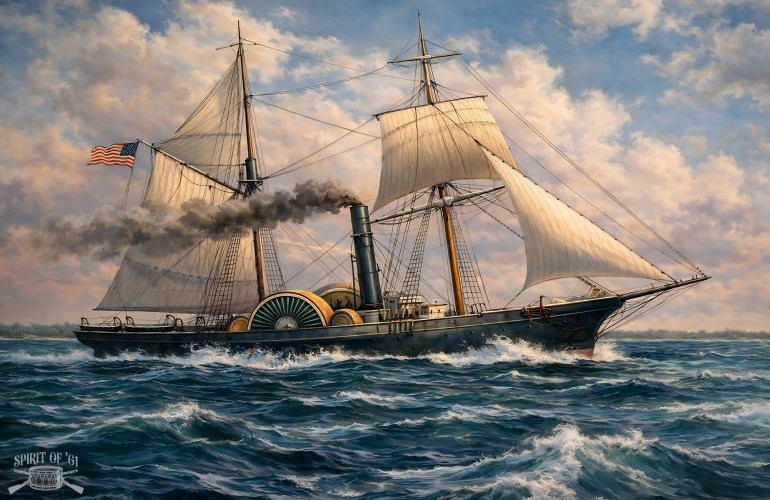
From firing one of the first naval shots of the Civil War off Charleston Harbor to helping secure a vital Union foothold on North Carolina’s Outer Banks, the USS Harriet Lane played an outsized role in the conflict’s opening months. Follow her journey from revenue cutter to warship, highlighting her actions at Fort Sumter, Pig Point, and the pivotal Hatteras expedition.
Built by naval architect William H. Webb for the U.S. Treasury Department, the USS Harriet Lane was launched in New York City in November 1857. She was named after Harriet Rebecca Lane, socialite and niece of President James Buchanan. She was a 619-ton, dual side-wheel steamer, 180 feet in length, with a crew of about 100.
Prior to the Civil War, Harriet Lane served as a revenue cutter, her routine interrupted only by a temporary transfer to the U.S. Navy in late 1858 for a mission to Paraguay. Revenue cutters patrolled U.S. coastal waters and harbors, intercepting vessels that sought to evade tariffs and customs duties. Their speed and mobility made them especially well-suited for catching smugglers and preventing unlawful cargo from entering the country without paying taxes.
Harriet Lane’s longtime captain was 54-year-old John Faunce (1807-1891), a Massachusetts-born sailor with a thick beard and receding hairline who had been at sea since the age of twelve. He had served aboard a revenue cutter off the coast of Florida during the Second Seminole War and was present at Harriet Lane’s launch and christening in 1857.
In February 1861, with the secession crisis heating up, Harriet Lane was outfitted with two 32-pounder guns. On March 30, 1861, she was again transferred to the Navy for service with the expedition sent to Charleston Harbor, South Carolina, to resupply the garrison at Fort Sumter. Departing New York on April 8, she arrived off Charleston on April 11.
The following day, Harriet Lane fired a shot across the bow of the merchant steamer Nashville when the vessel appeared without flying any colors. Nashville avoided further attack by promptly hoisting the United States ensign, though she would soon begin a career as one of the Confederacy’s most elusive privateers.
After Major Robert Anderson surrendered Fort Sumter on April 13, Harriet Lane withdrew from Charleston Harbor along with her sister ships and remained off the coast for several weeks.
On May 10, she was ordered to Hampton Roads to join the Atlantic Blockading Squadron, arriving on the 24th. Soon after, she captured two schooners, the Iris and Catherine, attempting to run the blockade to Baltimore. She then, alongside Quaker City and Monticello, transported troops from Fort Monroe to occupy Newport News.
Following the Union occupation of Newport News, Major General Benjamin F. Butler turned his attention south. “My next point of operation I propose shall be Pig Point, which is exactly opposite the News, commanding the Nansemond River,” he wrote. “Once in command of that battery, which I believe may be easily turned, I can then advance along the Nansemond River and easily take Suffolk, and there either hold or destroy the railroad…”
Butler ordered Harriet Lane, which had been placed at his disposal, to conduct a reconnaissance by fire against Pig Point. She carried out the mission on June 5, suffering minor damage and five wounded sailors. The Pig Point battery proved too formidable, and Butler’s ambitious plan was never carried out.
Harriet Lane’s next major service came later that summer, when a task force was sent against Fort Clark and Fort Hatteras on North Carolina’s Outer Banks to suppress blockade running. The ships sailed from Hampton Roads on August 26, 1861, beginning the war’s first major combined amphibious operation. The next morning, Harriet Lane, Monticello, and Pawnee moved in close to shore to support the landings while heavier vessels engaged the forts from offshore.
The last resistance was crushed the following afternoon, providing a badly needed boost to Northern morale after the disheartening defeat at the First Battle of Bull Run a month earlier. More importantly, the success of the combined operation opened inland waterways to Union vessels and gave the North Atlantic Blockading Squadron a base deep in Southern waters.
Sources
Author unknown. “Harriet Lane (Side-Wheel Steamer).” Naval History and Heritage Command. July 24, 2015. https://www.history.navy.mil/research/histories/ship-histories/danfs/h/harriet-lane-side-wheel-steamer.html
Bell, Kensil. “Always ready!”: The Story of the United States Coast Guard. New York: Dodd, Mead & Company, 1943.
Coddington, Ronald S. “The Love of His Life: Capt. John Faunce and the Harriet Lane.” Military Images Digital. September 3, 2016. https://www.militaryimagesmagazine-digital.com/2016/09/03/love-of-his-life-autumn-2016/
Official Records of the Union and Confederate Navies in the War of the Rebellion. Series I, Vol. 5. Washington: Government Printing Office, 1897.
Pulsifer, F. H. “Reminiscences of the Harriet Lane.” Journal of the United States Coast Guard Association 1 (January 1917).
The War of the Rebellion: A Compilation of the Official Records of the Union and Confederate Armies. Series I, Vol. II. With additions and corrections. Washington: Government Printing Office, 1902.
The War of the Rebellion: A Compilation of the Official Records of the Union and Confederate Armies. Series I, Vol. LI, Part II. Washington: Government Printing Office, 1897.

 Spirit of '61