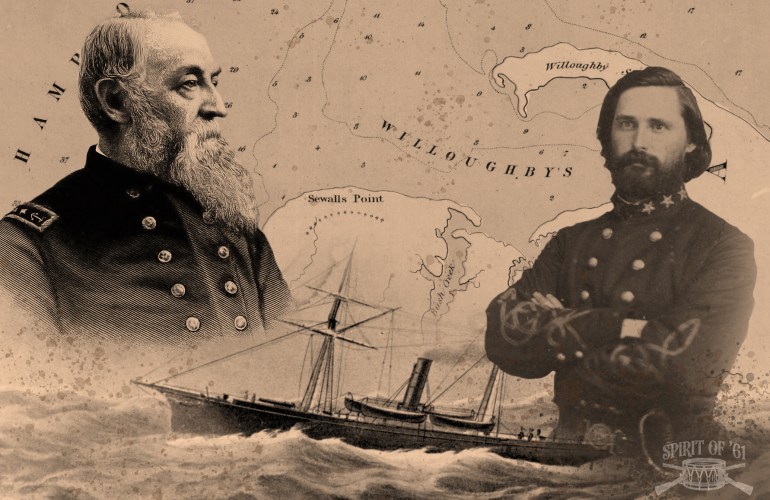
Just days before Virginia’s secession vote, the Engagement at Sewell’s Point on May 18–19, 1861, saw Union gunboats exchange fire with a hastily constructed Confederate battery near Fort Monroe in Hampton Roads. Though the skirmish caused little damage and few injuries, it marked one of the earliest naval engagements of the Civil War in Virginia and signaled that the conflict had reached the Commonwealth’s shores.
In April 1861, events in Virginia were at a boiling point. The attack on Fort Sumter, South Carolina, and President Abraham Lincoln’s call for 75,000 volunteers to “suppress the rebellion” in the Deep South galvanized secessionists and radicalized moderates. Delegates at the convention in Richmond quickly passed an ordinance of secession, pending the results of a popular referendum on May 23.
The Gosport Navy Yard in Norfolk, Virginia, was among the nation’s finest naval facilities. Determined not to let it fall into hostile hands, its commandant ordered the yard destroyed on the night of April 20-21, with many of its ships scuttled or burned. The destruction was incomplete, however, and Virginia militia seized hundreds of cannon and 250,000 pounds of powder.
U.S. Flag-Officer Garrett J. Pendergrast, aboard the 50-gun frigate USS Cumberland, withdrew to Fort Monroe with the remnants of the Home Fleet. Situated at Old Point Comfort in Hampton Roads, Fort Monroe was the only federal facility in Virginia that remained in Union hands.
During the move on Gosport, Confederate Secretary of War LeRoy Pope Walker telegraphed Georgia Governor Joseph E. Brown for reinforcements. “Governor Letcher, of Virginia, telegraphs for troops. …Unless they go at once they will be too late. Can you send them without delay?”
The Columbus Light Guard, led by Captain Peyton H. Colquit, was among the first to respond. In February, Ella Rose Ingram presented the company with a new flag on behalf of the ladies of Columbus. It bore the Georgia coat-of-arms and a single star on one side, the Goddess of Liberty on the other, all set on a white field with blue trim. The company arrived in Portsmouth, Virginia, on April 23 and was assigned to an artillery battery at Hospital Point on the Elizabeth River, opposite Norfolk.
Meanwhile, Governor John Letcher placed 65-year-old Flag-Officer French Forrest in charge of the Gosport Navy Yard. A lifelong sailor, Forrest had fought in both the War of 1812 and the Mexican-American War, and was to cooperate with Virginia Brig. Gen. Walter Gwynn, a former railroad engineer commanding the land forces. To prevent Union ships and troops at Fort Monroe from retaking the yard, Gwynn began constructing an artillery battery at Sewell’s Point, directly facing the fort.
By mid-May, the U.S. Blockading Squadron under Flag-Officer Silas H. Stringham consisted of five ships: the USS Cumberland (Captain John Marston), USS Star / Monticello (Captain Henry Eagle), USS Harriet Lane (Captain John Faunce), USS Quaker City (Acting Master Samuel W. Mather), and USS Yankee (Acting Master Charles Germain). The squadron soon expanded with the arrival of the USS Minnesota, several smaller vessels, and Commander James H. Ward’s Potomac Flotilla.
Stringham tasked Captain Eagle and the Star with blockading the mouths of the James and Elizabeth rivers. On May 18, the steam tug Kahukee delivered a work party of slaves, leased from local plantations, to help construct fortifications at Sewell’s Point. Captain Eagle pursued the tug up the Elizabeth River as far as the battery at Boush’s Bluff, which was manned by Captain Edward R. Young’s Halifax Light Artillery. Young fired a shot at the Star, forcing it to withdraw.
Off Sewell’s Point, Commander Ward arrived in his flagship, the 269-ton side-wheel steam tugboat USS Thomas Freeborn. Armed with two 32-pounder guns, the Thomas Freeborn joined the Star, and together they bombarded the unfinished fortifications for over an hour. Most of their shots, however, landed in the woods and swamp to the rear and did little damage.
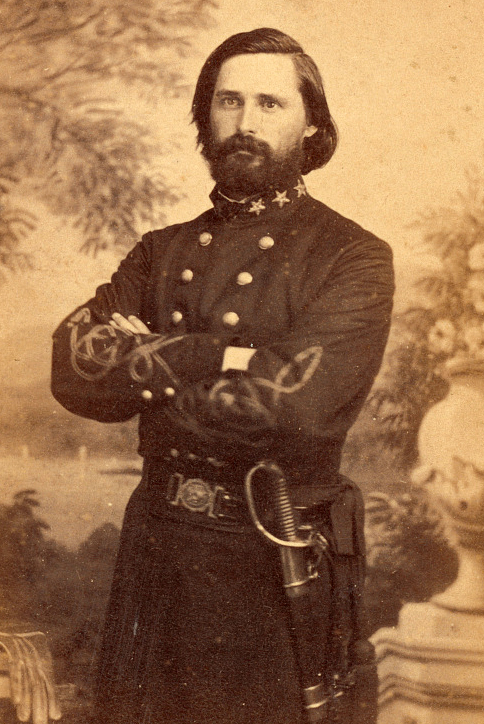
The following morning, Brig. Gen. Walter Gwynn arrived and directed reinforcements to complete the battery and mount the guns. Captain Colquit’s Columbus Light Guard was first on the scene, joined by a Virginia company known as the Woodis Rifles. More Virginians soon followed, including detachments from the Norfolk Light Artillery Blues and the Norfolk Juniors. The battery consisted of two 32-pounders and two smaller-caliber rifled guns.
Work continued all day within range of the Star’s 9-inch gun and two 32-pounders. The 9-inch Dahlgren smoothbore naval gun could hurl a 72.5-pound shell more than 3,000 yards. Around 5 p.m., Gwynn placed Captain Colquit in charge and returned to Norfolk. Less than 30 minutes later, just after three guns had been emplaced, the Star opened fire.
One member of the Columbus Light Guard later recalled, “Whiz-z-z came a shell, and bursted on our battery near Private Oliver Cleveland, who had gone out in front of one of our guns to shovel away sand.”
During the exchange, which lasted more than an hour, the Confederates hoisted the Georgian flag. The Star (Monticello) fired 114 shots and was hit five times in return, suffering only superficial damage and two wounded sailors. Just one Confederate gun was struck by a shell, and no casualties were reported other than a bruised leg. Short on ammunition, the Star withdrew.
On May 21, several blockading ships fired passing shots at the Sewell’s Point battery, causing no damage. Minor though it was, the engagement signaled that the Civil War in Virginia was underway, even as neither side yet knew what form the conflict would take. The coming weeks would be a crucial test.
Sources
Alexandria Gazette (Alexandria, VA) 22 May 1861.
Burton, H.W. The History of Norfolk, Virginia. Norfolk: Norfolk Virginian Job Print, 1877.
Cavanaugh, Michael A. 6th Virginia Infantry. Lynchburg: H.E. Howard, Inc., 1988.
Cobb, J. Michael, Edward B. Hicks, and Wythe Holt. Battle of Big Bethel: Crucial Clash in Early Civil War Virginia. El Dorado Hills: Savas Beatie LLC, 1997.
Henderson, William D. 12th Virginia Infantry. Lynchburg: H.E. Howard, Inc., 1984.
National Republican (Washington, DC) 21 May 1861.
Official Records of the Union and Confederate Navies in the War of the Rebellion. Series I, Vol. 5. Washington: Government Printing Office, 1897.
Richmond Dispatch (Richmond, VA) 23 May 1861.
Stewart, William H. A Pair of Blankets: War-Time History in Letters to the Young People of the South. New York: Broadway Publishing Co., 1911.
The War of the Rebellion: A Compilation of the Official Records of the Union and Confederate Armies. Series I, Vol. II. With additions and corrections. Washington: Government Printing Office, 1902.
Walters, John. Norfolk Blues: The Civil War Diary of the Norfolk Light Artillery Blues. Shippensburg: Burd Street Press, 1997.

 Spirit of '61