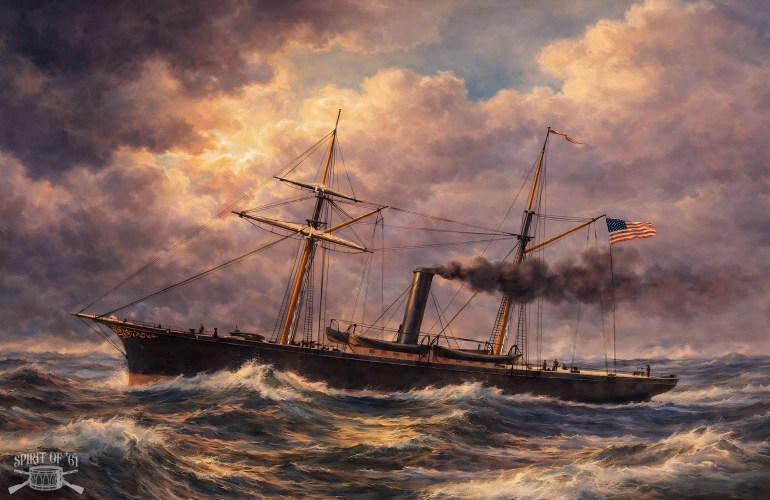
Small and lightly built with a teetotaling veteran captain, the USS Monticello (Star) became an early workhorse of the Union blockade, trading fire with Confederate batteries from the James River to Cape Hatteras.
The USS Monticello was a schooner-rigged, wooden screw steamer constructed at Mystic, Connecticut, in 1859. The U.S. Navy chartered her in May 1861 for service with the Atlantic Blockading Squadron, placing her under the command of Captain Henry Eagle. She was named after Thomas Jefferson’s estate in Albemarle County, Virginia, which likely led to her being briefly renamed Star on May 3. She reverted to her original name later that month.
At 655 tons and 180 feet long, with a crew of 96, Monticello was a relatively small ship, but she packed a punch. She was armed with one 9-inch gun and two 32-pounders. The 9-inch Dahlgren smoothbore naval gun could hurl a 72.5-pound shell more than 3,000 yards.
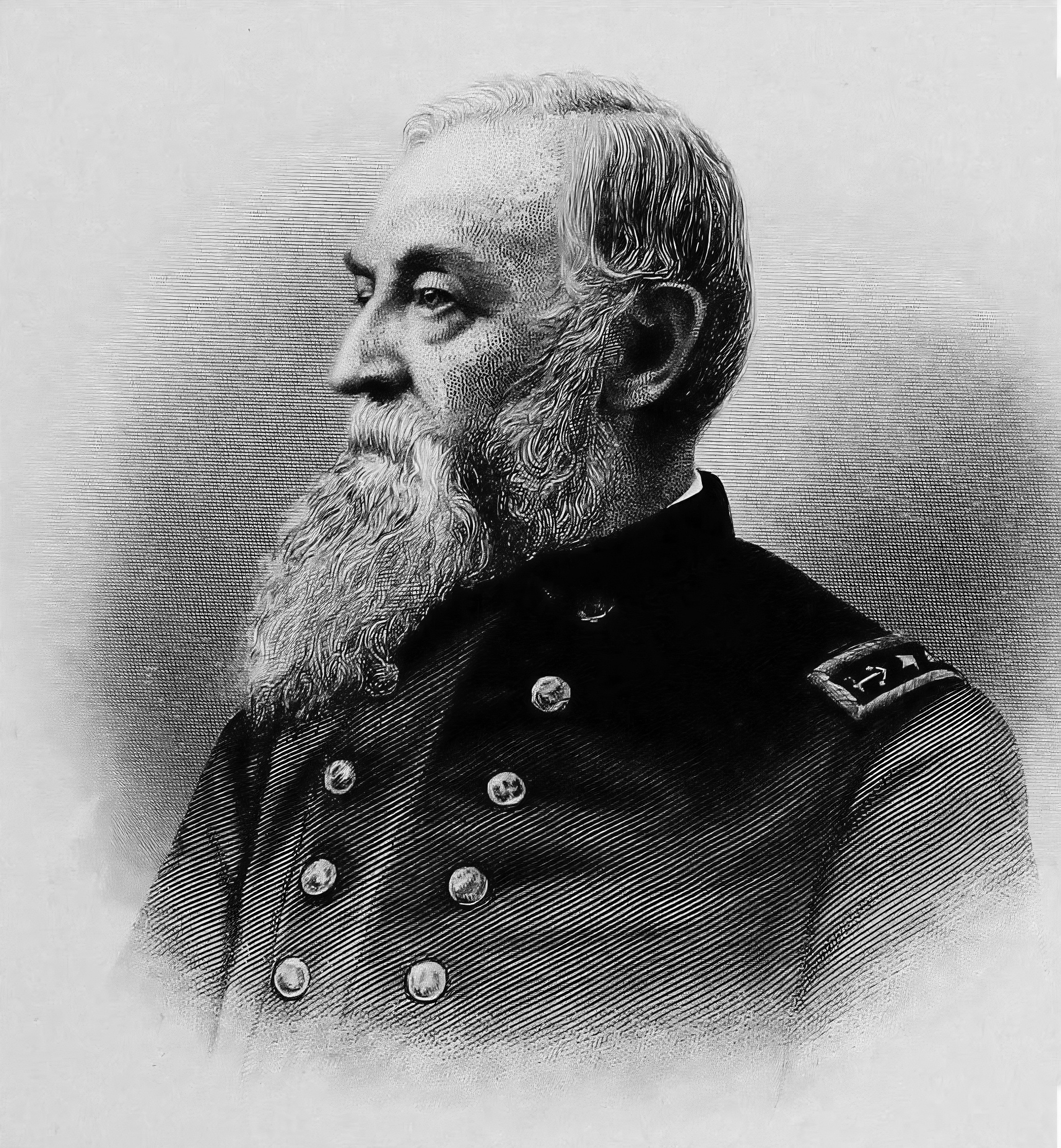
Her captain, Henry Eagle (1801–1882), was a 60-year-old Irish American from New York City. He entered the U.S. Navy in 1818 and saw combat during the Mexican-American War, later serving as military governor of Tabasco and briefly commanding the steam clipper USS Princeton. He married Minerva Smith in 1833, and together they had nine children.
When the Civil War began, Eagle carried an important dispatch from the commandant of the Brooklyn Navy Yard to Washington, DC, then volunteered for active service and was assigned command of Monticello. Unlike the stereotypical sailor, he was reserved in temperament. He neither drank nor smoked and did not swear.
Monticello was quickly thrown into active service. On May 2, she relieved the USS Baltimore on blockade duty at the James River, helping to sever communications with the Elizabeth River, and on May 8 she replaced Quaker City off Cape Henry. Between May 18 and 19, she was damaged in an engagement with Confederate batteries at Sewell’s Point.
After undergoing repairs at the Washington Navy Yard, Monticello steamed up the Rappahannock River as far as Smith’s Island. On June 24, while under the command of Lt. Daniel L. Braine, a landing party was ambushed by Virginia militia at Pop Castle on Carter’s Creek, leaving one sailor dead and another wounded.
In July, she cooperated with Army forces on the James River above Newport News, dispersing a Confederate cavalry detachment. She frequently exchanged fire with Southern shore batteries through the remainder of 1861 and took part in the joint naval assault that captured the defenses at Hatteras Inlet on August 28–29, a notable early Union success.
Sources
Author unknown. “Monticello I (ScStGbt).” Naval History and Heritage Command. August 11, 2015. https://www.history.navy.mil/research/histories/ship-histories/danfs/m/monticello-i.html
Encyclopedia of Contemporary Biography of New York, Vol. 3. New York: Atlantic Publishing and Engraving Company, 1884.
Official Records of the Union and Confederate Navies in the War of the Rebellion. Series I, Vol. 5. Washington: Government Printing Office, 1897.
U.S. Navy Dept. Bureau of Ordnance. Ordnance instructions for the United States Navy. Washington: Government Printing Office, 1866.

 Spirit of '61