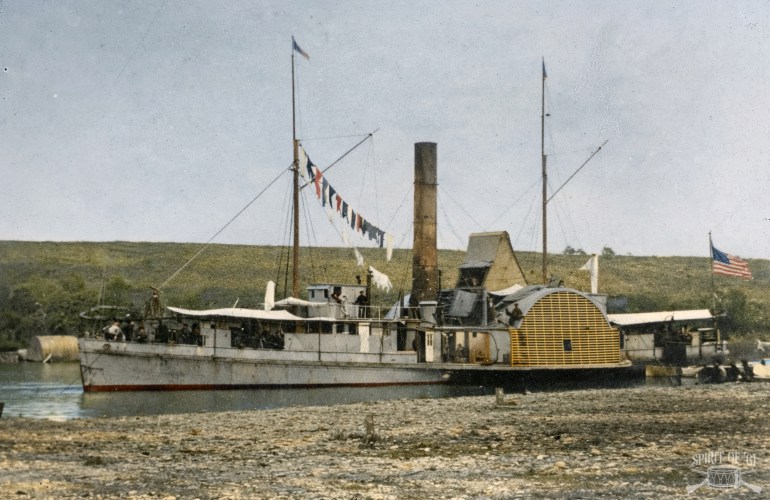
A small, lightly armed tugboat doesn’t sound like the kind of vessel that makes history, until it does. In the Civil War’s opening weeks, USS Yankee, under Lt. Thomas O. Selfridge, Jr., became the Navy’s eyes on the Chesapeake, scouting hostile waterways and snapping up prizes.
Notable for exchanging the first shots of the Civil War in Virginia, the USS Yankee was a small side-wheel steamer tugboat built in 1860 in New York City. It was one of three steam tugs chartered in early April 1861 for the expedition to provision Fort Sumter, South Carolina. She weighed 328 tons, was 146 feet in length, and was crewed by 48 men. The Navy outfitted her with two 32-pounder guns.
In late April and May 1861, she was commanded by 25-year-old Lt. Thomas Oliver Selfridge, Jr. (1836–1924), the son of Capt. Thomas O. Selfridge, who had led the sloop USS Dale during the Mexican-American War. The younger Selfridge was born in Massachusetts and graduated from the U.S. Naval Academy at Annapolis in 1854.
The Yankee left New York on April 8 and reached the Charleston Bar on the 15th, only a few hours after Maj. Robert Anderson’s command had evacuated the battered fort and embarked aboard the Federal transport Baltic. On the 20th, Yankee helped evacuate the Norfolk Navy Yard at Norfolk, Virginia, towing the frigate Cumberland to safety, then returned to the New York Navy Yard.
During the evacuation, Lt. Selfridge was serving on the Cumberland and personally delivered a message to William B. Taliaferro, who was commanding the Virginia militia threatening the Navy Yard.
Meanwhile, the Yankee left the New York Navy Yard on April 26, 1861, and went to work as a dispatch and escort vessel running between Annapolis and Havre de Grace, Maryland. On April 30, she received orders to proceed to Hampton Roads for reconnaissance duty between the artificial island of Rip Raps and Cape Henry, Virginia.
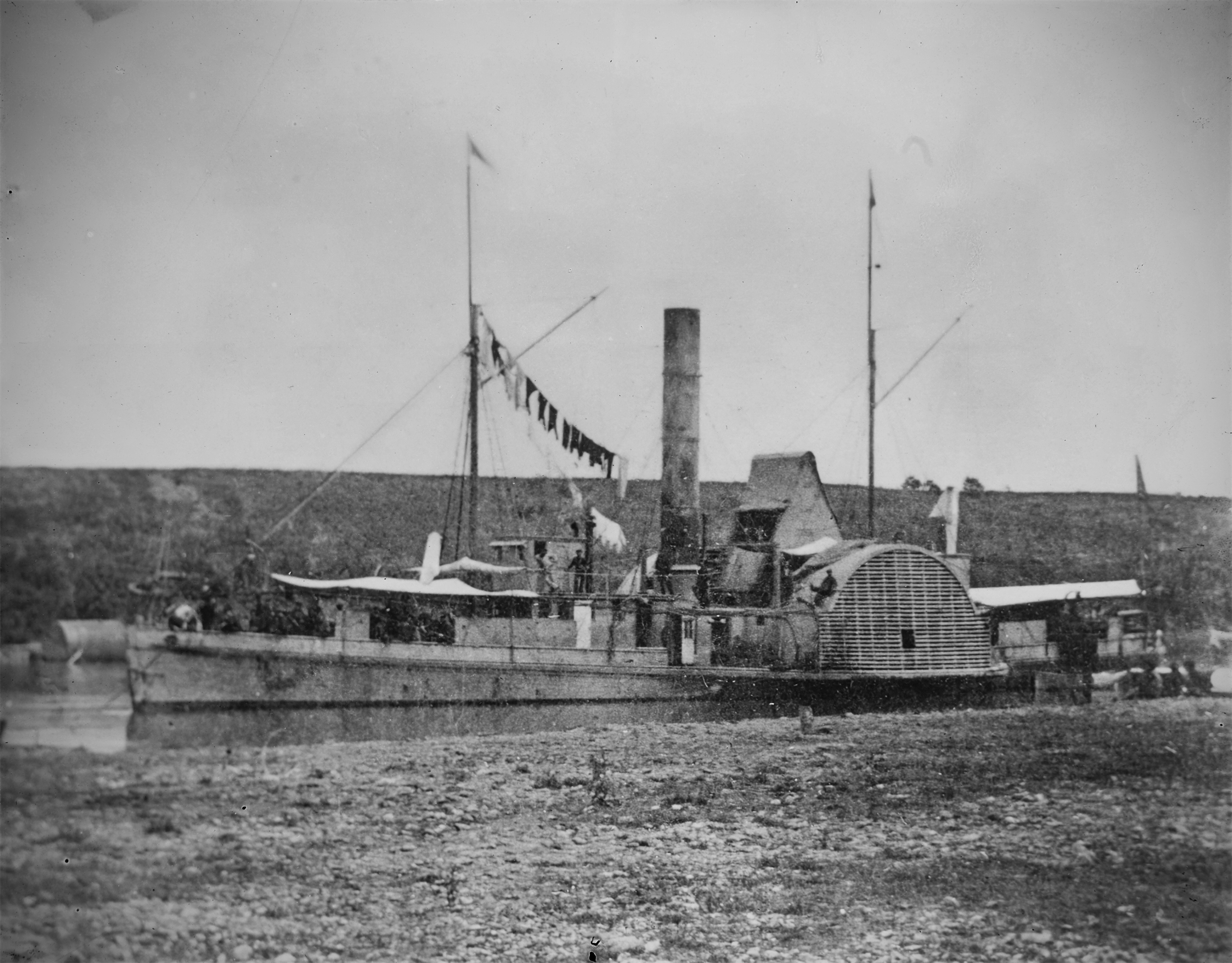
Virginia shore batteries at Gloucester Point fired on the Yankee on May 7, but did little damage. After more reconnaissance work along Virginia’s Eastern Shore and up the James River, she steamed to the Washington Navy Yard on the 25th to deliver the prize schooners General Knox and Georgeanna. She sailed back to Hampton Roads on the last day of May and arrived June 2, but a week later she was sent north for major repairs at the Philadelphia Navy Yard.
On July 2, 1861, Yankee departed Philadelphia, bound for Hampton Roads by way of the Washington Navy Yard. Confederate activity along the Potomac, however, forced her to remain at Washington, and on the 9th she was attached to the Potomac Flotilla.
Over the ensuing months, the Yankee continued operating against Confederate vessels on the Potomac. On July 18, she captured the Confederate schooner Favorite in the Yeocomico River. Eleven days later, she and the gunboat Reliance engaged a Confederate battery at Marlborough Point, Virginia. Yankee destroyed the sloops T. W. Riley and Jane Wright near Smith’s Island, Virginia, on August 16, and captured the schooner Remittance near Piney Point, Maryland, on August 28.
Though small and lightly armed, the USS Yankee performed admirably in the first few months of the Civil War, capturing or destroying several vessels and participating in the first hostile exchange of fire in Virginia. It served as the eyes of the Navy at a time when resources were stretched thin, conducting critical reconnaissance along Virginia’s Chesapeake Bay tributaries.
Sources
Mooney, James L. “Yankee I (Tug) 1861-1865.” Naval History and Heritage Command. April 13, 2021. https://www.history.navy.mil/research/histories/ship-histories/danfs/y/yankee-i.html
The War of the Rebellion: A Compilation of the Official Records of the Union and Confederate Armies. Series I, Vol. II. With additions and corrections. Washington: Government Printing Office, 1902.
Official Records of the Union and Confederate Navies in the War of the Rebellion. Series I, Vol. 4. Washington: Government Printing Office, 1896.

 Spirit of '61
2 thoughts on “The Role of USS Yankee in Early Civil War Naval Operations”