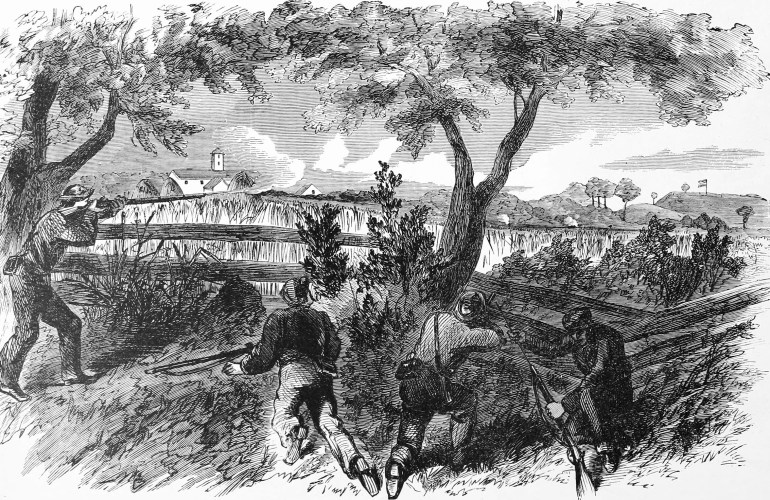
On July 17, 1861, as Union forces advanced on Fairfax Court House, Col. Robert E. Rodes’ 5th Alabama Infantry Regiment engaged in a fierce skirmish at Farr’s Crossroads, delaying Col. Dixon S. Miles’ division long enough to secure a safe Confederate withdrawal behind Bull Run. While Brig. Gen. Milledge Bonham’s retreat from Fairfax was widely criticized, Rodes’ disciplined fighting retreat earned praise from Gen. P.G.T. Beauregard, though he later felt his regiment’s efforts were overshadowed by the Battle of Manassas.
Confederate Brig. Gen. Pierre Gustave Toutant-Beauregard arrived at Manassas Junction on June 2 to take command of the Alexandria Line, later known as the Army of the Potomac. The 43-year-old Louisiana Creole had previously led the forces that compelled Fort Sumter’s surrender in April. After evaluating his troops and the terrain, he proposed a grand offensive maneuver, but the Confederate War Department in Richmond dismissed it as impractical.
Forced into a defensive stance, Beauregard followed a strategy of withdrawing from forward positions to protect the junction of the Orange and Alexandria Railroad and the Manassas Gap Railroad along Bull Run. If necessary, Brig. Gen. Joseph E. Johnston’s Army of the Shenandoah could be swiftly transported to the area via the Manassas Gap Railroad. Beauregard’s defensive plan relied on 21,000 infantry and cavalry to guard multiple crossing points along Bull Run, from the Warrenton Pike to Union Mills.
The First Brigade, commanded by Brig. Gen. Milledge L. Bonham, and the Second Brigade, led by Brig. Gen. Richard S. Ewell, occupied the most forward positions in the Confederate army. Bonham’s brigade, composed primarily of South Carolina infantry and Virginia cavalry, was stationed around Fairfax Court House. Meanwhile, Ewell’s smaller brigade, consisting of the 5th and 6th Alabama and 6th Louisiana infantry regiments, the 1st Company of Washington (Louisiana) Artillery, and a squadron of Virginia cavalry, held Fairfax Station, 3.5 miles to the south.
On June 29, Union Brig. Gen. Irvin McDowell met in Washington, D.C., with President Abraham Lincoln and Lieutenant General Winfield Scott to plan a march on Richmond, Virginia, the newly established Confederate capital. McDowell doubted that his small, inexperienced army was ready, but Lincoln pressured him to act, as many of the 90-day volunteer enlistments would expire by the end of July. The initial plan called for 30,000 men to advance around Beauregard’s right flank, beginning on July 8, but McDowell did not start moving until July 16. By then, he had approximately 34,000 infantry and cavalry present for duty.
Part of McDowell’s carefully orchestrated plan called for three divisions to converge on Fairfax Court House from different directions, aiming to trap and destroy Bonham’s brigade before it could retreat. Brig. Gen. Daniel Tyler’s First Division advanced from Vienna in the north, Col. David Hunter’s Second Division moved directly along the Little River Turnpike in the center, and Col. Dixon S. Miles’ Fifth Division approached from Braddock Road in the south. However, as soon as McDowell’s troops left their camps, the plan began to unravel. Inexperience and lack of discipline, combined with oppressive heat, limited cavalry support, and poor knowledge of the terrain, slowed the advance and disrupted coordination.
At Fairfax Court House, Bonham’s hesitation nearly proved disastrous. He delayed withdrawing his wagons and baggage train until the morning of July 17, by which time Union forces were pressing his skirmishers from two sides. As a result, his troops were forced into a hasty and disorganized retreat, abandoning large amounts of camp equipment along the way. Around 9 a.m., Tyler’s advance units appeared on Flint Hill, just north of Fairfax Court House, forming for battle. Col. Joseph B. Kershaw’s regiment staged a delaying action, gradually falling back under light skirmishing. By 11 a.m., when Col. Ambrose Burnside’s brigade from Hunter’s division entered the town, they found it eerily deserted.
One and a half miles to the south, Col. Robert E. Rodes’ 5th Alabama Infantry Regiment was encamped at Farr’s Crossroads, at the intersection of Braddock Road and Ox Road, which led from Fairfax Station to Fairfax Court House. Their camp was directly in the path of Miles’ 6,000-man division.
The previous evening, Capt. Charles M. Shelley’s Company E had been posted in an advanced position along Braddock Road. As they returned to camp early on July 17, a private from Company H, which partially had replaced them on guard duty, arrived with a prisoner and warned of the enemy’s approach. Acting swiftly, Rodes ordered Shelley to reverse course and prepare to confront the threat about a mile east of the 5th Alabama’s camp. No Union report mentioned a missing or captured soldier.
Around 8:30 a.m., after spending hours clearing felled trees and other obstacles blocking their advance, skirmishers from Companies A and K of the 18th New York Infantry Regiment, led by Lt. Col. William H. Young and supported by two companies from the 16th New York Infantry Regiment, encountered an artillery epaulement across the road. There, they came upon the advanced guard of Company H, 5th Alabama. The confrontation quickly escalated, and the first shots of the engagement were fired.
“About three miles from Fairfax our skirmishers fell in with the first rebel outposts, and exchanged shots with them, when they hastily fell back without doing us any injury,” reported Lieut. Col. Samuel Marsh of the 16th New York. “We continued our march for a mile farther as rapidly as the roads could be cleared, when we again came upon a strong force, upon which the outposts had fallen back.”
As the guard from Company H joined Capt. Shelley’s men, the skirmish intensified. Amid the exchange of fire, one soldier was wounded in the leg, another in the ear. Outnumbered, the Alabamians conducted a fighting retreat through the woods flanking the road, using the terrain to slow the Union advance. Their tenacious defense bought valuable time for Col. Rodes, who had just received word from a courier that Bonham had abandoned Fairfax Court House. With the delay, Rodes was able to withdraw the remainder of his regiment and wagons safely.
As the 16th and 18th New York regiments deployed for battle, Lt. Edward W. Groot and three other wounded men were brought in from the skirmish line. But it was too late. By approximately 1:30 p.m., the New Yorkers arrived at the 5th Alabama’s abandoned camp. Disorganized and exhausted from the day’s slow advance, they halted their pursuit and encamped for the night, while Rodes’ regiment slipped safely across Bull Run.
In contrast to Brig. Gen. Bonham, who faced widespread criticism for his disorganized retreat from Fairfax Court House, Col. Rodes earned high praise. Beauregard later commended him as “that excellent officer” who had prepared his men for a “resolute, protracted defense against heavy odds,” while also noting that Rodes’ subordinates “acted with intelligent gallantry.” Despite this recognition, Rodes always believed that his command’s efforts at Farr’s Crossroads were overshadowed by the larger and more decisive Battle of Manassas that followed.
Sources
Collins, Darrell L. Major General Robert E. Rodes of the Army of Northern Virginia: A Biography. New York: Savas Beatie LLC, 2008.
Davis, William C. Battle at Bull Run: A History of the First Major Campaign of the Civil War. Mechanicsburg: Stackpole Books, 1977, 1995.
Detzer, David. Donnybrook: The Battle of Bull Run, 1861. Orlando: Harcourt, Inc., 2004.
Evening Star (Washington, DC) 18 July 1861.
Fry, James B. “McDowell’s Advance to Bull Run” in Battles and Leaders of the Civil War, Vol. I. New York: The Century Co., 1887.
Longacre, Edward G. The Early Morning of War: Bull Run, 1861. Norman: University of Oklahoma Press, 2014.
National Republican (Washington, DC) 17 July 1861.
The New York Herald (New York, NY) 18 July 1861.
The War of the Rebellion: A Compilation of the Official Records of the Union and Confederate Armies. Series I, Vol. II. With additions and corrections. Washington: Government Printing Office, 1902.
The War of the Rebellion: A Compilation of the Official Records of the Union and Confederate Armies. Series I, Vol. LI, Part II. Washington: Government Printing Office, 1897.

 Spirit of '61