From the first battlefield amputation to the first conventional land battle, Virginia was the stage for many pivotal “firsts” of the Civil War. This article explores these groundbreaking moments, shedding light on the early conflicts, innovations, and key figures that shaped the war’s opening chapters.
Following the bombardment and surrender of Fort Sumter on April 12–13, 1861, military activity briefly subsided as both sides prepared for war. Given its proximity to Washington, D.C., Virginia was naturally poised to become a major battleground, especially after the Confederacy moved its capital to Richmond. It is no surprise, then, that many Civil War “firsts” took place in Virginia, which at the time also included the region that would later become West Virginia.
There is inherent ambiguity—and consequently, disagreement—when determining the first casualties, battles, and other significant events of the war. In early 1861, who was considered an officer? Who qualified as a soldier? What exactly constituted a “battle”? The answers to these questions are not always clear.
For example, in April, May, and June of 1861, Virginia’s volunteer soldiers were paid by the state. Most were not formally sworn into the Confederate Army until July. Officer ranks were equally complex, with distinctions among state militia officers, volunteer officers, and those elected by their units but not yet officially recognized. One notable case is Thornsbury Bailey Brown, a Union volunteer from Virginia, who was killed before his company had been sworn into federal service. Should he be considered the first Union casualty, or was he simply a civilian?
For the purposes of this list, Virginians who sided with secession are considered synonymous with “Confederates,” even though Virginia’s official entry into the Confederacy was a gradual process rather than a single definitive event.
First invasion of Confederate soil
Although Virginia’s secession and entry into the Confederacy was a process rather than a single event, there is general agreement that the results of the May 23 referendum made its course clear. The Union high command waited until May 24 to cross the Potomac River and occupy northeastern Virginia. However, at Fort Monroe, Union General Benjamin Butler did not wait. On the morning of May 23, he ordered the 1st Vermont Regiment to occupy the town of Hampton in an effort to disrupt the secession vote. The vote resumed as soon as they left. That night, District of Columbia militia crossed the Potomac River bridges to prevent them from being burned. Therefore, strictly speaking, the brief occupation of Hampton on May 23 was the first invasion of a Confederate state.
First naval battle / engagement
On April 27, 1861, U.S. President Abraham Lincoln extended the naval blockade of the seven original Confederate states to include the ports of Virginia and North Carolina. In response, Virginia began constructing shore batteries at key locations around the Chesapeake Bay and Potomac River. On Tuesday, May 7, Union Commodore Garrett J. Pendergrast ordered the converted steam tugboat USS Yankee to sail up the York River and assess the fortifications being built at Gloucester Point. As the Yankee approached, the battery fired 12 to 13 shots, and the Yankee responded with about six rounds from its two cannons. This was the first naval engagement of the Civil War.
First uniformed Confederates captured
As previously mentioned, on the night of May 23, District of Columbia militia, led by Major James McHenry Hollingsworth, crossed the Potomac River to secure the bridges and ensure a smooth crossing for the main Union invasion force. At approximately 9:30 p.m., Company A, the “Anderson Rifles,” led by Captain Charles H. Rodier, crossed Chain Bridge and established a guard post. There, they captured two members of the Fairfax Cavalry: Sergeant John Thomas Ball and Private George F. Kirby. Ball and Kirby were the first uniformed Confederate prisoners of war.
First Confederate casualty
On Wednesday, May 22, three members of a Virginia state volunteer company called the Letcher Guard, George E. Glenn, Daniel W. S. Knight, and William Reese, were on picket duty along the Northwestern Turnpike at Fetterman Bridge over the Tygart Valley River. Lt. Daniel Wilson and Thornsbury Bailey Brown were returning from a recruiting rally for the unionist Grafton Guards in nearby Pruntytown when they attempted to cross the bridge. The pickets ordered them to halt, but they ignored the warning. Brown fired his pistol and struck Knight in the ear. The pickets returned fire, killing Brown. This makes Corporal Daniel W. S. Knight the first Confederate casualty of the Civil War.
First Union casualty
On Friday, April 19, 1861, a secessionist mob in Baltimore killed and wounded several Union soldiers. While these were technically the first Union casualties of the war, the incident was more akin to a police action than a military engagement. The first Union casualties in Virginia were two unnamed sailors aboard the USS Monticello/Star, who were wounded during an exchange of fire with a shore battery at Sewell’s Point on May 18 and 19. In his official report, Captain Henry Eagle referenced an enclosure from the ship’s medical officer, but that document was never included in the Official Records. However, The New York Times reported on May 24, 1861, that two sailors had been slightly wounded by splinters. Another possible candidate for the first Union casualty was Thornsbury Bailey Brown, as previously mentioned, though he was a civilian at the time of his death and had not yet been sworn into federal service.
First military use of a railroad in North America

It is often claimed that the American Civil War was the first war in which troops were transported by rail. This is untrue. Railroads were used for military purposes in Europe during the 1840s and 1850s. The Civil War was, however, the first war in North America in which railroads were extensively used for military operations. This first occurred in northwestern Virginia when General George B. McClellan began transporting his troops along the Baltimore & Ohio (B&O) and North Western Virginia railroads on May 27, 1861. Although the B&O Railroad attempted to remain neutral, Colonel Benjamin F. Kelley of the 1st Virginia Infantry (U.S.), who was himself a B&O freight agent, threatened to seize the train cars by force under military authority if the company refused to cooperate. He also took control of the B&O telegraph office in Wheeling, (West) Virginia.
First Confederate officer killed
The title of first Confederate officer killed is somewhat disputed, and it depends on what is meant as an officer and what is meant by Confederate. A possible candidate is Captain Stephen Roberts (sometimes misnamed Christian Roberts), who led an irregular band of Virginia militia at Glover’s Gap. He was killed on May 28, 1861, in what is now Marion County, West Virginia. It remains unclear whether he was a commissioned officer or merely a self-proclaimed captain. It’s likely he was a civilian at the time of his death.
Most sources point to Captain John Q. Marr of the Warrenton Rifles, killed near Fairfax Court House on the morning of Saturday, June 1, 1861. We should note that, technically, Marr was not a Confederate officer but a member of the Virginia Provisional Army, receiving his commission from the Governor of Virginia. Governor John Letcher did not formally transfer control of Virginia’s armed forces to the Confederate government until June 6, 1861.
First Union officer killed
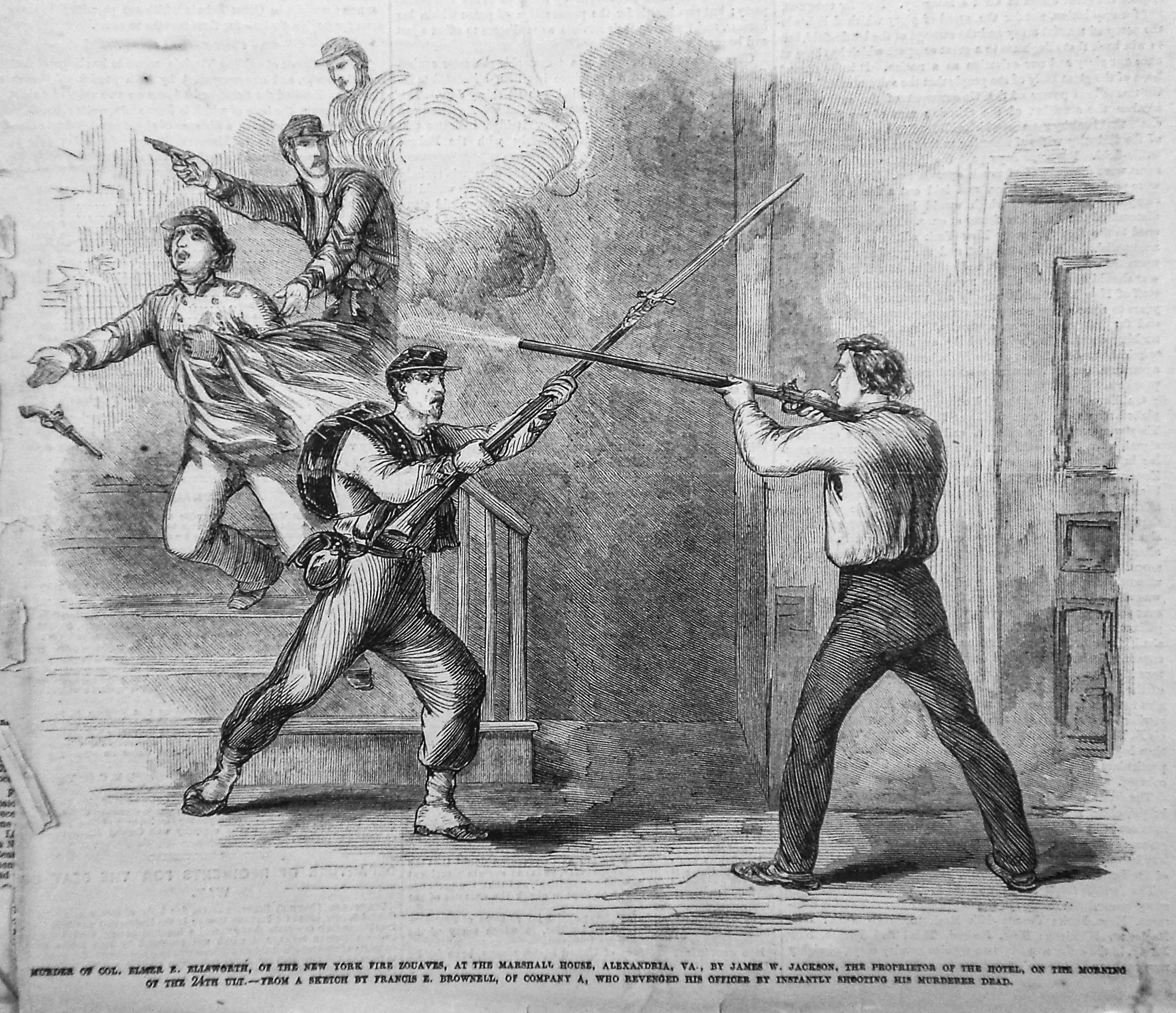
The first Union officer killed in the Civil War was Colonel Elmer E. Ellsworth of the 11th New York Infantry Regiment (Ellsworth Zouaves). On May 24, 1861, during the Union occupation of Alexandria, Virginia, Ellsworth decided to personally remove a large Confederate flag flying over the Marshall House inn. Accompanied by seven men, he rushed inside. As Ellsworth descended the stairs with the flag in hand, the inn’s proprietor, James W. Jackson, suddenly appeared with a double-barreled shotgun and fired, killing Ellsworth instantly. In response, Corporal Francis Brownell, who was with Ellsworth, shot and killed Jackson. Ellsworth, a former clerk from Abraham Lincoln’s law office in Springfield, Illinois, became the North’s first Civil War martyr and was honored with a hero’s funeral.
First Confederate field-grade officer killed
A field-grade officer is an army officer who holds the rank of major or above. The first Confederate field-grade officer to be killed in the Civil War was Lt. Col. Charles Dreux of the 1st Louisiana Infantry Battalion. He was killed near Smith’s Farm on the Virginia Peninsula early on the morning of Friday, July 5, 1861 while leading a failed ambush.
First Confederate general officer killed
A general officer is an army officer who holds the rank of Brigadier General, Major General, Lieutenant General, or General. The first Confederate general officer to be killed in the Civil War was Brigadier General Robert Selden Garnett (1819-1861). Garnett took command of the Confederate Army of the Northwest (Virginia) in June 1861 and was killed on Saturday, July 13, 1861 directing his retreating army across Corrick’s Ford in what is today Tucker County, West Virginia.
First land battle / engagement
Fought on Saturday, June 1, 1861, the engagement at Fairfax Court House was the first skirmish on land between two uniformed forces for longer than a few minutes. In the broadest sense, it qualifies as the first land “battle” of the Civil War. However, the first engagement to fully meet the criteria of a traditional battle was the Battle of Big Bethel on Monday, June 10. This engagement involved over 6,000 combatants and resulted in a clear Confederate victory, with 86 recorded casualties.
Big Bethel was the first battle in which regiments fought in fixed formations on a well-defined battlefield. The Union forces launched a planned offensive with a clear objective, and both sides operated under an established chain of command. Unlike earlier skirmishes, this battle featured organized regiment-on-regiment combat. For these reasons, Big Bethel is recognized as the first conventional land battle of the Civil War.
First battlefield amputation
On Monday, June 3, 1861, approximately 3,000 Union troops descended on 775 Confederates in the small town of Philippi, in northwestern Virginia. The Confederates, who had already planned to withdraw, fled in disorder at the first sign of contact, firing only a few shots as they retreated. Casualties were minimal, but among the wounded was James Edward Hanger, a member of the Churchville Cavalry. Hanger was struck in the leg by a cannonball and captured. To save his life, Union surgeons Dr. James D. Robinson and Dr. George W. New performed an amputation, making it the first battlefield amputation of the Civil War. Despite this injury, Hanger went on to invent an artificial leg that became a precursor to modern prosthetics.

 Spirit of '61