In the tense opening days of the Civil War, a single gunshot would mark the first true casualty of battle—but whose name deserves that grim distinction? Between riots, duels, and chaotic skirmishes, the first soldier killed in action is a title claimed by many, but only one truly fits the definition.
Because of its proximity to Washington, DC, Virginia was the first seceded state to be invaded by federal forces in the American Civil War. Virginia shore batteries exchanged fire with U.S. Navy ships as early as May 7, 1861, and on May 23, the 1st Vermont Regiment briefly occupied the town of Hampton outside of Fort Monroe to disrupt the secession vote. The night of May 23-24, 1861, the Union Army crossed the Potomac River and entered the Commonwealth of Virginia, marking the start of land operations in a war that would rage for four years. The question of who was the first soldier to die in this conflict is a debate almost as old as the war itself.
The War Begins
The bombardment and surrender of Fort Sumter in South Carolina, April 12–13, 1861, is recognized as the opening salvo of the war, but there were no casualties. On April 19, 1861, a pro-secession and antiwar mob attacked U.S. volunteers marching through Baltimore, but this was a riot–not a battle in the traditional sense. Five U.S. volunteers and twelve civilians were killed.
As Virginia (which in 1861 included territory that would become the state of West Virginia) mobilized for war, a volatile situation unfolded in the northwest region of the state, as counties and towns sometimes produced two volunteer companies–one that pledged its allegiance to the South and another to the North. While most avoided direct confrontation, violence had the potential to erupt at any moment. So right at the onset, Virginia faced hostilities from multiple directions, as well as internally.
What defines a soldier? What is “in action”?
The distinction between soldier and civilian is an important one, as in the United States and other Western countries, soldiers fall under a different legal category than civilians. A soldier is governed by military law. In 1806, the U.S. Congress enacted 101 Articles of War and those were still in effect in 1861. The Confederate Congress established a similar law.
Today, when you join the military you sign a contract and swear an oath. Similarly, in 1861, a volunteer was “mustered in”, meaning he was officially enrolled and registered into a military company for a certain defined period of time. He underwent a physical inspection and was issued arms and equipment (ideally) and was paid by the state or national government.
Killed in Action (KIA) is a military term that refers to a soldier who died during combat operations, meaning they were killed while actively engaged with enemy forces or as a direct result of hostile actions during a battle. This does not apply to soldiers who die accidentally, from illness, or who are murdered in a non-combat situation. For our purposes, in order for a soldier to be “killed in action,” he has to be engaged in combat with another group of uniformed soldiers.
The Candidates
Thornsbury Bailey Brown – May 22, 1861
The title of “first soldier killed in action” in Virginia is sometimes attributed to Thornsbury Bailey Brown, a Union volunteer from what is now Grafton, West Virginia. He was killed by a member of the “Letcher Guard” near a bridge outside Fetterman on May 22, 1861. However, Brown’s unit, the Grafton Guards, was not officially sworn into federal service until days after his death, making him technically a civilian at the time. Nevertheless, he is buried in Grafton National Cemetery, an honor normally reserved for service members and their immediate family. A monument at the site where he was killed reads, in part, “first Union soldier killed in the Civil War.” His killer, Daniel W.S. Knight, was later tried for his murder in a civilian court but acquitted.
Elmer E. Ellsworth – May 24, 1861
Colonel Elmer E. Ellsworth commanded the 11th New York Infantry Regiment, also known as the Ellsworth Zouaves or First New York Zouaves. On May 24, 1861, Ellsworth and his regiment were transported to Alexandria, Virginia by boat and took control of the town. Virginia militia fled, except for one cavalry company, which was captured without firing a shot. Ellsworth and seven men headed for the Marshall House inn and removed large Confederate flag. As Ellsworth descended the stairs, flag in hand, James W. Jackson, the inn’s proprietor, suddenly appeared with a double-barreled shotgun and fired, killing Ellsworth instantly. In response, Corporal Francis Brownell, who had accompanied Ellsworth, shot and killed Jackson. The two became martyrs for their respective causes. Although Ellsworth was the first Union officer to die in Virginia, he was murdered by a civilian and not killed in action.
Stephen Roberts – May 28, 1861
Another possible candidate is Stephen Roberts (sometimes misnamed Christian Roberts), who led an irregular band of Virginia militia at Glover’s Gap. He was killed on May 28, 1861, in what is now Marion County, West Virginia, by a patrol from the Washington Rifle Guards, a Pennsylvania volunteer company that later joined the 2nd Virginia Infantry (U.S.) as Company A. However, Roberts’ combatant status is disputed, as his “company” was never officially sworn into service and disbanded shortly after his death. It remains unclear whether he was a commissioned officer or merely a self-proclaimed captain. It’s likely he was a civilian at the time of his death.
Henry S. Cornell – May 31, 1861
A fourth contender is Private Henry S. Cornell of the 11th New York Volunteer Infantry, who was shot and killed at Cloud’s Mill west of Alexandria, Virginia shortly before midnight on May 31, 1861. However, it’s unclear whether he was shot accidentally or by hostile fire. In a letter published in the New York Leader on July 3, 1861, under the pseudonym Harry Lorrequer, Private Arthur O’Neil Alcock—a former newspaper editor in Company A of the 11th New York—wrote: “The simple fact is, that since we left New York we have had only one man killed and two wounded, as is said, by the fire of the rebels. And it is by no means certain that these were not shot by friends in mistake, or by themselves accidentally or through carelessness.” No Confederate accounts of the event exist and no individual or unit has ever been credited, to my knowledge.
John Q. Marr – June 1, 1861
In all the preceding cases, either one of the two parties involved was a civilian, or the incident does not meet the traditional definition of “military combat.” There is no such ambiguity in the case of Captain John Q. Marr. Early in the morning of Saturday, June 1, 1861, Lieutenant Charles H. Tompkins, along with Company B of the 2nd United States Cavalry and part of the 2nd U.S. Dragoons, rode into Fairfax Court House, where Marr and his Warrenton Rifles were quartered in the Methodist Church. The U.S. cavalry fired wildly in all directions, and early in the skirmish, Marr became separated from his men. A bullet struck him in the chest, killing him instantly. His body was later found lying in a clover field near the church. Lt. Tompkins later claimed to have killed Marr, though no evidence supports this claim.
George H. Tiebout – June 10, 1861
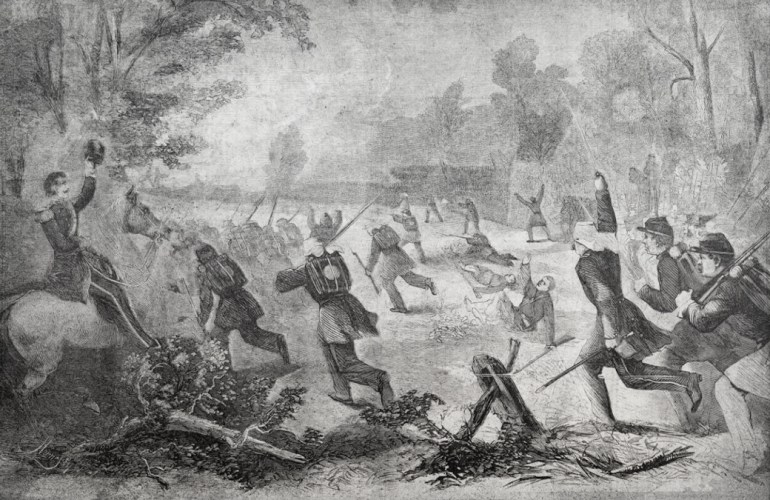
An honorable mention is Private George H. Tiebout of the 5th New York Infantry Regiment, “Duryée’s Zouaves,” who was the first soldier killed at the Battle of Big Bethel on the Virginia Peninsula. Tiebout was killed in action during the initial infantry charge on the center of Confederate fortifications. The Battle of Big Bethel was the first Civil War battle of any significance, involving around 6,000 total combatants.
The Verdict
The first soldier on our list to unambiguously meet the traditional definition of “killed in action” was John Q. Marr. Marr was a commissioned officer and a confirmed member of a Virginia volunteer company on the state’s payroll. This distinction makes him the first Southern officer killed in the conflict and the first uniformed soldier to die in action during the war. He’s sometimes called the first “Confederate” officer killed, but it is important to note that Marr was not a Confederate officer but a member of the Virginia Provisional Army, receiving his commission from the Governor of Virginia. Governor John Letcher did not formally transfer control of Virginia’s armed forces to the Confederate government until June 6, 1861.

 Spirit of '61