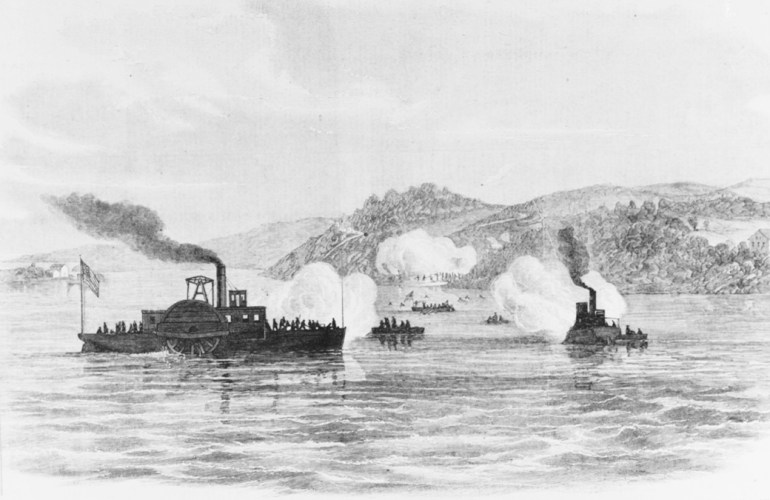
In the summer of 1861, Union forces launched a desperate attempt to secure Mathias Point, a strategic bend in the Potomac River that Confederate troops used to disrupt shipping. What began as a routine landing quickly unraveled into a deadly ambush, claiming the life of Commander James H. Ward and forcing the Union to abandon its foothold, leaving Washington, DC’s vital waterway vulnerable for months to come.
With the Union offensive in northeast Virginia stalled, attention shifted back to the Potomac River. At the end of May, the Potomac Flotilla failed to silence a Confederate shore battery near Aquia Landing. During the engagement, Commander James H. Ward reconnoitered Mathias Point and found it unoccupied. Over the next month, however, Confederate skirmishers took advantage of the wooded terrain, using it as cover to harass passing Union vessels with small-arms fire. Determined to keep the river open between Washington, D.C., and the Chesapeake Bay, Ward devised a plan to seize and fortify the point.
Mathias Point formed the southern portion of a sharp bend in the Potomac River. With its 270-degree vantage point, high ground, and dense tree cover, it was a natural stronghold for enemy forces to menace Union shipping. To deny the Confederates this advantage, Ward proposed a combined land and naval operation. On June 23, he requested 200 troops and equipment to help clear the woods. He had no way of knowing this mission would be his last.
Securing Mathias Point posed significant challenges. Brigadier General Theophilus H. Holmes (1804-1880), who had replaced Colonel Daniel Ruggles as commander of the Military Department of Fredericksburg, commanded approximately 3,000 infantry and cavalry. The local population, sympathetic to the Confederate cause, provided shelter, supplies, and intelligence to his forces.
Since colonial times, the Hooe family had lived at Barnsfield, their ancestral estate three miles south of Mathias Point, and operated Hooe’s Ferry across the Potomac. By 1861, the property was in the hands of Dr. Abram B. Hooe II (1805-1867), a staunch secessionist. A cavalry unit known as Lee’s Light Horse (Westmoreland Cavalry) aided him in ferrying supplies for the Confederate Army and had burned the New Jersey schooner Christiana Keen in mid-June.
On June 25, Acting Master William Budd, commanding the USS Resolute, took action to halt the ferry operation. He fired several shots from his bow gun to disperse any occupants at Barnsfield before taking a landing party ashore to burn the house and outbuildings. By day’s end, the estate was reduced to smoldering ruins.
That same day, Commander Stephen C. Rowan approached Mathias Point with the eight-gun, steam-powered sloop-of-war USS Pawnee and the steamboat James Guy. Early in the morning, two boats ferried 40 sailors and marines, led by Lieutenant James C. Chaplin and U.S. Army engineers Captains Daniel P. Woodbury and William R. Palmer, to investigate whether the Confederates were constructing an artillery battery.
Horsemen, likely from Lee’s Light Horse, appeared on shore, prompting the Pawnee to fire a few rounds to scatter them. The Union party suffered only one minor injury—a sailor wounded in the wrist—and captured two horses and a slave, who revealed the location of a Confederate camp belonging to Company D, “Farmer’s Fork Grays,” of the 40th Virginia Infantry Regiment. The Pawnee lobbed explosive shells into the camp, though no injuries were reported.
On June 27, Commander Ward arrived off Mathias Point with the USS Thomas Freeborn and USS Reliance. As the ships provided covering fire, a landing party of 34 men, led by Lieutenant Chaplin, went ashore carrying shovels, hatchets, sandbags, tar, and a lantern to fortify a small position and clear the dense woods. As they advanced inland, they encountered several hundred Confederate troops under Lieutenant Colonel Richard A. Claybrook. Ward ordered them to retreat to their boats while he returned to the Thomas Freeborn to resume bombardment.
Believing the cannon fire had cleared the enemy from the thick woods, the Union landing party returned to shore and resumed fortifying their position. However, Confederate reinforcements were already en route. Colonel John M. Brockenbrough dispatched Major Robert M. Mayo with one cavalry and three infantry companies. Approaching through the thick woods, Mayo left two companies in reserve and positioned the Sparta Grays and Lee’s Light Horse (dismounted) within 250 yards of the Union forces and “immediately commenced a fire both upon the boats and the steamer.”
Outnumbered, the Union sailors and marines scrambled back to their boats. Amid the retreat, a sailor from Louisiana, John Williams, was shot through the thigh while ensuring no man was left behind. His actions would later earn him the Medal of Honor. “Every man must die on his thwart sooner than leave a man behind,” he declared, referring to the supports in the center of a rowboat.
Meanwhile, aboard the Thomas Freeborn, Commander Ward received a mortal wound to the stomach while sighting a gun. In the ensuing confusion, the ship failed to provide covering fire for the retreating landing party. Ward became the first U.S. Navy officer killed in action during the Civil War, and his death set back Union efforts to control the Potomac. “The gloom which prevailed this locality was oppressive,” wrote a correspondent for the New York Times. Thomas Tingey Craven succeeded him as commander of the Potomac Flotilla.
The engagement at Mathias Point marked the last significant action in the sector until the fall, when the Confederates effectively sealed off the river, blockading Washington, D.C. The situation remained unchanged until the spring of 1862.
Sources
Barnes, James. The Photographic History of The Civil War, Vol. 6: The Navies. New York: The Review of Reviews Co., 1911.
Beale, Richard L.T. History of the Ninth Virginia Cavalry in the War Between the States. Richmond: B.F. Johnson Publishing, 1899.
Daily Exchange (Baltimore, MD) 28 June 1861.
Daily Herald (New York) 27 June 1861.
Evening Star (Washington, DC) 28 June 1861.
Krick, Robert K. 9th Virginia Cavalry. Lynchburg: H.E. Howard, Inc., 1982.
Krick, Robert K. 30th Virginia Infantry. Lynchburg: H.E. Howard, Inc., 1985.
Krick, Robert K. 40th Virginia Infantry. Lynchburg: H.E. Howard, Inc., 1985.
Musselman, Homer D. 47th Virginia Infantry. Athens, GA: New Papyrus Company, 2010.
National Republican (Washington, DC) 27 June 1861.
New York Times (New York) 29 June 1861.
Official Records of the Union and Confederate Navies in the War of the Rebellion. Series I, Vol. 4. Washington: Government Printing Office, 1896.
Richmond Dispatch (Richmond, VA) 2 July 1861.
Richmond Dispatch (Richmond, VA) 27 December 1891.
Scharf, J. Thomas. History of the Confederate States Navy from its Organization to the Surrender of its Last Vessel. New York: Rogers & Sherwood, 1887.
Wills, Mary Alice. The Confederate Blockade of Washington, D.C. 1861-1862. Parsons: McClain Printing Company, 1975.

 Spirit of '61