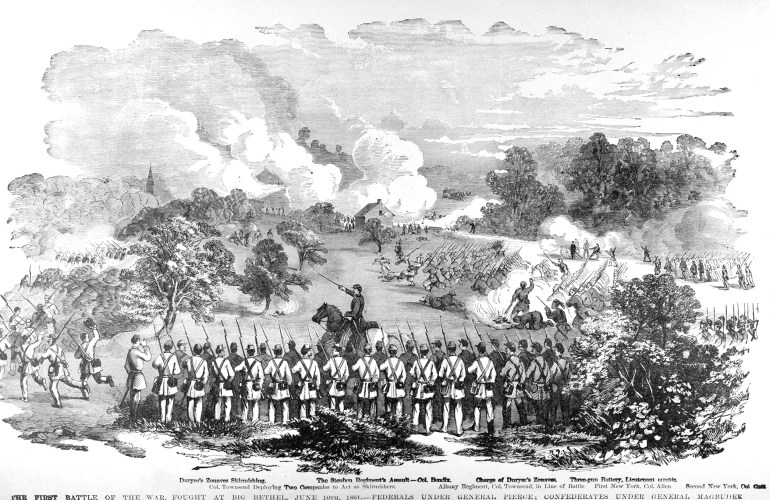
Based on a careful analysis, it’s reasonable to conclude that the Union force had approximately 4,518 men on the field that day.
The Battle of Big Bethel, June 10, 1861, on the Virginia Peninsula was unequivocally the first pitched battle of any magnitude in the American Civil War. Approximately 6,000 Union and Confederate soldiers participated, with casualties exceeding 80. It paled in comparison to future clashes, but its significance can’t be discounted. Estimates vary when it comes to determining exactly how many men fought in the battle and how many casualties were sustained. By examining multiple sources, we can make an educated guess.
Calculating the number of Union troops in the Battle of Bethel is not as simple as it first appears. The Union’s attacking force had seven under-strength infantry regiments, four cannon, and no cavalry. But among the official after-action reports, very few contain estimates of unit strengths. Only one commander, Lt. Col. Peter T. Washburn, gave the exact number of men and officers in every company under his command. Strengths for two New York regiments are given as simple rounded estimates. We’re not given any estimates for the others.
In April 1861, the Adjutant-General’s Office of New York called for each regiment to be comprised of 10 field staff (colonel, quartermaster, etc.) and 10 companies of 77 men and officers, meaning each New York regiment, at full strength, would consist of around 780 men. A notable exception to this was the 3rd New York infantry, which mustered in with a 12-member band. But not every regiment was at full strength at the time of the battle.
In Battles and leaders of the American Civil War, Vol. 2, Maj. Gen. Joseph B. Carr (then colonel of the 2nd New York) said 118 men were discharged from his regiment for disability. Of the 781 who initially enrolled, how many had been discharged by June 10th? How many men were sick or otherwise left behind? It’s difficult to say.
The following is a breakdown of each unit and its strength according to multiple sources. Those sources are evaluated to come up with the most likely (and accurate) accounting of the Union force.
1st NY Infantry Regiment
| Commander | Source A | Source B | Source C | Source D |
|---|---|---|---|---|
| Col. William H. Allen | 750 | 650 | 798 | 846 |
- Source A: Gordon, E.C. “The Battle of Bethel” in Contributions to a History of the Richmond Howitzer Battalion, Pamphlet No. 1. Richmond: Carlton McCarthy & Co., 1883.
- Source B: Hill, Daniel Harvey. Bethel to Sharpsburg, Vol. 1. Raleigh: Edwards & Broughton, 1926.
- Source C: A Record of the Commissioned Officers, Non-commissioned Officers, and Privates, of the Regiments which Were Organized in the State of New York, Vol. 1. Albany: Comstock & Cassidy, 1864.
- Source D: Annual Report of the Adjutant General of the State of New York. Albany: C. Van Benthuysen, 1862.
Estimates for the 1st NY Infantry Regiment vary wildly. E. C. Gordon estimated the 1st New York’s strength at 750, because 750 was the average of the two unit strengths given in official reports for the other NY regiments (850 and 650). While this is a logical deduction, it’s just as much a guess as Daniel Harvey Hill, Jr.’s (son of the Confederate general), who picked 650 based on the number given for the 3rd NY in official reports. According to the 1st NY’s initial muster roll, it contained 798 men and officers. The Adjutant General’s report published on January 15, 1862, stated that the regiment had 846 men when it departed New York. I think it’s safe to discard the estimates from Source A and B, since they are not based on any primary sources. That means the total strength of the 1st NY was probably somewhere between 798 and 846. The average of the two is 822.
2nd NY Infantry Regiment
| Commander | Source A | Source B | Source C | Source D |
|---|---|---|---|---|
| Col. Joseph B. Carr | 750 | 650 | 781 | 791 |
- Source A: Gordon, E.C. “The Battle of Bethel” in Contributions to a History of the Richmond Howitzer Battalion, Pamphlet No. 1. Richmond: Carlton McCarthy & Co., 1883.
- Source B: Hill, Daniel Harvey. Bethel to Sharpsburg, Vol. 1. Raleigh: Edwards & Broughton, 1926.
- Source C: A Record of the Commissioned Officers, Non-commissioned Officers, and Privates, of the Regiments which Were Organized in the State of New York, Vol. 1. Albany: Comstock & Cassidy, 1864.
- Source D: Annual Report of the Adjutant General of the State of New York. Albany: C. Van Benthuysen, 1862.
The 2nd New York was subject to the same estimations as the 1st. Its initial muster roll showed a return of 781 men and officers. The Adjutant General’s report stated that the regiment had 791 men when it departed New York. Two of those were captured during the skirmishes around New Market Bridge on June 8th (with an unknown number possibly wounded, although not reported). I think it’s reasonable to conclude the 2nd NY had around 786 men for this battle.
3rd NY Infantry Regiment
| Commander | Source A | Source B | Source C |
|---|---|---|---|
| Col. Frederick Townsend | 650 | 716 | 780 |
- Source A: June 12th Report of Brigadier General E. W. Pierce, Massachusetts Militia.
- Source B: A Record of the Commissioned Officers, Non-commissioned Officers, and Privates, of the Regiments which Were Organized in the State of New York, Vol. 1. Albany: Comstock & Cassidy, 1864.
- Source C: Annual Report of the Adjutant General of the State of New York. Albany: C. Van Benthuysen, 1862.
The 3rd New York infantry was an unusual regiment because it was mustered in with a 12-member band. Its initial muster roll showed 716 men and officers, and the Adjutant General’s report stated that the regiment departed New York with 780 men. In his official after action report, Brig. Gen. Ebenezer W. Pierce wrote “He [Col. Duryée] was followed about two hours after by the Third Regiment New York State Volunteers, Colonel Townsend, with 650 men.” A simple typo might explain this discrepancy, but there’s no way to know for certain without looking at the original report.
5th NY Infantry Regiment
| Commander | Source A | Source B | Source C | Source D |
|---|---|---|---|---|
| Col. Abram Duryée | 850 | 803 | 842 | 850 |
- Source A: June 12th Report of Brigadier General E. W. Pierce, Massachusetts Militia.
- Source B: A Record of the Commissioned Officers, Non-commissioned Officers, and Privates, of the Regiments which Were Organized in the State of New York, Vol. 1. Albany: Comstock & Cassidy, 1864.
- Source C: Annual Report of the Adjutant General of the State of New York. Albany: C. Van Benthuysen, 1862.
- Source D: New York Times (New York) 14 June 1861.
The 5th New York Regiment is among the few that had a number called out in official reports. Brig. Gen. Pierce wrote “Colonel Duryea [Duryée] passed the remainder of his command over the river at Hampton, and pushed on for Little Bethel, having now upon that side of the river some 850 men.” Although this number is larger than what they left New York with, it is confirmed by other sources. An adjutant’s report for the 5th NY appeared in the New York Times, dated two days after the battle, reporting 792 officers and men present, 11 absent, and 43 sick, for a total of 846. It reports an aggregate of 850 on June 10, with four men killed in the battle. So 850 appears to be accurate.
7th NY Infantry Regiment
| Commander | Source A | Source B | Source C |
|---|---|---|---|
| Col. John F. Bendix | 750 | 779 | 783 |
- Source A: Gordon, E.C. “The Battle of Bethel” in Contributions to a History of the Richmond Howitzer Battalion, Pamphlet No. 1. Richmond: Carlton McCarthy & Co., 1883.
- Source B: A Record of the Commissioned Officers, Non-commissioned Officers, and Privates, of the Regiments which Were Organized in the State of New York, Vol. 1. Albany: Comstock & Cassidy, 1864.
- Source C: Annual Report of the Adjutant General of the State of New York. Albany: C. Van Benthuysen, 1862.
No estimate is given for the 7th New York Regiment in official reports. According to to its initial muster roll, the regiment enrolled with 779 men and officers. The Adjutant General’s report stated that the regiment departed New York with 783 men. I think it’s reasonable to assume it had around 780 men at the Battle of Big Bethel.
1st VT Infantry Regiment
| Commander | Source A | Source B | Source C |
|---|---|---|---|
| Lt. Col. Peter T. Washburn | 300 | 300 | 275 |
- Source A: Gordon, E.C. “The Battle of Bethel” in Contributions to a History of the Richmond Howitzer Battalion, Pamphlet No. 1. Richmond: Carlton McCarthy & Co., 1883.
- Source B: Hill, Daniel Harvey. Bethel to Sharpsburg, Vol. 1. Raleigh: Edwards & Broughton, 1926.
- Source C: June 11th Report of Lieut. Col. Peter T. Washburn, First Vermont Infantry
Five companies of the 1st Vermont Infantry Regiment and five companies of the 4th Massachusetts Infantry Regiment formed a combined unit led by Lt. Col. Peter T. Washburn at Big Bethel. E.C. Gordon gave an estimate of 600 for the combined unit. Daniel Harvey Hill, Jr. estimated 300 men for each. They may not have been aware of Washburn’s after action report, which ended up in Series I, Vol. LI, Part I of the Official Records, Union reports and correspondence that didn’t make it into earlier volumes. Washburn was extremely specific about the number of men under his command. He gave the number of men and officers for each individual company, which ended up totaling 544 (Washburn miscalculated the total, stating 538). The five Vermont companies had a total of 262 men and 13 officers.
4th MA Infantry Regiment
| Commander | Source A | Source B | Source C |
|---|---|---|---|
| Maj. Horace O. Whittemore | 300 | 300 | 269 |
- Source A: Gordon, E.C. “The Battle of Bethel” in Contributions to a History of the Richmond Howitzer Battalion, Pamphlet No. 1. Richmond: Carlton McCarthy & Co., 1883.
- Source B: Hill, Daniel Harvey. Bethel to Sharpsburg, Vol. 1. Raleigh: Edwards & Broughton, 1926.
- Source C: June 11th Report of Lieut. Col. Peter T. Washburn, First Vermont Infantry.
As stated above, five companies of the 1st Vermont Infantry Regiment and five companies of the 4th Massachusetts Infantry Regiment formed a combined unit led by Lt. Col. Peter T. Washburn. E.C. Gordon gave an estimate of 600 for the combined unit. Daniel Harvey Hill, Jr. estimated 300 men for each. Washburn, in his official report, gave specific numbers for each Massachusetts company, totaling 254 men and 15 officers.
2nd Artillery
| Commander | Source A | Source B |
|---|---|---|
| Lt. John Greble | 11 (w/2 guns, U.S. Arty) | 5 (w/2 guns from 2nd NY) |
- Source A: June 11th Report of Lieut. Col. Peter T. Washburn, First Vermont Infantry.
- Source B: June 12th Report of Brigadier General E. W. Pierce, Massachusetts Militia.
Very few sources attempted to estimate how many Union artillerists were on the field that day, but we know Lt. John Greble of the Regular U.S. Army commanded a small team of professional gunners to augment the volunteers. According to after-action reports, 11 artillerists and 2 guns were commanded directly by Lt. Greble, while an NCO and four privates directed two mountain howitzers from the 2nd New York. A Civil War cannon typically had eight crew members and four teamsters. It would be unusual and not very efficient for 16 soldiers to crew four artillery pieces. It’s possible the other crew members were detailed from the infantry regiments and would be counted among their number. Still, I think it’s reasonable to estimate 36 artillerists in the battle.
Total Engaged
In Battles and leaders of the American Civil War, Vol. 2, Maj. Gen. Joseph Carr speculated, “Reports credit us with 2500 men engaged; I believe we had not less than 3500 men.” E. C. Gordon, who fought at Big Bethel for the Confederate side, estimated the attackers had “4,350 muskets.” Based on a careful analysis of primary and secondary sources, it’s safe to say the number was slightly higher than that. I believe the Union force had approximately 4,518 men on the field that day.

 Spirit of '61