Based on a careful analysis, it’s reasonable to conclude that the Confederates had approximately 1,670 men on the field that day.
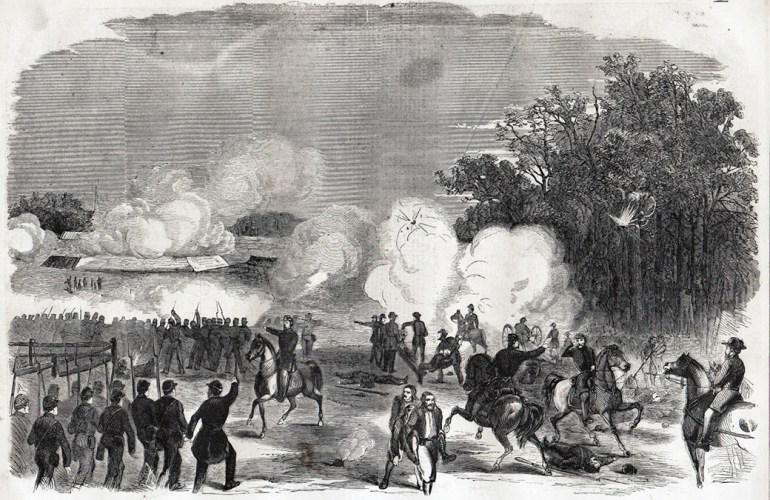
Though some minor skirmishes occurred in Virginia prior to June 10, 1861, the Battle of Big Bethel on the Virginia Peninsula was unequivocally the first pitched battle of any magnitude. Approximately 6,000 Union and Confederate soldiers participated, with casualties exceeding 80. It paled in comparison to future clashes, but its significance can’t be discounted.
Estimates vary when it comes to determining exactly how many men fought in the battle and how many casualties were sustained, sometimes by a large amount. By examining multiple sources, we can make an educated guess. It’s important to note that even the commanders involved didn’t know exactly how many men were present at any given time, and they gave an estimate.
The following Confederate units were present for the battle:
- 1st NC Infantry Regiment (6 mo.), 10 companies
- 3rd (15th) VA Infantry Regiment, 4 companies
- Montague’s Battalion, 3 companies
- Wythe Rifles, 1 company
- Charles City Troop, 1 company
- Old Dominion Dragoons, 1 company
- Nottoway Troop, 1 company
- Richmond Howitzer Battalion, 2 companies
The following is a breakdown of each unit and its strength according to multiple sources. Those sources are evaluated to come up with the most likely (and accurate) accounting of the Confederate force.
1st NC Infantry Regiment (6 mo.)
| Commander | Source A | Source B | Source C |
|---|---|---|---|
| Col. Daniel Harvey Hill | “not quite 800” | 800 | 800 |
- Source A: Report of Colonel D. H. Hill, First North Carolina Infantry, on Big Bethel.
- Source B: Gordon, E.C. “The Battle of Bethel” in Contributions to a History of the Richmond Howitzer Battalion, Pamphlet No. 1. Richmond: Carlton McCarthy & Co., 1883.
- Source C: Hill, Daniel Harvey. Bethel to Sharpsburg, Vol. 1. Raleigh: Edwards & Broughton, 1926.
Every source takes Colonel Hill’s estimate of his own regiment’s strength at face value, and I haven’t read anything to dispute it. Sources round up to the nearest hundred, but there’s a lack of specificity. It all depends on what Hill meant by “not quite 800”.
3rd (15th) VA Infantry Regiment, 4 companies
| Commander | Source A | Source B | Source C |
|---|---|---|---|
| Lt. Col. William D. Stuart | 180 | 208 | 278 |
- Source A: Report of Colonel D. H. Hill, First North Carolina Infantry, on Big Bethel.
- Source B: Report of Lieut. Col. William D. Stuart, Third Virginia Infantry, on Big Bethel
- Source C: Gordon, E.C. “The Battle of Bethel” in Contributions to a History of the Richmond Howitzer Battalion, Pamphlet No. 1. Richmond: Carlton McCarthy & Co., 1883.
This 3rd Virginia Regiment was officially re-christened as the 15th Virginia on June 1, 1861, but it took several months for the change to take effect. Companies B, G, and H under Lt. Col. William D. Stuart were assigned to Big Bethel. Company A arrived on the field as the battle was ongoing, which means it had a total of 4 companies present. Stuart gives 208 as the total for Companies B, G, and H (69 men each). The addition of Company A should have brought the total number to about 277. This is very close to Gordon’s estimate of 278.
Montague’s Battalion
| Commander | Source A | Source B | Source C |
|---|---|---|---|
| Maj. Edgar B. Montague | 200 | 215 | 208 |
- Source A: Gordon, E.C. “The Battle of Bethel” in Contributions to a History of the Richmond Howitzer Battalion, Pamphlet No. 1. Richmond: Carlton McCarthy & Co., 1883.
- Source B: Richmond Enquirer (Richmond) 27 April 1861 + estimate.
- Source C: Hill, Daniel Harvey. Bethel to Sharpsburg, Vol. 1. Raleigh: Edwards & Broughton, 1926.
Montague’s Battalion initially consisted of 3 companies: Halifax Light Infantry – Capt. John G. Grammer; Chatham Grays – Capt. William H. Werth; and Old Dominion Riflemen – Capt. Henry D. Dickerson. These companies were later transferred to the 53rd Virginia Infantry. Unfortunately, regimental historian G. Howard Gregory explained in his history of the 53rd VA that early records are scarce or nonexistent, so he didn’t give any estimate of the unit’s manpower in early 1861. An article in the Richmond Enquirer numbered the Chatham Grays at 84 men, Halifax Light Infantry at 70, for a combined total of 154. I couldn’t find a specific number for the Old Dominion Riflemen, but even if they were a small company of 60 men, that would put the battalion total at around 215 men. Attrition, sickness, etc might have put them close to 200, but I think 215 is a realistic estimate. Daniel Harvey Hill, Jr. (son of the Confederate general) estimated Montague’s Battalion at 208 based on Lt. Col. Stuart’s estimate of his own three companies. This is a reasonable assumption and not too far off from 215.
Wythe Rifles
| Commander | Source A | Source B | Source C |
|---|---|---|---|
| Capt. William R. Willis Lt. Samuel R. Chisman | 70 | 65 | 70 |
- Source A: Gordon, E.C. “The Battle of Bethel” in Contributions to a History of the Richmond Howitzer Battalion, Pamphlet No. 1. Richmond: Carlton McCarthy & Co., 1883.
- Source B: Jensen, Les. 32nd Virginia Infantry. Lynchburg: H.E. Howard, Inc., 1990.
- Source C: Hill, Daniel Harvey. Bethel to Sharpsburg, Vol. 1. Raleigh: Edwards & Broughton, 1926.
The Wythe Rifles were from nearby Hampton and were originally part of an infantry battalion that for a variety of reasons fell apart, leaving them independent during this battle. They later joined the 32nd Virginia as Company A. Regimental historian Les Jensen counted 4 officers, 10 NCOs, and 51 privates, for a total of 65 in late May. I’m inclined to accept this number because it’s actually based on muster rolls. Seventy strikes me as an estimate or rounded number.
Charles City Troop
| Commander | Source A | Source B | Source C | Source D |
|---|---|---|---|---|
| Capt. Robert Douthat | 100 | 51 | 84 | 35 |
- Source A: Report of Colonel D. H. Hill, First North Carolina Infantry, on Big Bethel.
- Source B: Gordon, E.C. “The Battle of Bethel” in Contributions to a History of the Richmond Howitzer Battalion, Pamphlet No. 1. Richmond: Carlton McCarthy & Co., 1883.
- Source C: Nanzig, Thomas P. 3rd Virginia Cavalry. Lynchburg: H.E. Howard, Inc., 1989.
- Source D: Hill, Daniel Harvey. Bethel to Sharpsburg, Vol. 1. Raleigh: Edwards & Broughton, 1926.
Gordon estimated a combined total of 152 for all three cavalry companies, which seems low. Regimental historian Thomas P. Nanzig wrote that 84 men were “on rolls for 1861”. This is a very broad period of time, but it is a more specific number than Colonel Hill’s estimate, and between Hill and Gordon’s. I’m inclined to favor this source over the others. Hill’s son, Daniel Harvey Hill, Jr., estimated the total cavalry at 105 “as it was almost impossible to get cavalry equipment in the Confederacy at that time”. That would put each cavalry company at just 35 men, a wild under count considering his own father reported Captain Douthat commanded 100 dragoons.
Old Dominion Dragoons
| Commander | Source A | Source B | Source C |
|---|---|---|---|
| Capt. Jefferson C. Phillips | 51 | 80 | 35 |
- Source A: Gordon, E.C. “The Battle of Bethel” in Contributions to a History of the Richmond Howitzer Battalion, Pamphlet No. 1. Richmond: Carlton McCarthy & Co., 1883.
- Source B: Nanzig, Thomas P. 3rd Virginia Cavalry. Lynchburg: H.E. Howard, Inc., 1989.
- Source C: Hill, Daniel Harvey. Bethel to Sharpsburg, Vol. 1. Raleigh: Edwards & Broughton, 1926.
Gordon estimated a combined total of 152 for all three cavalry companies, which seems low. Regimental historian Thomas P. Nanzig wrote that the company enlisted in May 1861 with 80 men, all the more reason to reject Daniel Harvey Hill, Jr.’s low estimate. I think Nanzig’s number is the most accurate because it’s based on actual muster rolls.
Nottoway Troop
| Commander | Source A | Source B | Source C |
|---|---|---|---|
| Capt. John E. Jones | 50 | 58 | 35 |
- Source A: Gordon, E.C. “The Battle of Bethel” in Contributions to a History of the Richmond Howitzer Battalion, Pamphlet No. 1. Richmond: Carlton McCarthy & Co., 1883.
- Source B: Nanzig, Thomas P. 3rd Virginia Cavalry. Lynchburg: H.E. Howard, Inc., 1989.
- Source C: Hill, Daniel Harvey. Bethel to Sharpsburg, Vol. 1. Raleigh: Edwards & Broughton, 1926.
As stated above, Gordon estimated a combined total of 152 for all three cavalry companies. Regimental historian Thomas P. Nanzig wrote that 58 men “enlisted in 1861”. Which, again, is a very broad period of time. We don’t know how many were on the initial enrollment and how many joined later that year. But assuming attrition and enlistments even out, I’m inclined to accept the 58 number.
Richmond Howitzer Battalion
| Commander | Source A | Source B |
|---|---|---|
| Maj. George J. Randolph | 84 | 155 |
- Source A: Hill, Daniel Harvey. Bethel to Sharpsburg, Vol. 1. Raleigh: Edwards & Broughton, 1926.
- Source B: Wallace, Lee A., Jr. The Richmond Howitzers. Lynchburg: H.E. Howard, Inc., 1993; White, William S. “A Diary of the War, or What I Saw of It” in Contributions to a History of the Richmond Howitzer Battalion, Pamphlet No. 2. Richmond: Carlton McCarthy & Co., 1883.
The Richmond Howitzer Battalion was formed in late April 1861 and initially consisted of three companies. These companies were split up and went to different locations. The 3rd and 2nd went to the Virginia Peninsula. At the Battle of Bethel, the 2nd Company had three cannon and 3rd Company had four. Daniel Harvey Hill, Jr. gave an estimate of 84 men based on his father’s report commending twelve gunners of Lt. Henry Hudnall’s cannon (including Hudnall). Assuming each gun had 12 men assigned, that amounts to 84, and a Civil War cannon typically had eight crew members and four teamsters. But that excludes support personnel that were present but not actively engaged at the guns. Artillery companies had many “unassigned” personnel like buglers, carpenters, blacksmiths, surgeons, etc that played a supporting role.
Unit historian Lee A. Wallace, Jr. stated that prior to Big Bethel, 2nd Company numbered 79, which equates to approximately 20 men per gun. At three guns, that would have been 60 men. At its inception, 3rd Company mustered in 85 privates, 8 NCOs, 2 lieutenants, and 1 captain, for a total of 95. That equals 24 men per gun. Taken together, the Richmond Howitzer Battalion would have had approximately 155 men on the field that day.
Total Engaged
| Source A | Source B | Source C | Source D | Our Estimate |
|---|---|---|---|---|
| 1,200 | “about 1,200 engaged; 1,400 in all” | 1,500 infantry & cavalry | 1,490 | 1,670 |
- Source A: Report of Colonel D. H. Hill, First North Carolina Infantry, on Big Bethel.
- Source B: June 10th Report of Colonel J. B. Magruder, C. S. Army, 1st
- Source C: Gordon, E.C. “The Battle of Bethel” in Contributions to a History of the Richmond Howitzer Battalion, Pamphlet No. 1. Richmond: Carlton McCarthy & Co., 1883.
- Source D: Hill, Daniel Harvey. Bethel to Sharpsburg, Vol. 1. Raleigh: Edwards & Broughton, 1926.
Estimates of the total number of Confederates at the Battle of Bethel vary. Colonels D.H. Hill and John B. Magruder agreed there were approximately 1,200 engaged, but Magruder added “1,400 in all”. Obviously these were rough estimates and neither men went around counting heads. Edward C. Gordon’s reasonable estimate of 1,500 did not include artillerymen. Daniel Harvey Hill, Jr. did include artillerymen in his estimate of 1,490, but he omitted the Wythe Rifles and severely under counted the cavalry. If you add our estimate of 155 artillerymen to Gordon’s, it comes to 1,655, which is very close to our total number. The only difference is in the number of cavalry, which I believe Gordon also under counted. Like in any battle, only a small portion of them were actively engaged at any given time.
Based on a careful reading of source material, it’s reasonable to conclude that the Confederates had approximately 1,670 men on the field that day.

 Spirit of '61