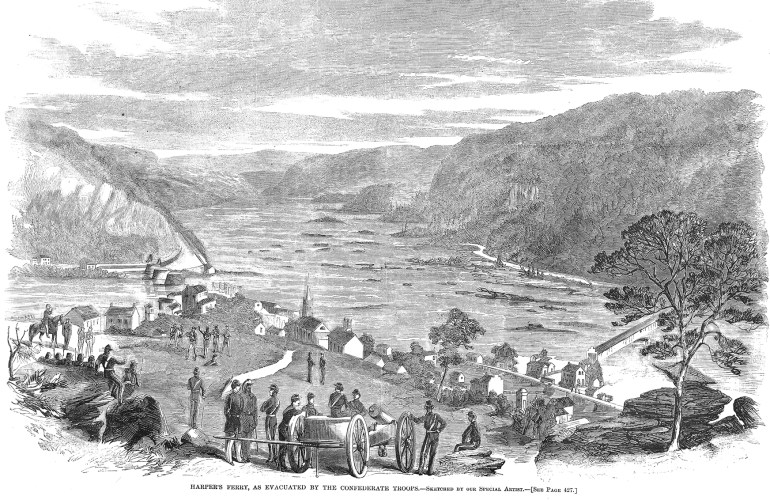
As July 1861 dawned, lead elements of Col. Charles Pomeroy Stone’s expedition along the Potomac River’s Maryland shore reached Sandy Hook and Maryland Heights opposite of Harpers Ferry, Virginia. Confederate Brig. Gen. Joseph E. Johnston had evacuated his troops from Harper’s Ferry in mid-June, destroying the bridges across the Potomac in the process. The town appeared nearly deserted, so when federal skirmishers from the 9th New York State Militia Regiment (not to be confused with the 9th New York Infantry Regiment on the Virginia Peninsula) saw a Confederate flag fluttering in town on Independence Day, they thought it was safe to cross the river in a small boat and take it down.
The men accomplished their mission, but they were mistaken about being unopposed. As they crossed back to the Maryland side, Confederates appeared in windows and around the ruined bridge, firing with deadly effectiveness. The New Yorkers’ smooth-bore muskets lacked the range to reply in kind. But who were these Confederates, since Johnston’s army had withdrawn to Winchester, nearly 30 miles to the southwest?
The Official Records are silent on the issue. The only published reports of the incident were written by Union officers. The few secondary sources to mention it, one being Harpers Ferry Under Fire: A Border Town in the American Civil War (2012) by Dennis E. Frye, also are silent on the identity of the Confederate skirmishers. Dennis E. Frye is a retired National Park Service historian from Harpers Ferry National Historical Park. So if he didn’t know, the information must be really obscure.
After searching through newspaper archives, I found a handful of contemporary articles that help identify the Confederate unit. The following appears in the Richmond Dispatch on July 9, 1861 [they referred to the Union soldiers as “Hessians” because many in New York regiments were German immigrants from New York City, like the Hessian mercenaries who fought for the British in the Revolutionary War]:
“For several days exciting reports have been circulated here of the presence of a large Federal force near Harper’s Ferry, on the Maryland side; and yesterday morning we received intelligence from an unquestionable source that some twenty of the enemy had crossed over and were attempting the hoisting of a Federal flag on the staff in the Armory yard. Acting upon this information, Lieut. Henderson, of the Virginia Rangers, with twenty-five men, repaired to the Ferry, with a view of capturing the flag. The Hessians, however, had become alarmed, and fled across the river without accomplishing their purpose, and only succeeded in carrying away a small portion of the Confederate streamer which was left floating there when our troops evacuated the town. Lieut. Henderson remained at the Ferry several hours, when the enemy again appeared on the Maryland side of the river, in a force supposed to number from one hundred and fifty to two hundred. A fire was at once opened upon them by our boys, which was responded to by the Hessians, supposed to be a detachment of the Ninth Regiment of New York. A lively skirmish was then kept up for over an hour, during which time three of the hirelings were observed to drop from the ranks.”
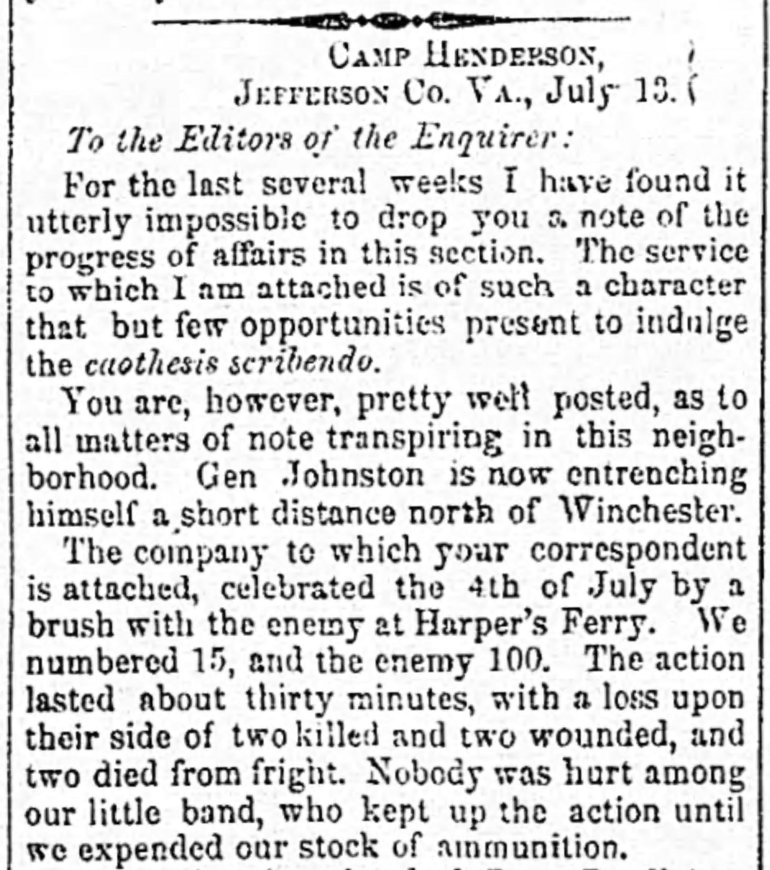
The key piece of information is that the article identifies the Confederate skirmishers as “Lieut. Henderson, of the Virginia Rangers” and 25 of his men. Likewise, a letter appearing in the Richmond Enquirer on July 16, 1861 from “Camp Henderson” read:
“The company to which your correspondent is attached, celebrated the 4th of July by a brush with the enemy at Harper’s Ferry. We numbered 15, and the enemy 100. The action lasted about thirty minutes, with a loss upon their side of two killed and two wounded, and two died from fright. Nobody was hurt among our little band, who kept up the action until we expended our stock of ammunition.”
Taken together, these articles seem to confirm that the commander on the Confederate side was someone named Henderson. But who was he, and who were the “Virginia Rangers”?
The book 7th Virginia Cavalry (1992) by Richard L. Armstrong doesn’t mention this skirmish, but it does include a Capt. John Henderson in the unit roster. A Guide to Virginia Military Organizations 1861-1865 lists Henderson’s Company as the original name of James W. Glenn’s Company in the 7th Virginia Cavalry. The 7th Virginia Cavalry, led early in the war by Col. Angus W. McDonald, Sr., had an unusually large number of companies, so after a while some were split off to other regiments. Glenn’s Company became Company A of the 12th Virginia Cavalry.
But around the time of this skirmish, Angus McDonald’s 7th Virginia Cavalry was assigned to guard and patrol an area from Harper’s Ferry to the headwaters of the Potomac River. Capt. John Henderson led his company from its inception in June 1861 until his wounding in September of that year. He wasn’t wounded by hostile fire, but one of his own men who was angry that Henderson arrested the man’s friend.
I found additional information about this company in Dennis E. Frye’s book 12th Virginia Cavalry (1988). Glenn’s Company [as Henderson’s] was mustered in at Charles Town on June 26, 1861, and was primarily made up of recruits from Jefferson County, (West) Virginia, the same county where Harper’s Ferry is located. Described as “the most veteran company in the regiment,” it had already served for a year before joining the 12th Virginia Cavalry.
I also found Henderson’s page on Find-a-Grave. His name was John Thomas Henderson. He was born in 1837 and died on May 3, 1912 at the age of 75. During the Civil War, he served in the 7th and 12th Virginia Cavalry regiments, first as a captain and later as a private (according to his profile). Junior officers during the Civil War sometimes shuffled between enlisted and officer ranks, especially in the Confederacy. After the war, he moved to Alexandria, Virginia, where he is buried.
So, I can say with reasonable confidence that the Confederates who skirmished with the 9th New York Infantry Regiment in Harper’s Ferry on Independence Day in 1861 belonged to Henderson’s Company of Angus McDonald’s 7th Virginia Cavalry.

 Spirit of '61