William “Billy” Davis was born in 1838 on a farm in Franklin Township, Johnson County, Indiana. At the outbreak of the Civil War, on April 18, 1861 at the age of 23, he enlisted for three months in Company H, 7th Regiment, Indiana Infantry. He served in that unit throughout its entire campaign in northwestern Virginia, writing a detailed journal that is perhaps the best primary source we have from that campaign. It was transcribed and published in 1989.
Davis’ journal is so significant because he either wrote as events unfolded or shortly after, not years later as was often the case with memoirs of this campaign. So we have an “as it happened” perspective. Obviously, he was just one person so the scope of what he described is narrow, but we can learn a lot through that narrow window.
Now that I have been able to re-create the battlefield as it likely looked in 1861, based on multiple sources, we can orient Davis’ words to the terrain and figure out where he was on what day, and where exactly those events took place. For instance, on July 8, 1861, he wrote:
- …now at nine o’clock the left wing of the 7th is at a fence facing to the South East, while the right wing is at a fence behind us facing to the North west. Are all waiting in line. Can hear Bugle calls in Rebel camp and an occasional shot at the front.
- Belington lies to our right beyond the 9th on the Pike.
- In front of Belington is a coneshaped hill on right of road, densely covered with timber. …It was on the hill to right where Captain Moody lost the two men yesterday. The one killed was Wm. T. Girrard… the soldiers have named the hill for the hero.
- On left of road and more directly in our front is another round hill also timbered. Our picket line is at or near the border of this timber.
- …More immediately in our front is an old field with here and there a clump of bushes, or briars, or a pile of logs. These were held by our skirmishers.
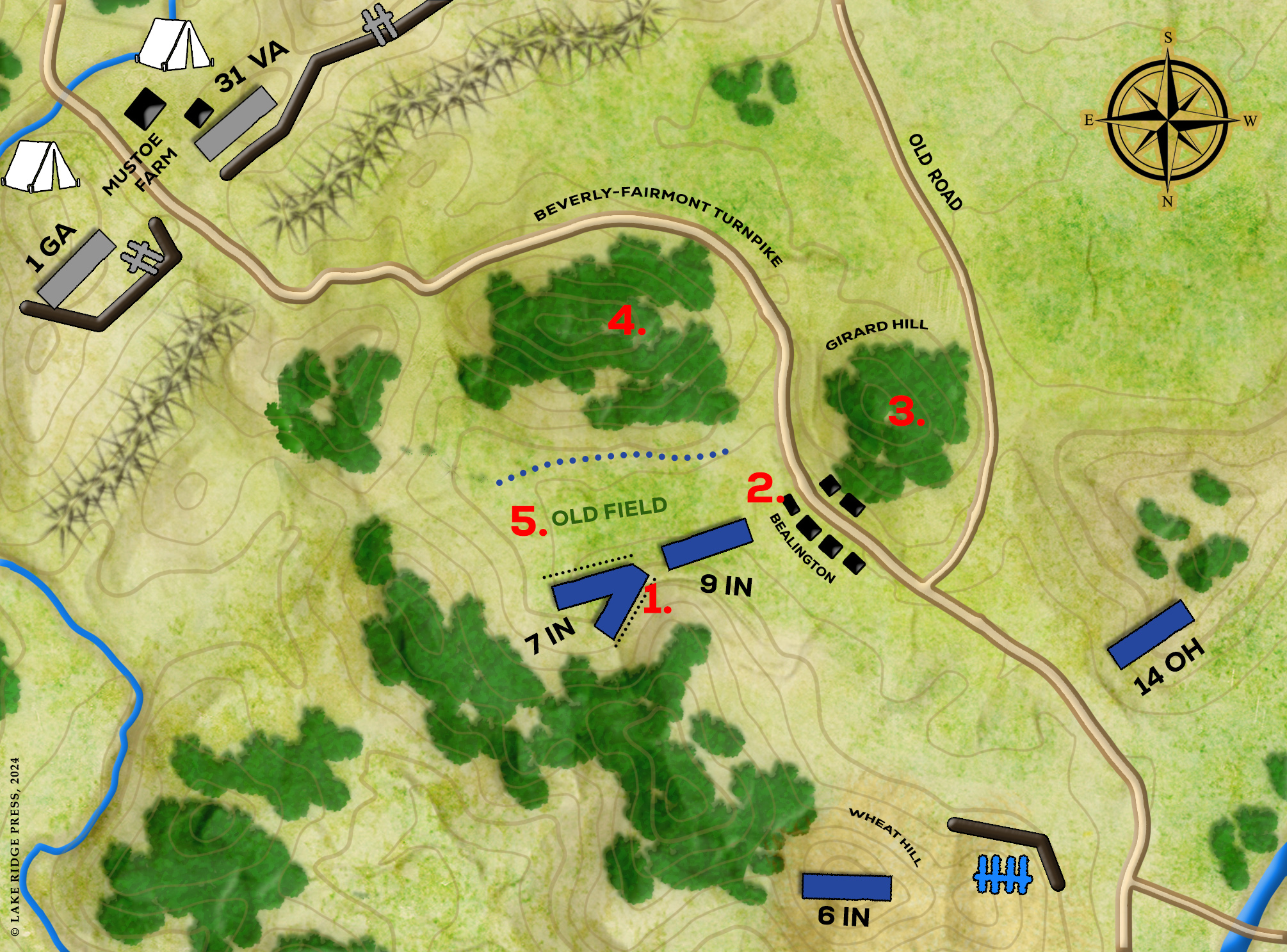
Note that I inverted the map to see it from Davis’ perspective, so south is facing the top of the map and north is facing the bottom.
The 7th and 9th Indiana Regiments were out front for the entire battle, although the 14th Ohio was also engaged and took casualties. On the morning of July 8, Davis described his regiment as being deployed in what I can only visualize as a ‘V’ formation, with the left flank facing the Confederate camp and the right wing facing to the rear. He specifically says the right wing is “behind us” facing the opposite direction. Why they would be doing so, facing their own camp instead of guarding their exposed flank, is hard for me to understand. This is the most confusing piece of information he gives us.
Davis places the 9th Indiana to their right, and the small village of Belington along the road to the right of the 9th. The “cone shaped hill” beyond Belington must be #3. The Cincinnati Daily Commercial describes it as the “Hill where skirmishing took place on the 7th, 8th, 9th, and 10th of July.” It was the hill where Pvt. William T. Girard of the 9th Indiana was killed on the first day of battle.
The “old field”, #5, is roughly where I suspected it was when I made my first map of the battlefield last year.
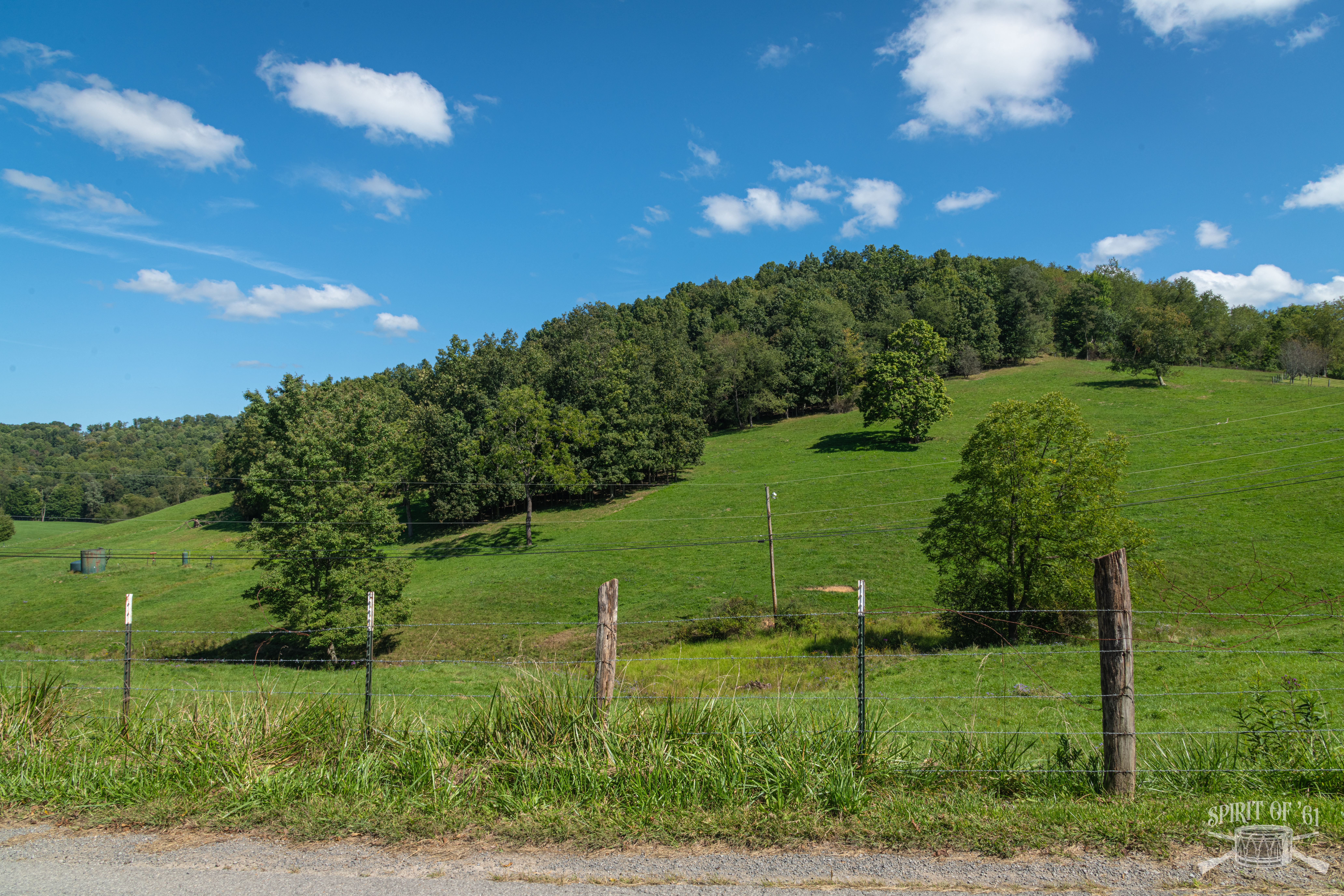
The above photo, taken last spring, shows the northern slope of the round hill (#4 on the map) directly between the 7th and 9th Indiana Regiments and the Confederate camp. The Union skirmish line would have been in the valley on the far left edge of this photo.
We can see that all the major landmarks align with Davis’ description of what was around him on the morning of Monday, July 8, 1861. We now know with reasonable certainty where most skirmishing took place. Today, almost all of it is private property.

 Spirit of '61