When sources are lacking, historians attempt to fill in the blanks, but we can use deduction to arrive at the most likely answer.
The 9th Battalion Virginia Infantry, otherwise known as Hansbrough’s Battalion, was a small unit consisting of four companies led by Lt. Col. George W. Hansbrough. It formed shortly after the Action at Philippi from the Letcher Guard, Mollohan’s Company, Braxton Blues, and Pocahontas Rescues. Its role in the Tygart Valley Campaign of June-July 1861 is not well understood.
Because it was such a small unit and Hansbrough never wrote an official report, authors have played loosely with its position during the critical battles of Belington/Laurel Hill and Rich Mountain. Some place Hansbrough’s Battalion at Laurel Hill and others fail to mention it at all. Richard L. Armstrong, author of 25th Virginia Infantry and 9th Battalion Virginia Infantry, placed it in Beverly.
Based on the few available primary sources, we can say with confidence that Hansbrough’s Battalion was not at Laurel Hill or Beverly. So where was it?

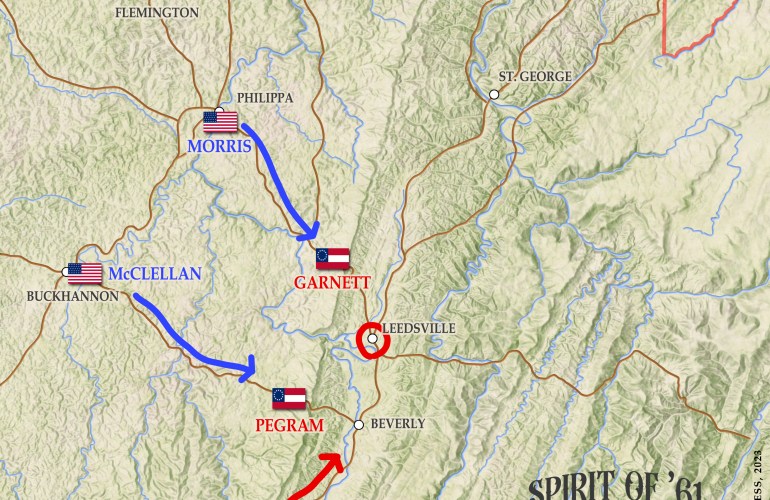
In order to understand the position of Union and Confederate troops, it helps to have an understanding of the terrain and transportation routes. There were two main north-south rivers in this area of Northwest Virginia: The Tygart Valley River, which runs from Huttonsville north to Fairmont, and the Cheat River and Shavers Fork, which runs from Cheat Mountain north to the Pennsylvania border.
The Tygart Valley River bisects Rich Mountain and Laurel Mountain. These mountains were nearly impassible except via two east-west roads: the Staunton-Parkersburg Turnpike and Beverly-Fairmont Turnpike. Today, these two roads are hardly fit for traffic. It’s difficult to imagine their importance in 1861, but they were the only means by which wagons could cross those mountains without going miles out of the way.
Confederate Brig. Gen. Robert S. Garnett positioned his small force along these two key routes, reasoning that the Union Army would have to take those roads if it wanted to penetrate further east across the Allegheny Mountains and into the Shenandoah Valley. His main supply base was just east of Rich Mountain in Beverly. There was a north-south road behind the Confederate lines running from Beverly to St. George and up to Rowlesburg, where Union troops were guarding the Baltimore & Ohio Railroad.
If those Union troops got behind Garnett’s forces on Laurel Hill, they would be trapped with no chance of escape. It would make sense to deploy a unit where the Beverly-Fairmont Turnpike met the road to St. George. Near this intersection was the small community of Leedsville/ Leadsville (modern-day Elkins, West Virginia).
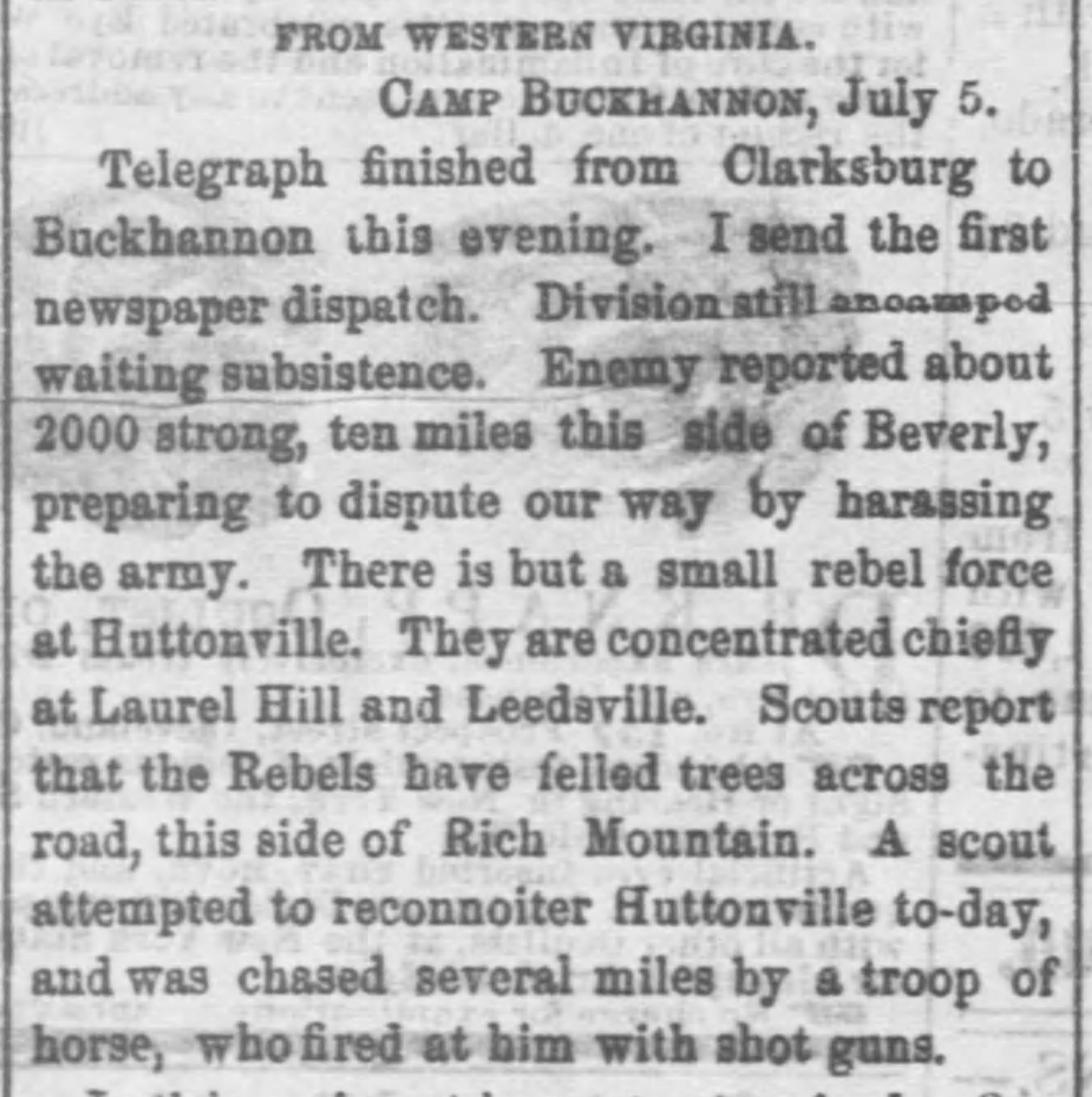
The following Special Dispatch to the Cincinnati Gazette was reprinted in the Cleveland Daily Leader, July 8, 1861, sent from the Union camp at Philippi via courier. It states: “There is but a small rebel force at Huttonville. They are concentrated chiefly at Laurel Hill and Leedsville.” It’s difficult to speculate how that information reached the reporter, since Leedsville was behind Confederate lines, but it is noteworthy that the article mentions Leedsville–not Beverly–as being home to a concentration of enemy troops.
Garnett’s Orders
Robert S. Garnett’s dispatches in the Official Records are confusing, but they clearly state his intention to have a unit guarding the road to St. George behind his position on Laurel Hill, and that unit was Hansbrough’s Battalion.
On July 1st, General Garnett wrote to Headquarters in Richmond:
“We hear, though with what truth it is impossible to say, that the enemy is receiving accessions to his force. Twenty-two car loads are reported to have re-enforced the force at Cheat Bridge. This and some other movements of the enemy seem to indicate an intention of getting in my rear from that point by the Saint George road, and this will require another division of my force, or compel me to fall to Leadsville, where that road comes into this; but this operation would lose this position to us. I shall transfer to-day Colonel Heck’s regiment to that road, and send five companies, under Colonel Hansborough, to relieve him in his present position, which is a strong one.”
Garnett writes of transferring Heck’s regiment to where the Beverly-Fairmont Turnpike meets the St. George Road (Leedsville), to keep watch on a federal approach from that direction. Lt. Col. Jonathan M. Heck commanded the 25th Virginia Inf. Regiment, which was stationed at Rich Mountain. That is the “strong position” to which Garnett refers. However, we know the 25th Virginia stayed at Rich Mountain. On July 6th, the day before the Battle of Laurel Hill commenced, Garnett wrote:
“I stated in my letter of the 1st instant that Colonel Heck’s regiment had been ordered to take up a position on the Saint George road, and that he had been relieved by Lieutenant-Colonel Hansborough’s battalion of five companies. This arrangement was countermanded in consequence of the appearance of the enemy in force at Buckhannon. Lieutenant-Colonel Hansborough took the positions on the Saint George road assigned to Lieutenant-Colonel Heck.”
So when McClellan’s force occupied Buckhannon in front of Rich Mountain, Garnett countermanded his previous order and told Heck to stay put. Instead, he ordered Hansbrough’s Battalion to take up the position previously assigned to Heck, which was just north of Leedsville at the junction of the Beverly-Fairmont Turnpike and St. George Road, as stated in his previous report. That position would best guard against a flanking attack from the north.
Firsthand Accounts
In the Official Records, there is an abstract from a return of the C.S. troops in Northwest Virginia dated July 8, 1861 that shows the “command at Beverly” had 331 officers and men (infantry) and 61 officers and men (cavalry) present for duty. The infantry was probably Hansbrough’s Battalion and cavalry was the Greenbrier troop reported at Leedsville Church. The Greenbrier Cavalry commanded by Capt. Robert B. Moorman was not in Beverly when Col. William C. Scott’s 44th Virginia arrived on July 10th, and neither were Hansbrough’s men.
“On arriving at Beverly I was immediately surrounded by a crowd of citizens and others,” Col. Scott, recalling the campaign, wrote in April 1862. “…Lieutenant Cochrane consulted me on the propriety of removing quartermaster and commissary stores from Beverly, and I ordered him to get all the wagons that could be procured and fill them with those stores…” Scott does not mention any other troops in Beverly besides the quartermaster and commissary personnel.
Col. William B. Taliaferro, commander of the 23rd Virginia Infantry Regiment, also wrote an account of his participation in the campaign. The 23rd Virginia was stationed at Laurel Hill and fought in the four-day skirmish there. On the night of July 11, all the Confederate units at Laurel Hill withdrew when they received word about the loss at Rich Mountain. When describing their order of march, Taliaferro wrote:
“The Thirty-seventh regiment, Colonel Fulkerson, Colonel Jackson’s regiment, and Lieutenant Colonel Hansborough’s battalion, which had joined us on the march, with a section of Captain Shumaker’s light battery, commanded bu that officer, and a squadron of cavalry under Captain Smith, formed the advance, General Garnett accompanying the division.”
In reference to Hansbrough’s Battalion, Col. Taliaferro clearly states that they “joined us on the march,” meaning they were not at Laurel Hill when the retreat began.
So if Hansbrough’s Battalion wasn’t at Laurel Hill, or Rich Mountain, or in Beverly, they must have been near Leedsville where Garnett had ordered them to guard the St. George Road, as stated in his July 6th dispatch.
Sources
- Armstrong, Richard L. 25th Virginia Infantry and 9th Battalion Virginia Infantry. Lynchburg: H.E. Howard, Inc., 1990.
- Daily Leader (Cleveland) July 8, 1861
- Heselberger, Fritz. Yanks from the South! The First Land Campaign of the Civil War: Rich Mountain, West Virginia. Baltimore: Past Glories, 1987.
- Lesser, W. Hunter. Rebels at the Gate: Lee and McClellan on the Front Line of a Nation Divided. Naperville: Sourcebooks, Inc., 2004.
- Taliaferro, William B. “Folly and Fiasco in West Virginia” in Battles and Leaders of the Civil War, Vol. 5. Champaign: University of Illinois Press, 2002.
- The War of the Rebellion: A Compilation of the Official Records of the Union and Confederate Armies. Series I, Vol. II. With additions and corrections. Washington: Government Printing Office, 1902.

 Spirit of '61