Amid the rugged terrain of Cheat Mountain, a deadly ambush at Hanging Rock left soldiers on edge as Confederate guerrillas vanished into the wilderness. This small but impactful action marked a dramatic moment in the struggle for control over northwestern Virginia’s strategic mountain passes. The death of Brigadier General Robert S. Garnett and the crippling…
Tag: Ohio Front
Bullets Over Middle Fork: How a Bridge Fight Opened the Path to Rich Mountain
In a tense twilight skirmish at the covered bridge over Middle Fork River, Union and Confederate forces traded deadly volleys, with bullets tearing through the darkness. This fierce encounter would prove to be the critical opening move that cleared the Union’s path to a decisive victory at Rich Mountain just days later. Following the Confederate…
Continue reading ➞ Bullets Over Middle Fork: How a Bridge Fight Opened the Path to Rich Mountain
What Units Fought at the Battle of Scary Creek?
Uncover the full story of the Battle of Scary Creek as we piece together the most accurate records of involved units and casualty figures available. The Battle of Scary Creek holds significance as one of the earliest substantial engagements prior to the First Battle of Bull Run. Although involving only about 2,100 men, it included…
Continue reading ➞ What Units Fought at the Battle of Scary Creek?
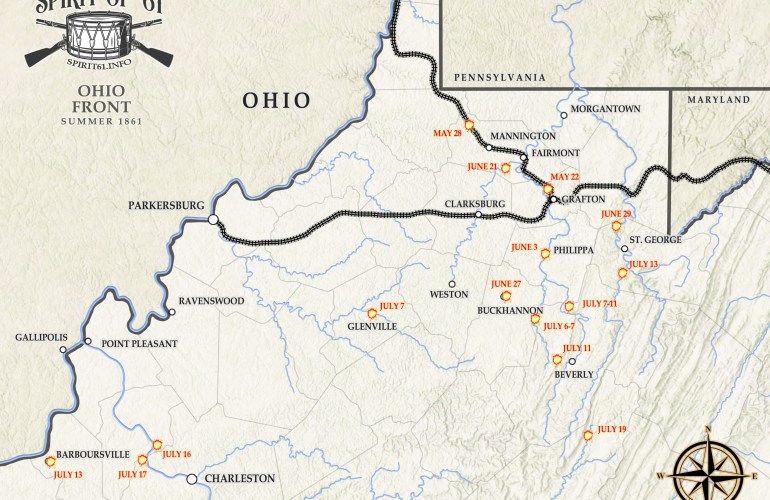
Map of the Battle of Scary Creek
The Battle of Scary Creek was fought on Wednesday, July 17, 1861 between Union forces commanded by Brig. Gen. Jacob D. Cox and Confederate forces commanded by Brig. Gen. Henry A. Wise in Putnam County, West Virginia. It resulted in a Confederate victory, but ultimately had no affect on the overall campaign. Union forces captured…
Clash at Scary Creek: Union Ambitions and Confederate Resistance in the Kanawha Valley
In July 1861, Union troops under Brig. Gen. Jacob Cox clashed with entrenched Confederate forces at Scary Creek, leading to a fierce battle of strategy, deadly crossfire, and unexpected losses—including the capture of several Union officers. Dive into the gripping details of how this intense fight turned the Union’s advance on its head. In early…
A Brilliant Little Dash: The Skirmish at Pocatalico
In July 1861, as Union forces advanced into the Kanawha Valley, a Confederate cavalry charge at Pocatalico River set the stage for the looming Battle of Scary Creek. But was this bold skirmish the victory it was claimed to be, or merely a fleeting clash amplified by Confederate hopes? As 34-year-old Maj. Gen. George Brinton…
Continue reading ➞ A Brilliant Little Dash: The Skirmish at Pocatalico
What Happened at Poca? Unpacking the Truth
Was the skirmish at the mouth of the Pocatalico River on July 16, 1861 a bold cavalry charge or blown out of proportion? Conflicting accounts tell vastly different tales, leaving us to sift through exaggerations and incomplete records to understand what really happened in this lesser-known prelude to the Battle of Scary Creek. A dramatic…
Continue reading ➞ What Happened at Poca? Unpacking the Truth
Clash at Red House: Friendly Fire or Something More?
The incident near Red House not only serves as a lesson in the hazards of nineteenth-century warfare but also underscores the importance for historians of cross-referencing newspaper reports with multiple sources. It was shortly after sundown on July 14, 1861. The Ohio longshoremen and steamboat crewmen of the 1st Kentucky Infantry Regiment (U.S.) were packed…
Continue reading ➞ Clash at Red House: Friendly Fire or Something More?
Skirmish at Fortification Hill: Neff’s Bold Assault in Barboursville
As Union forces crept toward the Kanawha River, a raid led by Lt. Col. George W. Neff erupted into a brutal skirmish on a rugged ridge above Barboursville. Facing relentless Confederate fire and a deadly ridge climb, Neff’s troops clawed their way to a hard-won victory. As his campaign to secure northwest Virginia got underway,…
Continue reading ➞ Skirmish at Fortification Hill: Neff’s Bold Assault in Barboursville
Artifact: Traitors in Wheeling
The town of Wheeling, located along the Ohio River in what was then the Virginia panhandle (today, West Virginia), was Virginia’s fourth largest city in 1860. Sandwiched between the free states of Ohio and Pennsylvania, it was largely populated by German immigrants with no affinity for Virginia’s Anglo-American planter class. When the Secession Convention in…