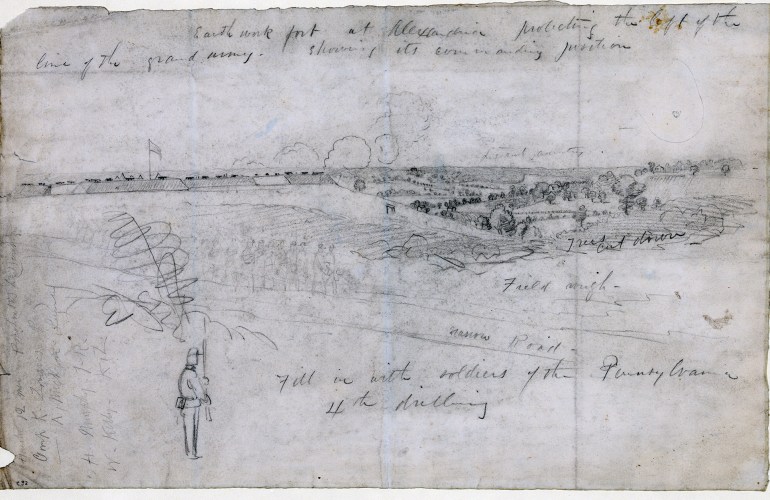
Earthwork Fort at Alexandria Protecting the Left of the Line of the Grand Army
This unfinished pencil drawing by famed artist Alfred Rudolph Waud (1828-1891) depicts Fort Ellsworth on Shuter’s (or Shooter’s) Hill, west of Alexandria in late June / early July 1861. Illustration has been enhanced to show details. Library of Congress Prints and Photographs Division. Click on the image to expand. The illustration is titled, Earthwork fort…

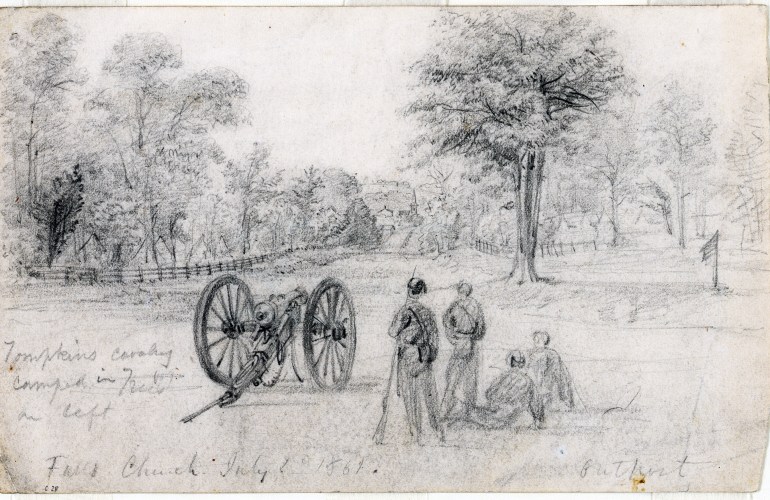
Outpost Watching Falls Church, Virginia, 1861

This pencil drawing by famed artist Alfred Rudolph Waud (1828-1891) depicts a Union artillery piece and camp of 2nd United States Cavalry, Company B, led by Lieutenant Charles H. Tompkins, near Falls Church, Virginia on July 1, 1861. Exactly one month earlier, Tompkins led a chaotic reconnaissance on Fairfax Court House, in which several of…

Map of the Battle of Scary Creek

The Battle of Scary Creek was fought on Wednesday, July 17, 1861 between Union forces commanded by Brig. Gen. Jacob D. Cox and Confederate forces commanded by Brig. Gen. Henry A. Wise in Putnam County, West Virginia. It resulted in a Confederate victory, but ultimately had no affect on the overall campaign. Union forces captured…

Where was Billy Davis on the Morning of July 8, 1861?

William "Billy" Davis was born in 1838 on a farm in Franklin Township, Johnson County, Indiana. At the outbreak of the Civil War, on April 18, 1861 at the age of 23, he enlisted for three months in Company H, 7th Regiment, Indiana Infantry. He served in that unit throughout its entire campaign in northwestern…

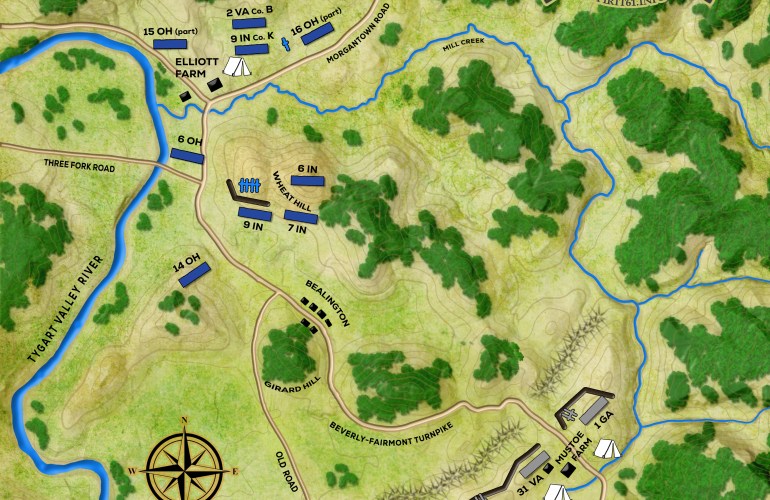
Revised Map of Laurel Hill Battle

Daily Commercial (Cincinnati) 18 July 1861 The Battle of Belington (Laurel Hill) was fought from Sunday, July 7 to Thursday, July 11, 1861 between Union forces commanded by Brig. Gen. Thomas A. Morris and Confederate forces commanded by Brig. Gen. Robert S. Garnett in what is today Barbour County, West Virginia. It involved around 8,000…

Illustration of James H. Ward

Connecticut-born James Harmon Ward (1806-1861) was a dyed in the wool Yankee steeped in his region's maritime tradition. He graduated from the American Literary Scientific and Military Academy at Norwich, Vermont in 1823 and entered the U.S. Navy as a midshipman. His varied naval career included interdicting illegal slave traders off the African coast and…

Illustration of Philip St. George Cocke

Philip St. George Cocke (1809–1861) was born along the James River in what is today Fluvanna County, Virginia to John Hartwell and Ann Blaws Barraud Cocke. As a member of Virginia's planter class, he was educated at the University of Virginia and attended the U.S. Military Academy at West Point, graduating in 1834. He briefly…

Virginia Fronts Spring-Summer 1861. Spirit61.info

Map of Virginia’s Military Fronts, Spring-Summer 1861

Maneuvers and battles in Virginia prior to the Battle of First Manassas, July 21, 1861, were centered around control of major waterways. Virginia had three main waterways that defined its antebellum borders: the Ohio, Potomac, and Chesapeake rivers. While the men who fought in the Civil War wouldn’t have recognized these as “fronts” or used…

Map Added for Ohio Front

Maneuvers and battles in Virginia prior to the Battle of First Manassas were centered around control of major waterways. Virginia had three main waterways that defined its antebellum borders: the Ohio, Potomac, and Chesapeake rivers. While the men who fought in the Civil War wouldn't have recognized these as "fronts" or used that terminology, I…