Blog

Earthwork Fort at Alexandria Protecting the Left of the Line of the Grand Army

This unfinished pencil drawing by famed artist Alfred Rudolph Waud (1828-1891) depicts Fort Ellsworth on Shuter’s (or Shooter’s) Hill, west of Alexandria in late June / early July 1861. Illustration has been enhanced to show details. Library of Congress Prints and Photographs Division. Click on the image to expand. The illustration is titled, Earthwork fort…

The Union’s Failed Gamble to Control Mathias Point

In the summer of 1861, Union forces launched a desperate attempt to secure Mathias Point, a strategic bend in the Potomac River that Confederate troops used to disrupt shipping. What began as a routine landing quickly unraveled into a deadly ambush, claiming the life of Commander James H. Ward and forcing the Union to abandon…

Rails, Rebels, and Ruin: The 1st Ohio Infantry’s Deadly Encounter at Vienna

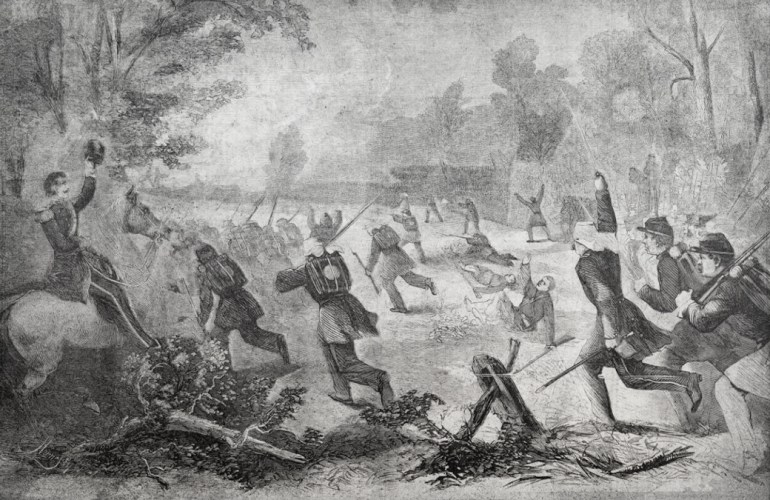
In June 1861, a Union reconnaissance mission along the AL&H Railroad took a deadly turn when Confederate forces ambushed a troop train near Vienna, Virginia. The surprise attack exposed the vulnerability of Union operations, forcing a hasty retreat and reinforcing the caution of military leaders as the conflict escalated. By mid-June 1861, the Union’s rapid…

Photo by M.A. Kleen, Spirit61.info

What Happened to Fairfax County’s John Q. Marr Monument?

John Q. Marr’s fatal encounter with Union cavalry in Fairfax Court House on June 1, 1861, marked a bloody opening salvo of the Civil War, yet the debate over his legacy—and the monument that once bore his name—continues over a century later. For over a century, a granite monument stood near the old Fairfax County…

Outpost Watching Falls Church, Virginia, 1861

This pencil drawing by famed artist Alfred Rudolph Waud (1828-1891) depicts a Union artillery piece and camp of 2nd United States Cavalry, Company B, led by Lieutenant Charles H. Tompkins, near Falls Church, Virginia on July 1, 1861. Exactly one month earlier, Tompkins led a chaotic reconnaissance on Fairfax Court House, in which several of…

Confusion and Chaos: The Unplanned Skirmish at Fairfax Court House, 1861

In the early hours of June 1, 1861, Union Lieutenant Charles H. Tompkins led a chaotic and unauthorized cavalry charge through Fairfax Court House, firing blindly in the dark and scattering the poorly armed Confederate defenders. The reckless raid resulted in the death of Captain John Q. Marr, the first Confederate officer killed in action,…

Chaos at Cloud’s Mill: Early Bloodshed in Civil War Virginia

In the early days of the Civil War, a nighttime skirmish near Cloud’s Mill led to confusion, tragedy, and one of the first Union casualties of the conflict. What seemed like an enemy ambush may have been something far more chaotic—a fatal case of friendly fire. On May 23, 1861, Virginia voters ratified secession, and…

When did Virginia join the Confederacy?

Determining precisely when Virginia joined the Confederacy is a complex issue. President Abraham Lincoln’s administration maintained that the Union was "indivisible" and that secession was illegal. According to this view, a state could not leave the Union under any circumstances. Therefore, those taking up arms against the federal government were considered rebels or insurrectionists, while…

Photo by M.A. Kleen, Spirit61.info

Which Mills? Decoding an Early Civil War Skirmish

Did the so-called "Skirmish at Arlington Mills" really happen? Learn how a simple newspaper error sparked a century-long myth about one of the Civil War’s first land engagements. Primary sources reveal conflicting accounts, misidentified locations, and a puzzling lack of Confederate testimony—raising questions about how historical narratives take shape and why verifying sources is essential…

The Call to Duty – The Common Soldier in the Civil War (1861)

Threads from the National Tapestry is among the best Civil War series on YouTube. Its narrator, Fred Kiger, has one of those voices perfectly suited for storytelling. And storytelling is this channel's strong suit. Their aim is to "make you feel as if you were there." In this video, Kiger discusses early mobilization, the motivations…