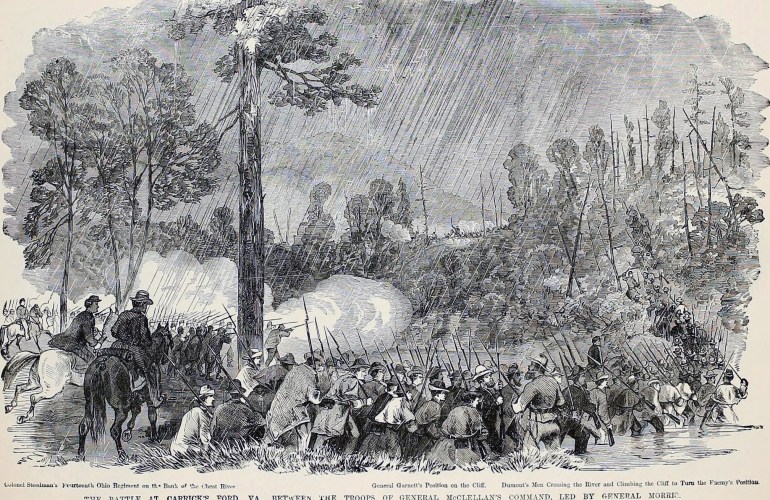
The following account of the death of Brig. Gen. Robert S. Garnett at Corrick’s Ford on July 13, 1861 was written by Henry Clay Wheeler (1841-1924), Company E, 7th Indiana, who claimed to be among the party who fired at the general on that fateful day. It appeared in The National Tribune, a veterans’ newspaper, on October 17, 1901. Written four decades later, the account contains a few errors, but is so detailed I find little reason to doubt its overall accuracy. The event obviously stayed fresh in Wheeler’s mind for the rest of his life.
CARRICK’S FORD.
An Eye-Witness Gives His Version of the Killing of Gen. Garnett.
Editor National Tribune: I read your valuable paper with a great deal of interest, and hardly know whose contribution I most admire. They are all good, and to one who served in the Army of the Potomac a character like Geo. Dallas Mosgrove, writing, we’ll say, from Stonewall Jackson’s Corps, would certainly be intensely interesting to many who operated against that wily chieftain; and I rather begrudge the boys who faced Morgan, in that they are having at this late date so fluent a writer as the author of “Bugle Notes.” Another subject that has attracted my attention is the death of Gen. Garnett.

I was a high private in Co. E, 7th Ind., first call for 75,000 men. The company was recruited from Aurora and vicinity. The required 100 names were enrolled before Fort Sumter fell and before that first call for 75,000 volunteers.
The company was mustered as follows: John H. Ferry, Captain; Alex B. Patterson, First Lieutenant; Henry Waller, Second Lieutenant, and B. F. Burlingame, Orderly Sergeant.
We were rendezvoused at Indianapolis, and were made color company of the 7th Ind., with no less personage for Colonel than Ebenezer Dumont, who had earned an enviable reputation during the Mexican war.
The 7th Ind. was the second regiment to leave the State. We disembarked at Grafton, W. Va. We then went to Webster, and from there, with other regiments and a battery, started out one very dark, rainy night for Philippi, where we arrived on schedule time.
The battle opened fire from the hilltop overlooking the town, while the infantry, led by Col. Dumont, charged down the hill and across the bridge by companies, in close column, through the streets and far beyond the limits of the town. There were no casualties in the 7th Ind. Col. Kelley, of the 1st W. Va., was shot through the lungs by a man in citizens’ clothes. The Virginians would have made short work of him but for the timely interference of Col. Dumont, who said that he should be accepted as a prisoner of war, since he had thrown away his weapon, an old-fashioned horse-pistol, and held up his hand, loudly calling for quarter. The Johnnies lost one man, wounded—leg shot off by a bursting shell.
We were not long delayed at the classic town of Philippi, but wended our way to Burlington [Belington] and Laurel Hill, where the rebel forces under Garnett disputed our passage. The choosing of locations and their fortifications were proof of skillful engineering. While we were daily skirmishing with them and thinking every day we would be allowed to assault their works, McClellan was busy getting in their rear at Cheat Mountain [Rich Mountain], where considerable strategy was shown, and after a stubborn battle, fought between Rosecrans and Gen. Pegram, and won by Rosecrans, who swooped down on the rear of the army at Laurel Hill, the only thing left for the Johnnies to do was to beat a hasty retreat—anything to get away and not be caught between two fires. Then the mad race commenced, with Garnett’s forces well in the lead. As the chase waxed warm the road became strewn with all kinds of army equipments. Finally, we commenced overtaking their stragglers, and the ones I saw were fine-looking fellows. They looked like men of leisure from the cities of the South, and their dress and deportment denoted Southern culture.
After passing over mountains and a lot of rough country, we struck the Cheat River Valley, portions of which were fine productive land. The 7th Ind. was second or third to the front. While thus surging to the front our ears were saluted by the fire from Garnett’s artillery, which was in position on elevated ground on the opposite side of the river, just to the left of the ford. The artillery and infantry were ready to dispute our passage of the ford.
Col. Dumont, who had as much fight in him as any man north or south of Mason and Dixon’s line, rushed furiously to the front and assisted in formation of line of battle, and then opened the much-longed-for battle. Our regiment did but little, if any, firing until Dumont led us across the river, which was probably 200 yards wide from bank to bank, and about three feet deep.
The approach to the ford from the enemy’s side of the river led through a narrow gorge, which was thickly grown up with trees and laurel bushes extending high up on the bluff or rapidly-rising ground.
To the left was the road, which was blockaded with wrecked wagons and one or two pieces of artillery, an antiquated iron piece, about a 12-pounder, all of which effectually blockaded the road. In crossing the swift-running current bore our column below the ford. Then commenced a scramble through the laurel thickets and up the rugged ascent. Our Second Lieutenant, who had seen service in the British army, and was very quick-witted, saw a point to be gained by bearing off to the left. Those of us who followed him worked our way through the wrecked train in approach to the ford and passed all obstructions. Then we had clear sailing on to the next ford above, about a third of a mile distant. Here we found the enemy behind several drifts that had formed in the bend on the opposite side of the river. My brother, Wm. Wheeler, was first to take position behind a tree, and fired the first shot. I came up to him just after he fired, and after scolding because I stood in the open where the bullets were falling thick and fast, he told me to shoot at an officer whose head and breast were above the drift, where he was either standing on something or mounted on a horse. I raised my gun to draw a bead on him, when Orderly Sergeant B. F. Burlingame said to wait and we would fire a volley at him. At the word or command from Burlingame, three of us fired, and my brother said, “You’ve killed him.” I am certain there were not 20 shots fired by us at this second ford. We crossed at once, the enemy having fled after the fall of their chieftain, and found Gen. Garnett with a fatal wound in the breast. I saw a quiver of the muscles and he was dead. I was one of probably a dozen who were the first to reach him.
I am not certain who the third man was in the firing party, but think it was either Laycock or Vinson, of Co. E. Now, I could not say positively whose shot killed Garnett. The credit was given to Burlingame at the time, and has never been otherwise until after a lapse of 40 years. When his gun was given over at Indianapolis a placard was placed on it which read: “This is the gun carried by B. F. Burlingame, and killed the first Major General of the war.”
My statement of what I know to be true is in defense of a man who is not here to defend his claim. He has long since answered the last roll-call. But there are some of the boys still living who were at the skirmish at the upper ford, and I will stand corrected when one of them says I am in error. J. C. Stewart, of Montana, who is still living, was one of the few who were there, and I’m sure he will recall the facts in the case.
When killed Garnett was behind the few of his demoralized troops that were with him. His rear-guard were crouching behind the drift. They did not fire another shot after Garnett fell. Had we possessed one regiment of cavalry, the last man of that once-imposing command could have been taken.
My mind is not clear as to whether we camped on the field, as stated by others, or not. My recollection is that our small party that formed the skirmish line followed up the chase for a mile or two, and then waited for the regiment to come up. Then we moved on toward St. George, where the chase was abandoned. From St. George we moved in the direction of Philippi, which we reached in due course of time, and there learned of the disaster which had befallen our troops at Bull Run. The regiment, both rank and file, was anxious to proceed to Washington and tender our services to the Government. However, our time being out, we were ordered to Indianapolis and discharged.
The above statements have been written 40 years after the battle of Carrick’s Ford, and entirely from memory. Have kept no diary and copied from no one, because I have never seen what I considered a correct statement of that affair.
I now await the statement of some comrade who was in that squad at the upper ford, where Garnett was killed. Our regimental badge bore the following: “From Philippi to Appomattox.”
—H. C. Wheeler, Co. E, 7th Ind., three months’ service, and Co. A, 7th Ind., three years, Dillsboro, Ind.

 Spirit of '61