While several early skirmishes and clashes claim the title of first land battle of the Civil War, only one engagement truly meets all the criteria of a traditional battle—discover which one and why it stands apart.
The claim of being the site of the first land battle of the American Civil War presents a study in contrasts. While the town of Philippi, West Virginia, has embraced this title in hopes of attracting tourism, Fairfax County, Virginia, has taken the opposite approach, removing all references to their own claim to the distinction from their historical courthouse grounds. There is a certain prestige, or notoriety, in being “the first.”
But which claimant truly deserves the title? What qualifies as a “land battle,” and what makes it the first? The distinction of “land battle” is necessary because several earlier engagements in May 1861 could also be considered battles. However, these were primarily artillery exchanges between ships and shore batteries, such as those at Gloucester Point, Virginia, on May 7, 1861, Sewell’s Point, Virginia, May 18–19, and Aquia Creek, Virginia, May 29–June 1, which resulted in a few minor casualties. These are considered naval operations.
Our encyclopedia sometimes uses the term “battle” as a catch-all to describe any armed encounter at this early stage of the war. But the traditional definition of a battle is a sustained and organized engagement between opposing military forces, typically involving significant troop movements, strategic planning, and direct combat.
Battles are distinct from things like raids or artillery exchanges in that they generally involve larger forces, a clear tactical objective, and a decisive outcome. Key characteristics include two or more organized (uniformed) military units engaged in combat for a significant duration, not just a brief clash. Units operate under organized leadership with a clear chain of command. Losses occur on both sides, and the engagement typically results in a victor, retreat, or stalemate.
The ground war began in Virginia in late May 1861, when the state still included both modern Virginia and West Virginia. Between May 23 and May 26, Union forces advanced from multiple directions. In western Virginia, unionists and secessionists mobilized in support of their respective causes, effectively creating a civil war within the larger Civil War. With tensions high and armed factions forming, a land battle was inevitable. But where and when would it occur?
There are several candidates for the title of “First Land Battle of the Civil War.” We will evaluate each one objectively, keeping in mind that not being “the first” does not diminish their significance or the impact they had on the people involved or the communities where they took place.
Fetterman – Taylor County, WV
This incident took place on Wednesday, May 22, near the town of Fetterman, at a bridge over the Tygart Valley River. It involved a skirmish between a small group of Virginia unionist and secessionist militia members. Only five people were involved, resulting in the death of Thornsbury Bailey Brown and the wounding of Daniel W. S. Knight. While the secessionist Letcher Guard had been officially sworn in for one year of service on May 13, the unionist Grafton Guards had not yet entered federal service. Although Brown is often credited as the first soldier killed in action in the Civil War, he was technically still a civilian at the time of his death. This event does not meet the criteria of a true battle, as it involved only a handful of participants, and one side consisted of civilians rather than uniformed soldiers.
Glover’s Gap – Marion County, WV
This incident occurred on Tuesday, May 28, along the Baltimore & Ohio Railroad in what was then northwestern Virginia. Similar to the skirmish at Fetterman, it involved a small number of participants, and one side may have been civilians. There is no record that the Confederate group, led by Stephen Roberts, was ever sworn into state service. While some historians speculate that Roberts was acting under orders from Col. George A. Porterfield, there is no definitive proof of this. The brief encounter, which resulted in Roberts’ death, does not meet the criteria of a battle.
Cloud’s Mill – Alexandria, VA
Shortly before midnight on Friday, May 31, two companies from the 1st Michigan and 11th New York were conducting a picket guard shift change at Cloud’s Mill, west of Alexandria, Virginia, when gunfire suddenly erupted in the darkness. In the confusion, one New York soldier was killed, and another was wounded. At the time, newspapers widely reported the incident as an attack by secessionist guerrillas. However, after more than 160 years, the identity of the shooters remains unknown. If it was hostile fire, it likely came from civilians rather than uniformed Confederates. Alternatively, it may have been a case of friendly fire. Regardless of the cause, this incident does not qualify as a battle due to its brief duration and the small number of participants.
Fairfax Court House – Fairfax County, VA
Before sunrise on Saturday, June 1, U.S. cavalry entered Fairfax Court House and engaged secessionist state volunteers, most of whom fled due to a lack of arms. The only armed unit present, the Warrenton Rifles, attempted to resist, but their captain was killed by a stray bullet. Former Virginia Governor William Smith quickly took charge, and the two sides exchanged fire for several minutes. With just over 100 combatants, this was the largest engagement so far and the first exchange of fire between two uniformed units. Unlike previous incidents, there was no ambiguity—both sides were actively engaged in combat. However, while significant, this encounter was unplanned and bore more resemblance to a raid than a conventional battle.
Philippi – Barbour County, WV
On Monday, June 3, approximately 3,000 Union troops descended on 775 Confederates in the small town of Philippi, in northwestern Virginia. At first glance, the scale of the engagement lends credibility to the claim that this was the first land battle of the Civil War. However, while shots were exchanged and around a dozen men were wounded, this was not a traditional stand-up fight between two armies.
The Confederates, who had already planned to withdraw, fled in disorder at the first sign of contact, firing a few shots as they retreated. A combination of darkness, a torrential rainstorm, and a shortage of ammunition made it unlikely that a sustained battle could have occurred, even if the Confederates had chosen to stand and fight. In contrast to the smaller skirmish at Fairfax Court House, Philippi is sometimes referred to as the first “organized” battle of the war—but in reality, the Confederate withdrawal was anything but organized.
New Market Bridge – Hampton, VA
The action at New Market Bridge served as a prelude to the Battle of Big Bethel. On Saturday, June 8, several companies of Confederate and Union volunteers engaged in a running gun battle on the Virginia Peninsula, using both small arms and artillery. Approximately 400 troops took part, but notably, there were no casualties. Despite some reports suggesting otherwise, only two captured soldiers can be confirmed. This engagement was so minor that it was not even recorded as a distinct event in the Official Records and has received little attention from historians.
Big Bethel – Hampton, VA
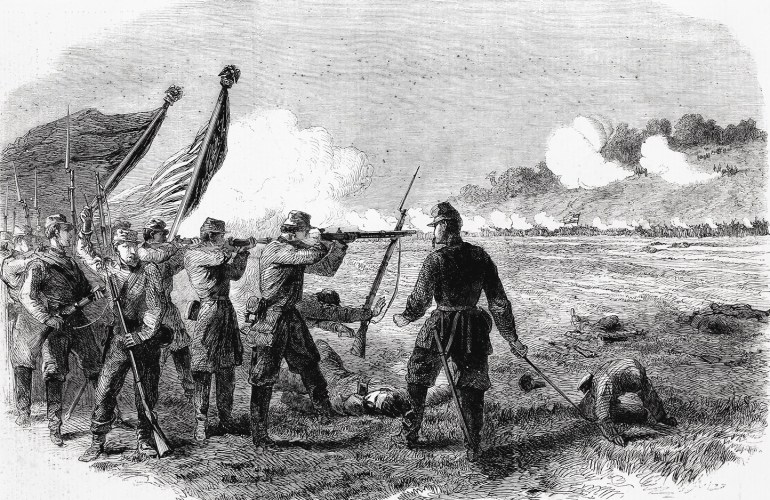
The first true battle of the Civil War, in the traditional sense, was the Battle of Big Bethel, which took place on Monday, June 10, on the Virginia Peninsula. This engagement involved over 6,000 combatants and resulted in a clear Confederate victory, with 86 casualties recorded. Big Bethel was the first engagement in which regiments fought regiments in fixed formations on a well-defined battlefield. The Union forces launched an attack against Confederate troops who were positioned behind field fortifications. Unlike the earlier skirmishes and retreats, Big Bethel marked a turning point—it was the first time Confederate forces decisively repelled a Union assault.
Conclusion
Given the criteria established at the beginning of this article, the first three engagements—Fetterman, Glover’s Gap, and Cloud’s Mill—can be easily dismissed. These were brief skirmishes involving only a handful of combatants, lasting just a few minutes. Furthermore, only one side in each case was confirmed to be composed of uniformed soldiers. Fairfax Court House, however, stands out as the first significant land engagement between two uniformed forces that fought for a sustained period. In that sense, in the broadest definition of the term, it qualifies as the first land “battle” of the Civil War.
That said, only one engagement meets every criterion of a traditional battle: Big Bethel. The Union forces launched a planned offensive with a clear objective, and both sides operated under a well-defined chain of command. Unlike earlier skirmishes, this battle featured organized regiments fighting in structured formations on a well-defined battlefield. For these reasons, Big Bethel is the first conventional land battle of the Civil War.

 Spirit of '61