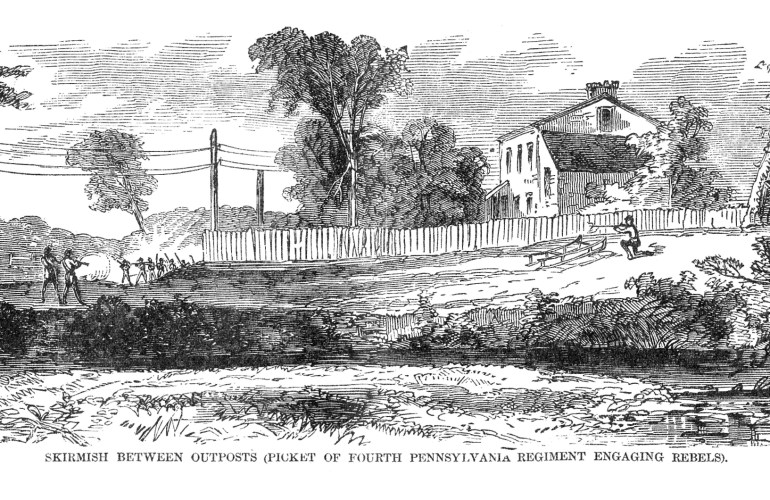
As June 1861 dragged on with little progress in northeast Virginia, restless Union and Confederate troops found themselves locked in a brief but bloody skirmish near Alexandria. A late-night clash between Pennsylvania infantry and Southern cavalry left men dead on both sides, yet did nothing to alter the course of the campaign.
June 1861 passed in a tense stalemate in northeastern Virginia, as both sides steadily reinforced. On June 26, Union Brigadier General Irvin McDowell, commanding the Department of Northeastern Virginia, reported 20 regiments with a total strength of over 15,000 men, including 12 artillery pieces. Many of these regiments had enlisted for three months at the war’s outset.
One such unit was the 4th Pennsylvania Volunteer Infantry, primarily raised in Norristown in the southeastern part of the state. It was led by 30-year-old Colonel John F. Hartranft, who would later become the 17th Governor of Pennsylvania. The regiment was poorly equipped, lacking proper uniforms and tents until mid-June.
On June 18, the regiment was ordered to reinforce Alexandria, Virginia, and arrived at Camp Hale that evening. The camp was located about a quarter mile north of Fort Ellsworth on Shuter’s Hill. An observer who encountered the regiment as it crossed the Potomac River noted, “They express themselves well pleased at the near prospects of a ‘brush’ with the traitors.” Once settled, they resumed drilling and assumed picket duty in the area.

Meanwhile, on the opposing side, another unit was growing restless with the monotony of camp life: the Governor’s Mounted Guard. This prewar cavalry company, first organized in 1859, was led by 44-year-old Captain John Grattan Cabell, a Richmond physician. Sixty-five men mustered into state service on May 8, 1861, and by June, they were stationed near Manassas Junction.
The Governor’s Mounted Guard frequently operated alongside the Goochland Cavalry, conducting mounted patrols along the Orange and Alexandria Railroad west of Union-held Alexandria. On June 8, two troopers from these companies, Thomas Fleming and Samuel Green, encountered a four-man patrol from the 1st Michigan Volunteer Infantry near Burke’s Station. When they attempted to pursue the infantrymen, the tables turned, and the troopers were captured.
On the morning of Friday, June 28, Major John B. Gordon of the 6th Alabama Infantry Regiment ordered Captain Walter H. Weems to lead a scouting expedition toward Alexandria. Weems’ force included 48 infantry and 10 cavalrymen from the Governor’s Mounted Guard and Goochland Cavalry, with Lieutenant Francis W. Chamberlayne commanding the cavalry scouts.
The first day, the group scouted the vicinity of Accotink Mill but found no enemy forces. They then moved north, stopping 3.5 miles from Alexandria. The next morning, they withdrew to Burke’s Station, where they met local scouts who offered to safely guide them toward the Union picket posts south of Alexandria. Weems sent half his force back to camp with the cavalry mounts while the remaining 29 men advanced on foot, bivouacking in the woods within sight of Union fortifications on Shuter’s Hill.
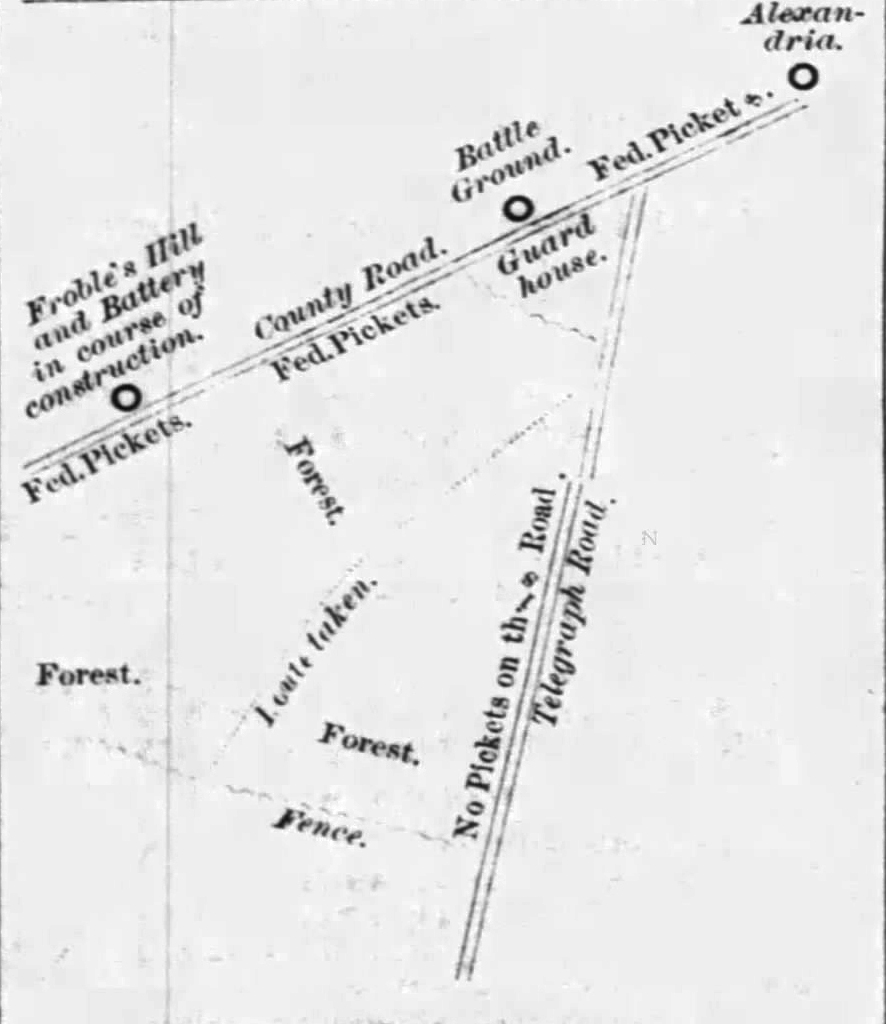
A few hours after midnight on June 30, Weems divided his force into small groups to probe the Union picket line. Sergeant Henry C. Hanes of the Governor’s Mounted Guard led his team to the intersection of Telegraph Road and Old Fairfax Road, where Lieutenant Matthew R. McClennan and two privates from the 4th Pennsylvania were standing guard.
Accounts of what happened next vary. One version states that Sergeant Hanes called on the Union soldiers to surrender. Another claims the pickets challenged Hanes’ men, who responded defiantly, telling them to “Go to Hell.” The Union guards then opened fire, killing Hanes. Hearing the commotion, a few men from Company E, 4th Pennsylvania rushed to assist. In the ensuing firefight, two Pennsylvania privates, Thomas Murray and Llewelyn Rhumer, were shot, with Murray suffering fatal wounds.
Weems later reported no wounded among his men. “Not more than twenty-five shots were fired by our side, and twelve or fifteen by the enemy,” he wrote. His force withdrew, leaving behind Hanes’ body and several weapons, and returned to camp that evening. Hanes’ remains were later sent to Richmond for burial. While dramatic and deadly, the skirmish had no strategic impact.
In mid-July, the 4th Pennsylvania advanced with McDowell’s army to Centreville. However, with their enlistment expiring on July 20, they were sent back to Alexandria to be mustered out. Colonel Hartranft remained behind as a staff officer and earned commendation for rallying fleeing troops during the Battle of Bull Run.
Sources
Bates, Samual P. History of Pennsylvania Volunteers, 1861-5, Vol. 1. Harrisburg: B. Singerly, State Printer, 1869.
Gambone, A.M. Major-General John Frederick Hartranft: Citizen Soldier and Pennsylvania Statesman. Baltimore: Butternut and Blue, 1995.
Hunsicker, Clifton Swenk. Montgomery County, Pennsylvania: A History, Vol. I. New York: Lewis Historical Publishing Company, 1923.
Patriot & Union (Harrisburg, PA) 21 June 1861.
Philadelphia Inquirer (Philadelphia, PA) 10 June 1861.
Philadelphia Inquirer (Philadelphia, PA) 1 July 1861.
Richmond Daily Enquirer (Richmond, VA) 11 June 1861.
Richmond Dispatch (Richmond, VA) 3 July 1861.
Richmond Dispatch (Richmond, VA) 4 July 1861.
Southern Confederacy (Atlanta, GA) 19 July 1861.
Staunton Spectator (Staunton, VA) 9 July 1861.
Stiles, Kenneth. 4th Virginia Cavalry. Lynchburg: H.E. Howard, Inc., 1985.
Wallace, Lee A., Jr. A Guide to Virginia Military Organizations, 1861-1865. Lexington: H.E. Howard, Inc., 1986.
York Gazette (York, PA) 25 June 1861.

 Spirit of '61