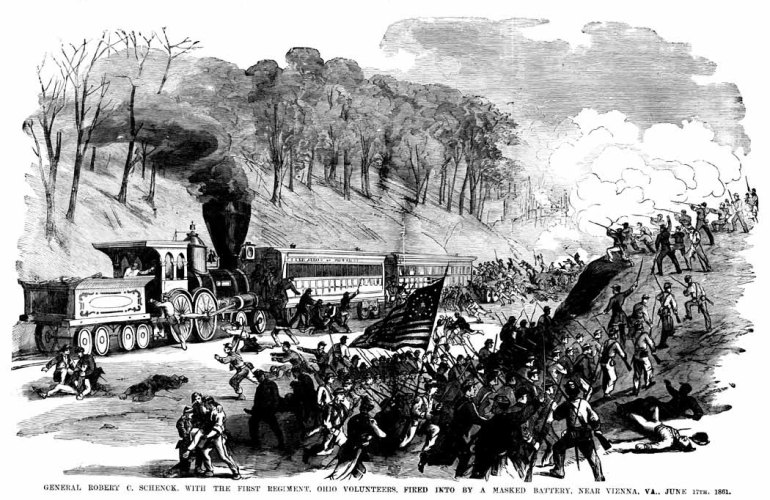
In June 1861, a Union reconnaissance mission along the AL&H Railroad took a deadly turn when Confederate forces ambushed a troop train near Vienna, Virginia. The surprise attack exposed the vulnerability of Union operations, forcing a hasty retreat and reinforcing the caution of military leaders as the conflict escalated.
By mid-June 1861, the Union’s rapid advance into northeastern Virginia had stalled along a line stretching from Alexandria to Chain Bridge and Little Falls. Over 12,000 Union troops were positioned across this 25-square-mile area just beyond the Potomac River from Washington, D.C. Although they encountered little armed resistance, a skirmish on June 1 rattled Union war planners when a cavalry patrol was driven out of Fairfax Court House, suffering six wounded and three captured. Though a minor incident, it prompted Union forces to proceed with greater caution.
On the morning of June 16, Brigadier General Irvin McDowell, commanding the Department of Northeastern Virginia, ordered Brigadier General Daniel P. Tyler to lead a detachment from the 1st Regiment Connecticut Volunteer Infantry on a reconnaissance mission along the Alexandria, Loudoun & Hampshire (AL&H) Railroad to Vienna. Union observers at Arlington Mills had spotted smoke rising in that direction and, fearing Confederate forces were setting fire to railroad bridges, reported their concerns to headquarters.
Upon reaching the area, Tyler discovered the bridges intact. However, northwest of Vienna, his men came across several locomotives and train cars in flames. After assessing the situation, he withdrew, but not before a civilian near Falls Church shot and wounded a Union soldier. The assailant was promptly taken prisoner. Meanwhile, the 69th New York Infantry advanced from Fort Corcoran to secure the railroad crossing just west of Four Mile Run.
At the same time, Confederate Colonel Maxcy Gregg of the 1st South Carolina Infantry Regiment led 575 men from Fairfax Court House on a reconnaissance mission toward the Potomac River. Along the way, he joined forces with 70 cavalrymen from the Clay Dragoons and Wise Troop, as well as Captain Delaware Kemper’s Alexandria Light Artillery, which included two 6-pounder cannons. The combined force scouted north to Dranesville, missing Tyler’s expedition by mere hours before setting up camp for the night.
The following day, McDowell directed Brigadier General Robert C. Schenck to send a regiment by rail along the AL&H Railroad to relieve the 69th New York and proceed toward Vienna, guarding bridges and clearing any obstructions. Schenck took 697 men from the 1st Ohio Infantry Regiment, leaving detachments along the route for security. Companies E, C, G, and H—totaling 271 men—traveled by rail on open platform cars.
That same morning, Colonel Gregg, having found little Union activity along the Potomac, moved south to Hunter’s Mill, where train cars still smoldered. Sensing an opportunity, he led his men two miles to Vienna and prepared an ambush, anticipating a Union return. Growing impatient, the Confederates were about to move on when, just before 6 p.m., the distant sound of a train whistle prompted them to reset their trap.
As the Union train rounded a bend, Kemper’s artillery opened fire—first with solid shot, then with canister rounds. The Ohio volunteers, exposed on open platform cars, scrambled for cover in the woods and underbrush. Eight were killed, and at least five wounded. Companies G and H, positioned on the second and third cars, bore the brunt of the attack.
The New York Daily Herald later reported: “When the attack was made Major Parrott, of Dayton, seized the colors and sprang upon the embankment and unfurled them, but was pulled back by some of the company, while admiring his gallantry, were unwilling he should needlessly expose himself.”
During the chaos, one soldier lost his arm to a cannonball but managed to retrieve it and jump from the car before collapsing.
The train’s engineer, panicked by the attack, detached the engine and sped back toward Alexandria, leaving the Ohio troops to fend for themselves. The Confederates attempted to pursue, but rough terrain and growing darkness forced them to abandon the chase. They captured one wounded Union soldier before withdrawing to Fairfax Court House after midnight.
The stranded Ohioans threw aside most of their accoutrements and made their way back to camp on foot, carrying their wounded in blankets. The next day, a local Unionist helped return the fallen soldiers to their regiment.
The Ambush at Vienna reinforced the Union high command’s growing sense of caution and further exposed the inexperience of its officers and troops. In response, General-in-Chief Winfield Scott advised McDowell against another advance on Vienna. For the next month, both sides remained in largely the same positions, holding their ground until mid-July.
Sources
Andrus, Michael J. The Brooke, Fauquier, Loudoun and Alexandria Artillery. Lynchburg: H.E. Howard, Inc., 1990.
Connery, William S. Civil War Northern Virginia 1861. Charleston: The History Press, 2011.
Daily Herald (New York) 19 June 1861.
Davis, William C. Battle at Bull Run: A History of the First Major Campaign of the Civil War. Mechanicsburg: Stackpole Books (reprint), 1995.
Daily Ohio Statesman (Columbus, OH) 19 June 1861.
Driver, Robert J., Jr. and H.E. Howard. 2nd Virginia Cavalry. Lynchburg: H.E. Howard, Inc., 1995.
Official Roster of the Soldiers of the State of Ohio in the War of the Rebellion, 1861-1866, Vol. I. Akron: The Werner Company, 1893.
The War of the Rebellion: A Compilation of the Official Records of the Union and Confederate Armies. Series I, Vol. II. With additions and corrections. Washington: Government Printing Office, 1902.
Wenzel, Edward T. Chronology of the Civil War in Fairfax County, Part I. CreateSpace: By the Author, 2015.
Zanesville Daily Courier (Zanesville, OH) 26 June 1861.
Zanesville Daily Courier (Zanesville, OH) 29 June 1861.

 Spirit of '61