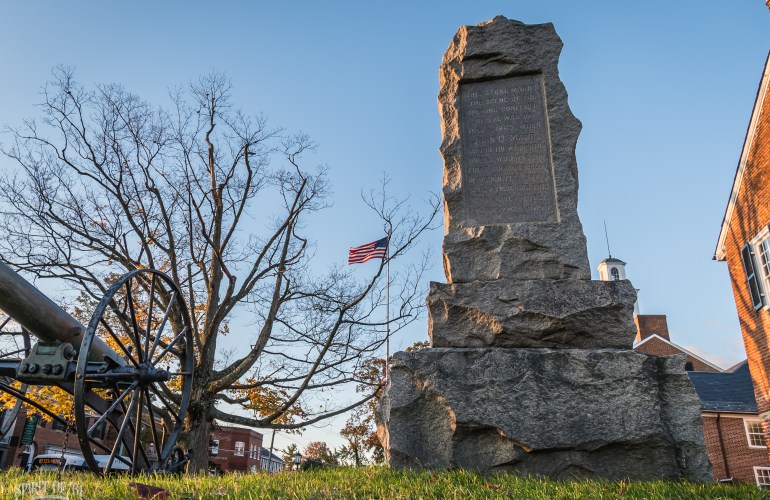
John Q. Marr’s fatal encounter with Union cavalry in Fairfax Court House on June 1, 1861, marked a bloody opening salvo of the Civil War, yet the debate over his legacy—and the monument that once bore his name—continues over a century later.
For over a century, a granite monument stood near the old Fairfax County Courthouse, commemorating the first land battle of the American Civil War and the first uniformed soldier killed in action on either side—John Q. Marr. The monument was flanked by two Dahlgren howitzers.
In September 2020, the Fairfax County Board of Supervisors voted to remove this monument along with two other Civil War markers. The inscription on the monument read:
This stone marks the scene of the opening conflict of the war of 1861–1865, when John Q. Marr, Captain of the Warrenton Rifles, who was the first soldier killed in action, fell 800 ft. S. 46 W. Mag. of this spot, June 1st, 1861.
Additionally, a Virginia Department of Historic Resources sign erected in 2009 outside the Fairfax County Judicial Center, marking “First Confederate Officer Killed,” was also removed.
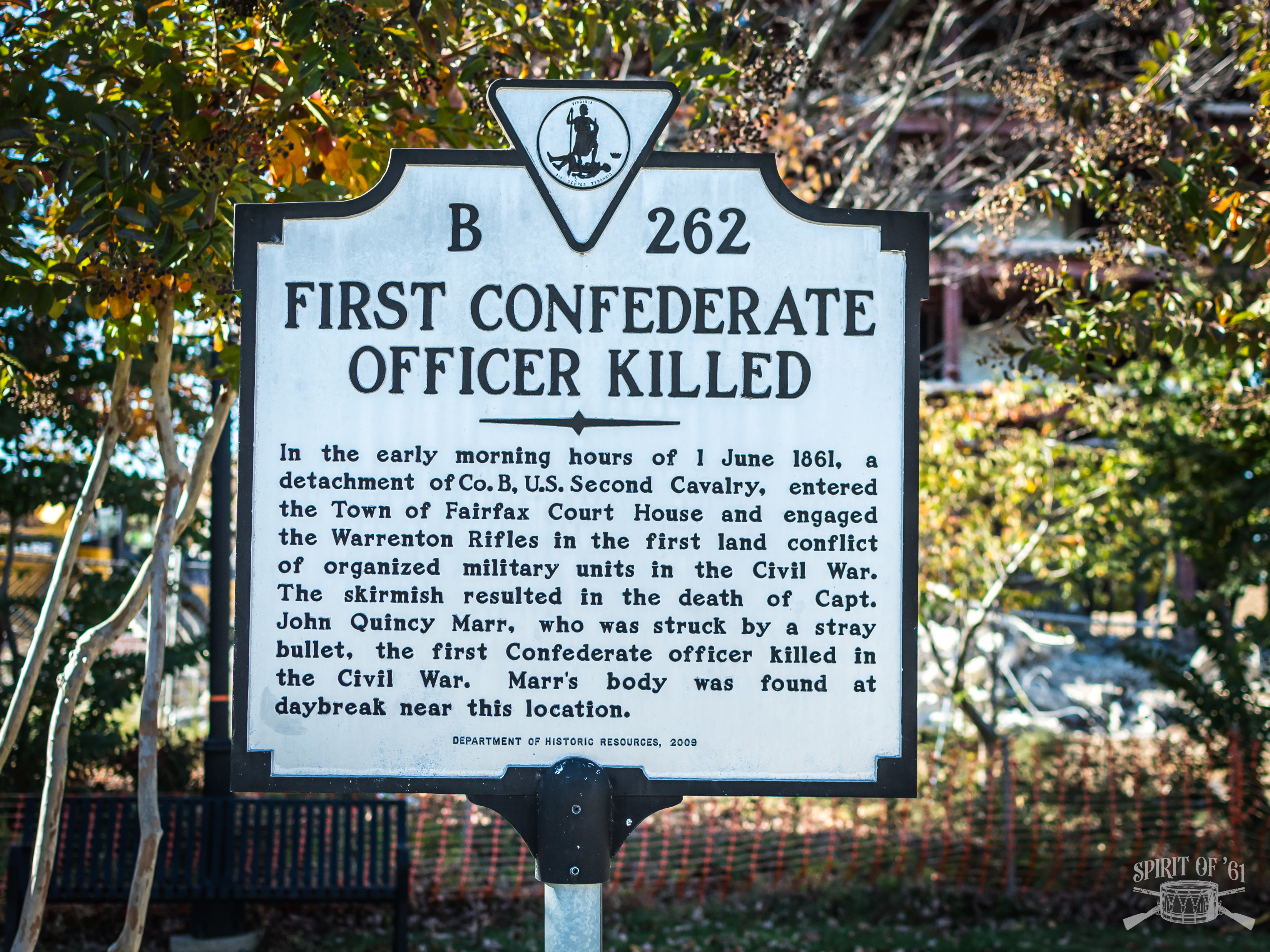
Over the past few decades, historical statues and monuments have increasingly come under scrutiny, a trend that accelerated in the summer of 2020 following the death of George Floyd, which sparked months of protests and riots. Public monuments and markers related to the Confederacy were removed throughout Virginia. In June 2020, a group vandalized the Fairfax County monument and demanded its removal, leading to the Board of Supervisors’ decision. Opponents of the markers argued that their text was historically inaccurate and that they glorified the Confederacy.
The Marr Camp of Confederate Veterans dedicated the six-ton, nine-foot-tall granite monument on June 1, 1904. It stood for 116 years, making it a historic artifact in its own right. After its removal, it was given to the Stuart Mosby Historical Society, which operated the Stuart Mosby Civil War Cavalry Museum in Centreville, although the museum has since closed. A spokesperson told us that the monument is currently at a secure but undisclosed location.
Who was John Q. Marr?
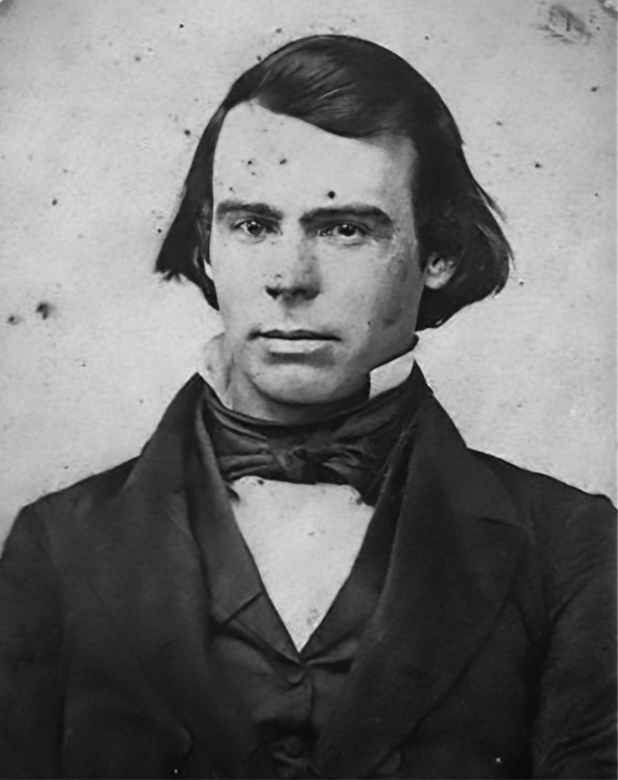
John Quincy Marr (1825–1861) was born on May 27, 1825, in Warrenton, Fauquier County, Virginia, to a family of French ancestry. He graduated second in his class at the Virginia Military Institute (VMI) in 1846 and briefly taught mathematics and tactics at the college after graduation. As a VMI graduate and a one-term sheriff of Fauquier County, Marr helped organize the Warrenton Rifles militia company in 1859.
A conditional Unionist, Marr served as a delegate to the Virginia Secession Convention and initially voted against secession. However, he changed his stance after the firing on Fort Sumter. The Warrenton Rifles were among the first militia companies to muster into Virginia’s provisional army, electing Marr as their captain.
Early in the morning of Saturday, June 1, 1861, Lieutenant Charles H. Tompkins, along with Company B of the 2nd United States Cavalry and part of the 2nd U.S. Dragoons, rode into Fairfax Court House, where Marr and the Warrenton Rifles were quartered in the Methodist Church. The U.S. cavalry fired wildly in all directions, and early in the skirmish, Marr became separated from his men. A bullet struck him in the chest, killing him instantly. His body was later found lying in a clover field near the church. Lt. Tompkins later claimed to have killed Marr, though no evidence supports this claim.
Marr’s untimely death underscored the grim reality of war, and he quickly became an early martyr for the Southern cause. He was buried beneath an obelisk in Warrenton Cemetery. As with many historical events, debate surrounds whether he was the first Confederate casualty. Technically, Marr was not a Confederate soldier but a member of the Virginia Provisional Army, receiving his commission from the Governor of Virginia. Governor John Letcher did not formally transfer control of Virginia’s armed forces to the Confederate government until June 6, 1861.
What is a Dahlgren howitzer?
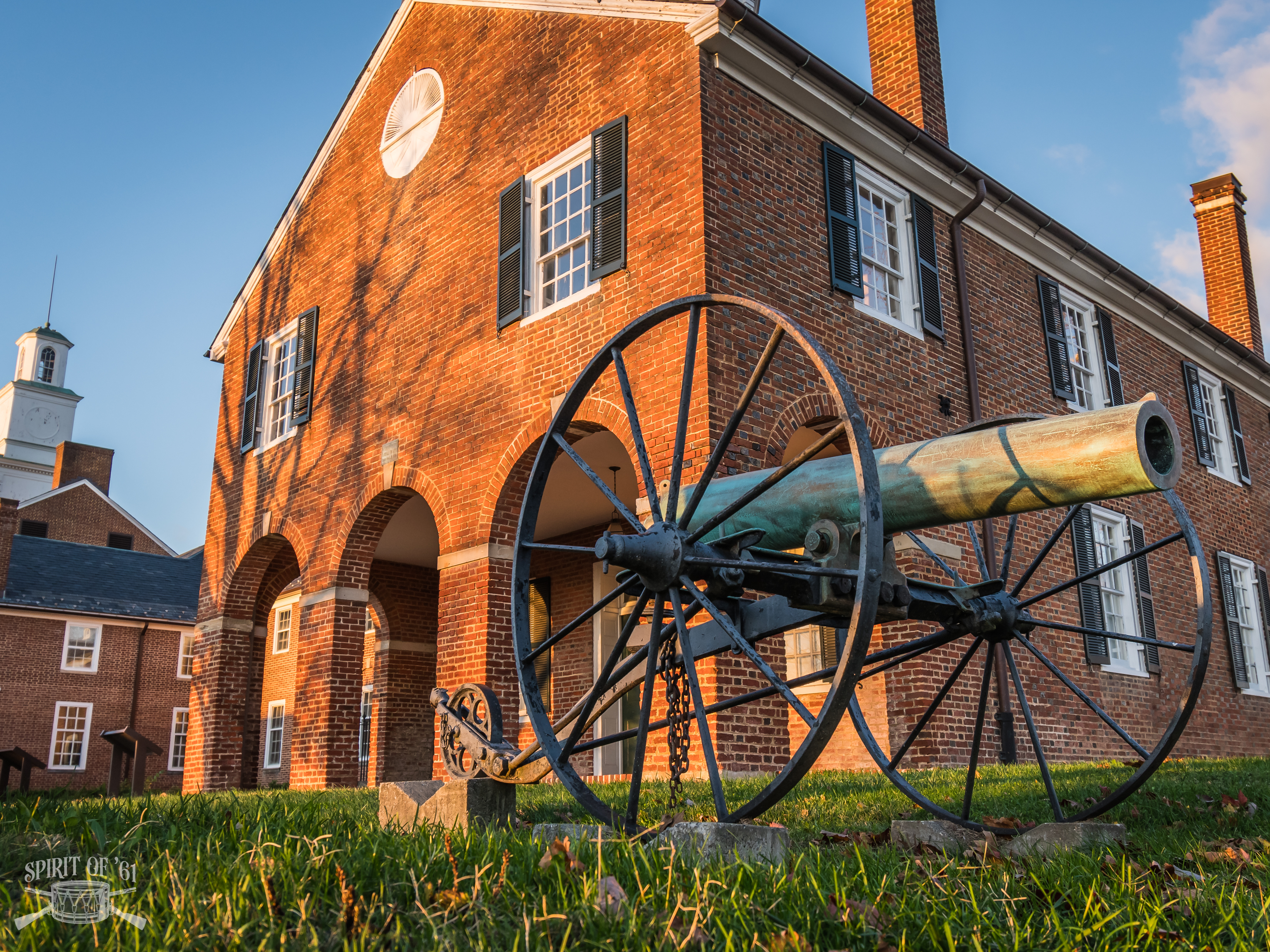
The Marr Monument was flanked by two well-preserved Dahlgren boat howitzers—artillery pieces not used at the Battle of Fairfax Court House but deployed by both sides during the Civil War. U.S. Navy officer John A. Dahlgren designed these lightweight, highly mobile weapons for use on small boats or in support of marine landings. The Richmond Howitzers utilized several Dahlgrens in 1861. Today, these cannons are on display at Manassas National Battlefield Park.
Was Marr the war’s first soldier killed in action?
The title of “first soldier killed in action” in Virginia is sometimes attributed to Thornsbury Bailey Brown, a Union volunteer from what is now Grafton, West Virginia. He was killed in a skirmish near a bridge outside Fetterman on May 22, 1861. However, Brown’s unit, the Grafton Guards, was not officially sworn into federal service until days after his death, making him technically a civilian at the time. Nevertheless, he is buried in Grafton National Cemetery.
Another possible candidate is Stephen Roberts, who led an irregular band of Virginia militia at Glover’s Gap. He was killed on May 28, 1861, in what is now Marion County, West Virginia, by a patrol from the Washington Rifle Guards, a Pennsylvania volunteer company that later joined the 2nd Virginia Infantry (U.S.) as Company A. However, Roberts’ combatant status is disputed, as his “company” was never officially sworn into service and disbanded shortly after his death. It remains unclear whether he was a commissioned officer or merely a self-proclaimed captain.
A third contender is Private Henry S. Cornell of the 11th New York Volunteer Infantry (First New York Zouaves), who was shot and killed at Cloud’s Mill west of Alexandria, Virginia shortly before midnight on May 31, 1861. However, it’s unclear whether he was shot accidentally or by hostile fire. No Confederate accounts of the event exist.
There is no such ambiguity in the case of John Q. Marr. He was a commissioned officer and a confirmed member of a Virginia volunteer company on the state’s payroll. This distinction makes him the first Southern officer killed in the conflict and the first uniformed soldier to die in action during the war.
Was Fairfax Court House the First Civil War Battle?
Despite several minor clashes between the U.S. Navy and Virginia shore batteries, as well as informal skirmishes involving small groups of combatants, the engagement at Fairfax Court House was the first land battle of the Civil War—if one defines a “battle” as an organized engagement between two uniformed forces. The Battle of Philippi, often cited as the first land battle, occurred two days later, on June 3, 1861.
The text on the 1904 granite marker and the Department of Historic Resources sign accurately commemorated a significant moment in American history. In many ways, the skirmish at Fairfax Court House was to the Civil War what the Battles of Lexington and Concord were to the American Revolution—a pivotal opening conflict. It deserves far greater recognition than it has received.

 Spirit of '61