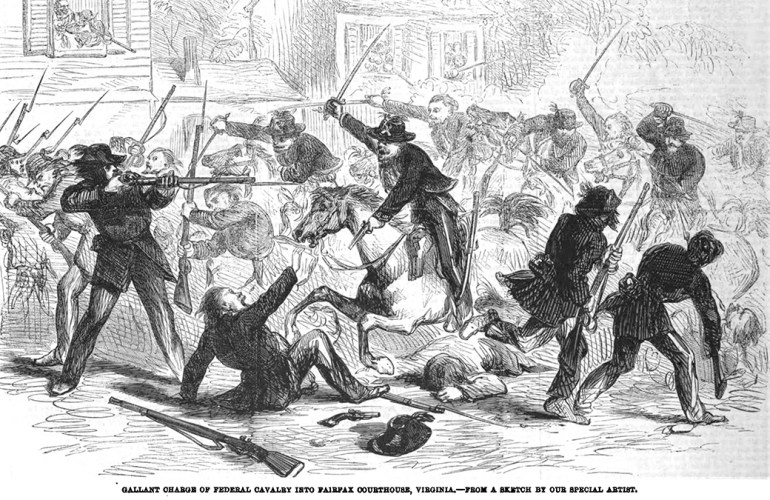
In the early hours of June 1, 1861, Union Lieutenant Charles H. Tompkins led a chaotic and unauthorized cavalry charge through Fairfax Court House, firing blindly in the dark and scattering the poorly armed Confederate defenders. The reckless raid resulted in the death of Captain John Q. Marr, the first Confederate officer killed in action, earning Tompkins both a Medal of Honor and a reprimand.
It was a calm, clear night. At 2 a.m. on May 23, 1861, under a bright moon, Lieutenant Charles H. Tompkins and Company B of the 2nd United States Cavalry crossed single-file over the Aqueduct Bridge into northern Virginia. They were followed by three New York infantry regiments and a company of engineers.
The cavalry advanced as far as the Loudoun & Hampshire Railroad, where Tompkins stopped a passenger train while U.S. Army engineers destroyed sections of track and burned two bridges over Four-Mile Run. Later that day, they, along with the 5th Regiment, New York State Militia, established Camp Union, half a mile west of Ball’s Crossroads near Falls Church. From there, they began patrolling the area for enemy activity.
On May 27, the same day that Irvin McDowell was appointed to command the new Department of Northeastern Virginia, U.S. cavalrymen surprised two Confederate soldiers—Privates Peyton Anderson and William Lillard of the Rappahannock Cavalry—who were on picket duty along the Falls Church Road, about two miles northeast of Fairfax Court House. Lillard was captured, while Anderson, though wounded, managed to escape.
Meanwhile, Major General Robert E. Lee, overseeing Virginia’s provisional army, inspected Brigadier General Milledge Luke Bonham’s defensive preparations at Manassas Junction. Bonham, a South Carolina congressman, had recently replaced Philip St. George Cocke as commander of the Alexandria Line. On May 29, Lee recommended that an advanced force be sent to Fairfax Court House under Lieutenant Colonel Richard S. Ewell, a former U.S. Regular Army officer.

The town, though strategically insignificant, served as the administrative seat of Fairfax County. It had about 300 residents, two churches, a hotel, and a jail. The Warrenton Rifles, Rappahannock Cavalry, and Prince William Cavalry, approximately 190 men in total, were stationed there, though both cavalry units were poorly armed and without ammunition. Further south, the Goochland and Hanover Light Dragoons were positioned at Fairfax Station, 3.5 miles away.
On May 31, William “Extra Billy” Smith, Virginia’s 30th governor, arrived at Fairfax Court House as a civilian to support “his boys” in the Warrenton Rifles. That evening, he briefly conferred with Ewell, who had just returned from reconnoitering the area, before they retired for the night.
Meanwhile, Col. David Hunter of the 3rd U.S. Cavalry, serving as a brigade commander in the Army of Northeastern Virginia, ordered Lt. Tompkins to conduct a reconnaissance mission toward Fairfax Court House. Tompkins took 50 men from his own company, 22 from the 2nd U.S. Dragoons under Lt. David S. Gordon, and three members of the 5th New York State Militia’s regimental staff. They advanced west along Falls Church Road.
At around 2:30 a.m. on June 1, just outside Fairfax Court House, Tompkins’ men surprised two Warrenton Rifles pickets, capturing one while the other escaped to warn his comrades. Instead of proceeding cautiously as ordered, Tompkins impulsively led his men on a reckless charge through the town. The cavalry rode through the dark streets, firing wildly in all directions, with only dim hotel lanterns illuminating the scene.

As the Union troopers stormed through, they encountered the Prince William Cavalry, capturing four of its members. Ewell, stepping out of his hotel to assess the commotion, was struck in the shoulder. The two Confederate cavalry companies, lacking ammunition, fled, as did part of the Warrenton Rifles. In the chaos, Captain John Q. Marr of the Warrenton Rifles became separated from his men and was killed—likely by a stray bullet. Tompkins later claimed credit for Marr’s death. His Medal of Honor citation, awarded in 1893, reads: “Twice charged through the enemy’s lines and, taking a carbine from an enlisted man, shot the enemy’s captain.”
After the initial charge, the Union cavalry rode out of town toward Germantown before doubling back. In the meantime, ex-Governor Smith rallied the leaderless Warrenton Rifles, attempting to block the Little River Turnpike between the courthouse and hotel. Ewell, bleeding from his wound, briefly joined them before leaving to find a courier to summon reinforcements from Fairfax Station.
Shortly thereafter, Tompkins and his men reappeared on the western side of town. The Warrenton Rifles fired a scattered volley, causing the cavalry to retreat. The Confederates then cautiously advanced toward Zion Episcopal Church, only to be met by another charge. This time, their volleys were more effective, mortally wounding nine Union horses and wounding six men, including Tompkins, who injured his foot when his horse fell on him. Three Union soldiers were taken prisoner, though one was mistakenly reported as dead.
By sunrise, Confederate reinforcements from Fairfax Station arrived, but the skirmish was over. Despite the chaotic nature of the fight, Marr was the only fatality.
Lt. Tompkins later wrote a self-serving report that grossly exaggerated the number of Confederate troops and their casualties. While his boldness earned him some praise, the Union leadership saw the engagement as a costly blunder. Irvin McDowell commended Tompkins’ courage but criticized his actions, writing that they had “frustrated unintentionally, for the time, a more important movement.” The skirmish at Fairfax Court House, though a minor engagement, revealed the inexperience of both sides in the opening months of the conflict.
Sources
Bell, John W. Memoirs of Governor William Smith, of Virginia. New York: The Moss Engraving Company, 1891.
Connery, William S. Civil War Northern Virginia 1861. Charleston: The History Press, 2011.
Kettell, Thomas P. History of the Great Rebellion. Worcester: L. Stebbins, 1863.
Longacre, Edward G. The Early Morning of War: Bull Run, 1861. Norman: University of Oklahoma Press, 2014.
Mingus, Scott L., Sr., Confederate General William “Extra Billy” Smith: From Virginia’s Statehouse to Gettysburg Scapegoat. El Dorado Hills: Savas Beatie LLC, 2013.
Musick, Michael P. 6th Virginia Cavalry. Lynchburg: H.E. Howard, Inc., 1990.
Pfanz, Donald. Richard S. Ewell: A Soldier’s Life. Chapel Hill: University of North Carolina Press, 1998.
Stiles, Kenneth. 4th Virginia Cavalry. Lynchburg: H.E. Howard, Inc., 1985.
The War of the Rebellion: A Compilation of the Official Records of the Union and Confederate Armies. Series I, Vol. II. With additions and corrections. Washington: Government Printing Office, 1902.
Wallace, Lee A., Jr. 17th Virginia Infantry. Lynchburg: H.E. Howard, Inc., 1990.
Wenzel, Edward T. Chronology of the Civil War in Fairfax County, Part I. CreateSpace: By the Author, 2015.
Wise, George. History of the Seventeenth Virginia Infantry, C.S.A. Baltimore: Kelly, Piet & Co., 1870.

 Spirit of '61
2 thoughts on “Confusion and Chaos: The Unplanned Skirmish at Fairfax Court House, 1861”