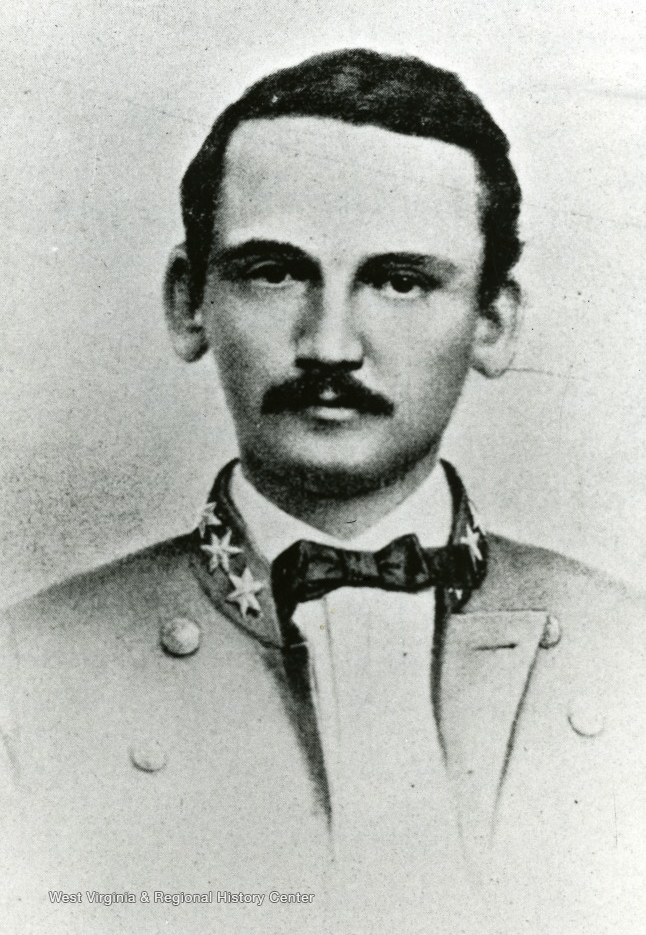
Portrait of John C. Higginbotham of Buchkannon. West Virginia & Regional History Center, Morgantown, WV
Soon after Virginia voted to secede, John Carleton Higginbotham (1842-1864), an 18-year-old student at Lynchburg College, returned home to fight for the Confederacy. His father, William Thomas Higginbotham (1821-1892), was a prominent landowner in Upshur County and owned nearly 10 percent of the county’s slaves. Higginbotham raised a company of mostly young men under the age of 23 called the Upshur Grays, and was unanimously elected their captain. Upshur County was predominantly unionist in sentiment, and the Upshur Grays was the only Confederate company recruited from that county.
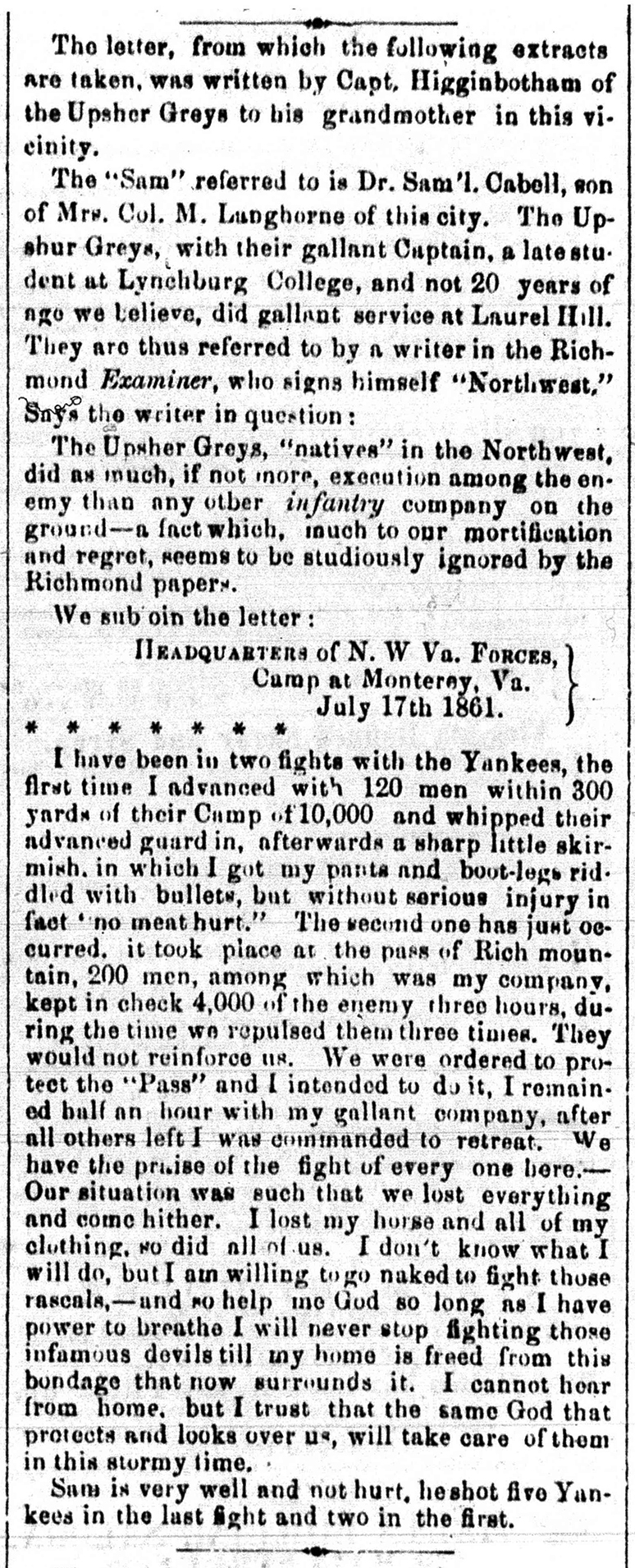
Higginbotham was slightly wounded at Rich Mountain and managed to evade capture with some of his men. He rose to the rank of brigadier general, but at the age of 21 was killed at the Battle of Spotsylvania before his commission reached him. Following the Battle of Rich Mountain, the Confederates in northwestern Virginia consolidated in Monterey, where Higginbotham wrote the following letter to his grandmother, who lived near Lynchburg. The letter was partially reprinted in the local newspaper, the Daily Virginian, on July 23, 1861 and has been cited many times by historians.
The Lynchburg Daily Virginian has not been digitized, however, and libraries with its microfilm reel are few and far between. I was able to obtain a scan of it from the very helpful William & Mary Libraries Research Department. The first fight Higginbotham alludes to is Middle Fork Bridge.
The letter, from which the following extracts are taken, was written by Capt. Higginbotham of the Upshur Greys to his grandmother in this vicinity.
The “Sam” referred to is Dr. Sam’l Cabell, son of Mrs. Col. M. Langhorne of this city. The Upshur Greys, with their gallant Captain, a late student at Lynchburg College, and not 20 years of age we believe, did gallant service at Laurel Hill [Rich Mountain]. They are thus referred to by a writer in the Richmond Examiner, who signs himself “Northwest.” Says the writer in question:
The Upshur Greys, “natives” in the Northwest, did as much, if not more, execution among the enemy than any other infantry company on the ground–a fact which, much to our mortification and regret, seems to be studiously ignored by the Richmond papers.
We subjoin the letter:
Headquarters of N.W. Va. Forces, Camp at Monterey, Va. July 17th 1861
I have been in two fights with the Yankees, the first time I advanced with 120 men within 300 yards of their Camp of 10,000 and whipped their advanced guard in, afterwards a sharp little skirmish, in which I got my pants and boot-legs riddled with bullets, but without serious injury in fact “no meat hurt.” The second one has just occurred. it took place at the pass of Rich Mountain, 200 men, among which was my company, kept in check 4,000 of the enemy three hours, during the time we repulsed them three times. They would not reinforce us. We were ordered to protect the “Pass” and I intended to do it, I remained half an hour with my gallant company, after all other left I was commanded to retreat. We have the praise of the fight of every one here.—Our situation was such that we lost everything and come hither. I lost my horse and all of my clothing, so did all of us. I don’t know what I will do, but I am willing to go naked to fight those rascals,—and so help me God so long as I have power to breathe I will never stop fighting those infamous devils till my home is freed from this bondage that now surrounds it. I cannot hear from home, but I trust that the same God that protects and looks over us, will take care of them in this stormy time.
Sam is very well and not hurt, he shot five Yankees in the last fight and two in the first.
Lynchburg Daily Virginian (Lynchburg, VA) 23 July 1861.
Michael Kleen is an author, raconteur, and occasional traveler. He has a M.A. in History and M.S. in Education. He enjoys studying military history, folklore, and philosophy.
View all posts by Michael Kleen

 Spirit of '61