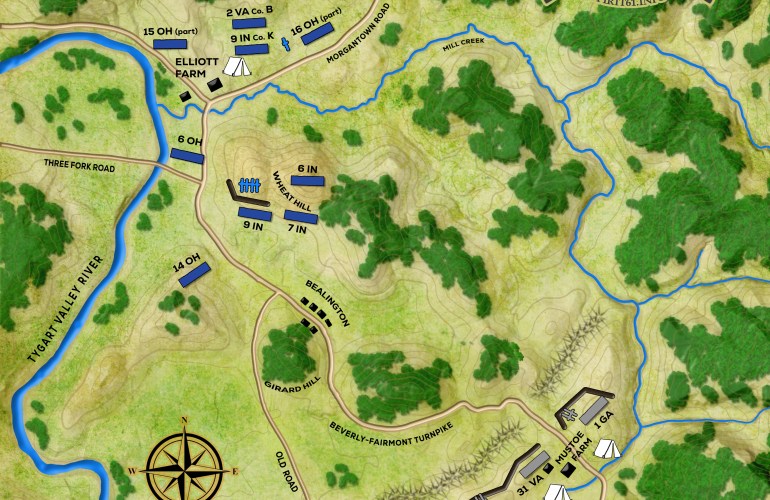

The Battle of Belington (Laurel Hill) was fought from Sunday, July 7 to Thursday, July 11, 1861 between Union forces commanded by Brig. Gen. Thomas A. Morris and Confederate forces commanded by Brig. Gen. Robert S. Garnett in what is today Barbour County, West Virginia. It involved around 8,000 Union and Confederate soldiers.
Last summer, I attempted to create a map of the battle, which as far as I’m aware, has never been done before, based on primary and secondary descriptions. Since then, I’ve learned new facts that forced me to make significant revisions. Most importantly, I discovered a hand-drawn map of the battlefield in the Cincinnati Daily Commercial that outlines the major landmarks and the positions of Union regiments.
It turns out that the village of Belington or Bealington (or Beelington as it was sometimes spelled), was not located along the Tygart River as it is today, but a little less than a mile southeast of there along the Beverly-Fairmont Turnpike. This shed a new light on everything else I had read. Suddenly, descriptions that seemed confusing made much more sense.
When looking at the Daily Commercial map, it’s important to note that it is from the Union perspective looking south and drawn from memory, so it’s not going to be 100% accurate. They did not have a bird’s eye view of the battlefield.
You can see the major roads and landmarks, including the hills that Union soldiers referred to as “Girard Hill” after Pvt. William T. Girard of the Ninth Indiana, who died early in the battle, and “Wheat Hill”.
William “Billy” Davis of the Seventh Indiana Regiment wrote in his journal:
“now at nine o’clock the left wing of the 7th is at a fence facing to the South East, while the right wing is at a fence behind us facing to the North west. Are all waiting in line. Can hear Bugle calls in Rebel camp and an occasional shot at the front. Belington lies to our right beyond the 9th on the Pike. In front of Belington is a coneshaped hill on right of road, densely covered with timber. On left of road and more directly in our front is another round hill also timbered. Our picket line is at or near the border of this timber. It was on the hill to right where Captain Moody lost the two men yesterday. The one killed was Wm. T. Girrard… the soldiers have named the hill for the hero.”
At the time he wrote this, the Seventh and Ninth Indiana must have been at an advanced position slightly east of Belington.
The map below is my best approximation of the battle based on all available sources. Unit positions are based on the Cincinnati Daily Commercial map, but of course they moved during the course of the battle. The Confederate regiments came out from behind their fortifications to skirmish in front of Belington. Union forces did not directly attack the fortifications on Laurel Hill.


 Spirit of '61
Thanks for posting the map. Always interested in posts about troops from Indiana.
LikeLiked by 1 person
Lots of Indiana troops in that campaign
LikeLike