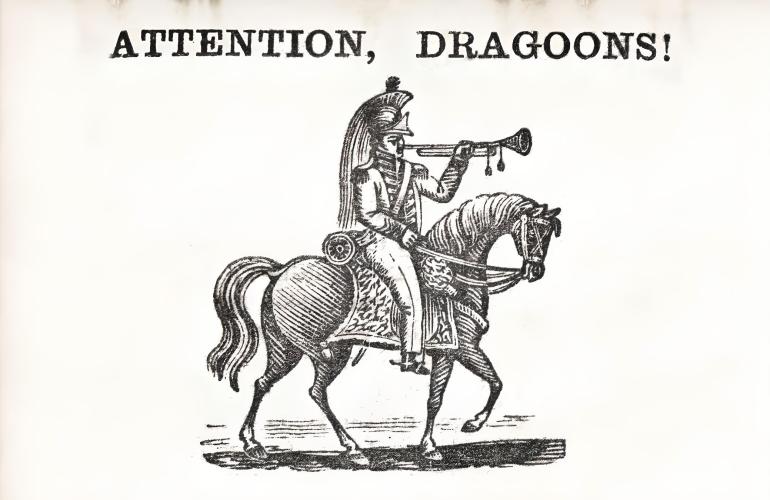
James Humbles, a freeman of mixed ancestry, served with distinction in the 1st Virginia Cavalry in 1861.
Spared & Shared has an extensive collection of transcribed Civil War Era letters across multiple websites. While searching for letters from 1861, I came across this one from Philip Henry Powers, 1st Virginia Cavalry, to his wife shortly after the Battle of Hoke’s Run. He mentions a Union soldier shot dead by “the only negro in our party”.
Any mention of a black Confederate soldier turns heads (for obvious reasons), and a debate has raged for decades about the validity of reports to that effect. We know Confederate soldiers brought slaves with them into the army. But a free black man standing shoulder to shoulder, fighting alongside white slave owners? It seems too incredible to be real.
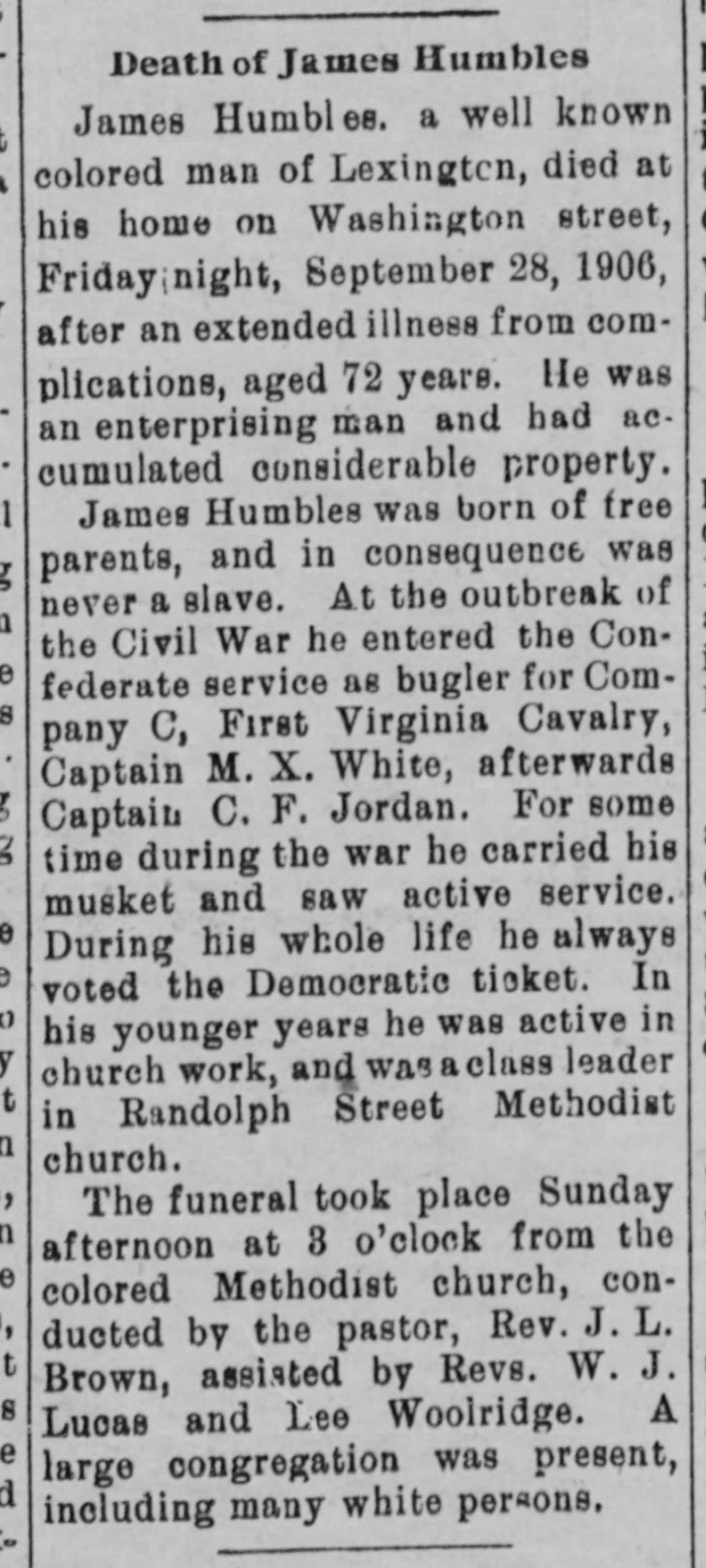
Enter James Humbles, a free “mulatto” from Lexington, Virginia who enlisted in the First Rockbridge Dragoons in April 1861. Mulatto was a term for a mixed-race person, usually black and white, but in Humbles’ case, he also had some American Indian ancestry. According to one obituary in the Rockbridge County News, he was “credited with having considerable Indian blood in his veins, and his complexion, manner and tall, spare, erect form indicated it.”
Humbles was born a freeman to free parents. There were 58,042 free people of color living in Virginia according to the 1860 census, among the largest free black population in the South. James Humbles worked as an engineer maintaining Lexington’s waterworks.
The unit’s enrollment officer did not believe he should be mustered into the unit, but evidently he was. Records show he joined the First Rockbridge Dragoons as a bugler. The First Rockbridge Dragoons became Company C, 1st Virginia Cavalry Regiment. It was led by Captain Matthew X. White and fought in the battles of Hoke’s Run and First Manassas. In his July 4, 1861 letter, Philip Henry Powers wrote:
“Col. Stuart instantly had us in the saddle and marched down to meet them keeping on their flank. Almost before we knew it, we came upon their lines. And finding one company of about fifty men detached and resting under a tree, we charged them, surrounded and captured every man of them except four who ran and were killed. One fellow was creeping away under cover of a fence when he was shot dead by the only negro in our party. However, we made a most narrow escape for we had hardly started our prisoners when a whole regiment of infantry came up to the place where this skirmish had taken place and pursued us. We were too fast for them and got off with all the prisoners, their arms and accoutrements.”
It wasn’t the only time Humbles took up arms. One obituary says he “booted and spurred and with sword in hand rode with the column” when his unit charged at First Manassas. He did not serve for the entire war. At some point he mustered out but continued to support his former unit by transporting supplies and provisions from back home.
After the war, Humbles remained a prominent resident of Lexington, operated several businesses, “accumulated considerable property,” and was active in the Methodist Church. In 1889, he was presented with two metal engravings honoring his Confederate service. His obituaries noted that he voted with the Democratic Party his entire adult life. He died on September 28, 1906 at the age of 72.
Like instances of women disguising themselves as men and serving in combat, James Humbles’ example was extremely rare, so its importance shouldn’t be exaggerated. However, it does show that history is nuanced, and the reality of life during the American Civil War was not as black and white as we often assume.
Sources
- Philip Henry Powers to Roberta Macky Smith, July 4, 1861.
- Staunton Vindicator (Staunton) 4 Jan 1889.
- Lexington Gazette (Lexington) 3 Oct 1906.
- Rockbridge County News (Lexington) 4 Oct 1906.
- Driver, Robert J., Jr. 1st Virginia Cavalry. Lynchburg: H.E. Howard, Inc., 1991.
- Williams, Richard G. Lexington, Virginia and the Civil War. Charleston, SC: The History Press, 2013.

 Spirit of '61
2 thoughts on “Who was James Humbles?”