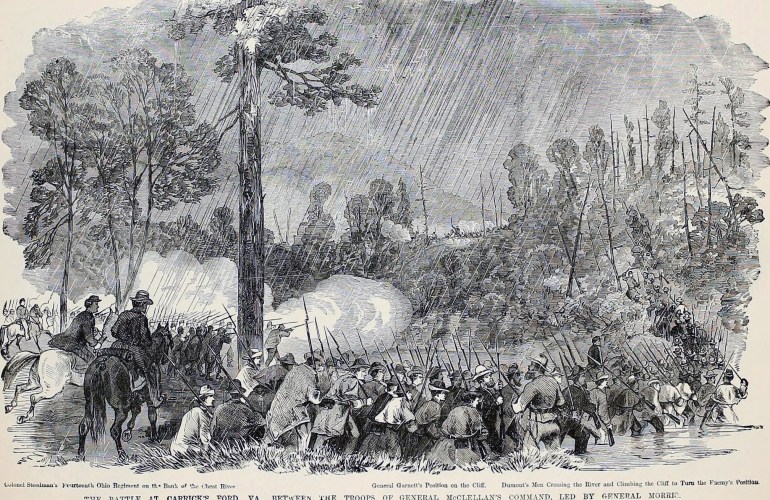
The following account of the death of Brig. Gen. Robert S. Garnett at Corrick's Ford on July 13, 1861 was written by Henry Clay Wheeler (1841-1924), Company E, 7th Indiana, who claimed to be among the party who fired at the general on that fateful day. It appeared in The National Tribune, a veterans' newspaper,…
Tag: primary sources
Governor Letcher’s 1861 Call to Arms: Uniting Virginia for the Confederacy
In June 1861, just weeks after Virginia’s secession from the Union, Governor John Letcher issued a fiery proclamation to the people of Northwestern Virginia—a region increasingly resistant to Confederate alignment. His message was clear: the time for debate was over, and unity under the Confederate cause was now a matter of duty and survival. John…
Continue reading ➞ Governor Letcher’s 1861 Call to Arms: Uniting Virginia for the Confederacy
Account of the Action at Pike’s Creek in the Diary of Anne S. Frobel
When a brief Civil War skirmish near Alexandria left two men dead, its aftermath sparked outrage on both sides. A Virginia woman’s diary captured the moment in gut-wrenching detail. Before sunrise on the morning of Sunday, June 30, 1861, a brief but deadly clash unfolded just southwest of Alexandria, Virginia, where Confederate scouts encountered Union…
Continue reading ➞ Account of the Action at Pike’s Creek in the Diary of Anne S. Frobel
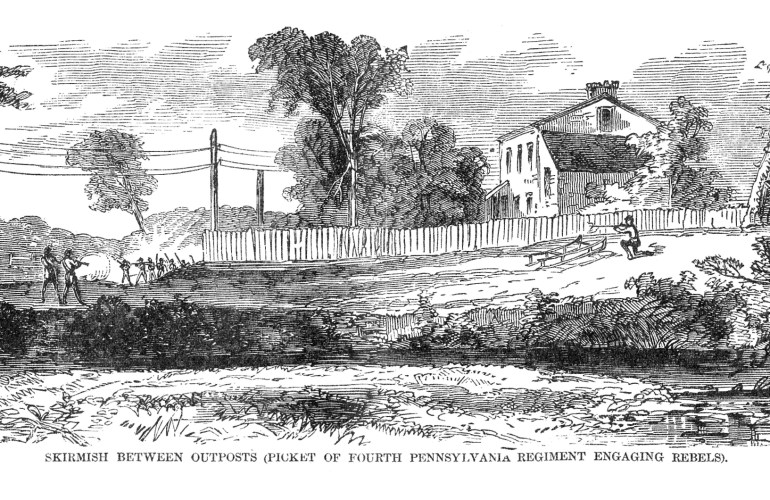
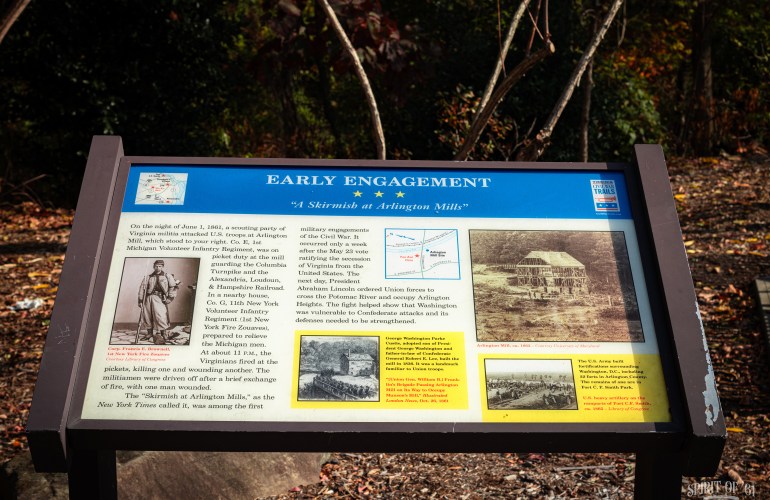
Which Mills? Decoding an Early Civil War Skirmish
Did the so-called "Skirmish at Arlington Mills" really happen? Learn how a simple newspaper error sparked a century-long myth about one of the Civil War’s first land engagements. Primary sources reveal conflicting accounts, misidentified locations, and a puzzling lack of Confederate testimony—raising questions about how historical narratives take shape and why verifying sources is essential…
Continue reading ➞ Which Mills? Decoding an Early Civil War Skirmish
A PROCLAMATION BY THE GOVERNOR OF VIRGINIA
John Letcher, governor of Virginia, 1860–1864. Library of Congress Prints and Photographs Division The following proclamation by the Virginia governor, John Letcher (1813-1884), appeared in the Richmond Whig, Thursday, April 18, 1861, as well as other newspapers around the state in response to U.S. President Abraham Lincoln's calling for a volunteer army to suppress the…
Continue reading ➞ A PROCLAMATION BY THE GOVERNOR OF VIRGINIA
“No Meat Hurt”: Letter from John C. Higginbotham
Portrait of John C. Higginbotham of Buchkannon. West Virginia & Regional History Center, Morgantown, WV Soon after Virginia voted to secede, John Carleton Higginbotham (1842-1864), an 18-year-old student at Lynchburg College, returned home to fight for the Confederacy. His father, William Thomas Higginbotham (1821-1892), was a prominent landowner in Upshur County and owned nearly 10…
Continue reading ➞ “No Meat Hurt”: Letter from John C. Higginbotham
New Issue of Frank Leslie’s Illustrated Newspaper
Frank Leslie's Illustrated Newspaper was published in New York from 1855 to 1922 and produced many volumes of compiled illustrated histories of the American Civil War. Its correspondents and illustrators got close to the action, so close, in fact, that one of their freelance correspondents, James R. O'Neill, was killed during the Battle of Baxter…
Continue reading ➞ New Issue of Frank Leslie’s Illustrated Newspaper
What Happened at Poca? Unpacking the Truth
Was the skirmish at the mouth of the Pocatalico River on July 16, 1861 a bold cavalry charge or blown out of proportion? Conflicting accounts tell vastly different tales, leaving us to sift through exaggerations and incomplete records to understand what really happened in this lesser-known prelude to the Battle of Scary Creek. A dramatic…
Continue reading ➞ What Happened at Poca? Unpacking the Truth
Clash at Red House: Friendly Fire or Something More?
The incident near Red House not only serves as a lesson in the hazards of nineteenth-century warfare but also underscores the importance for historians of cross-referencing newspaper reports with multiple sources. It was shortly after sundown on July 14, 1861. The Ohio longshoremen and steamboat crewmen of the 1st Kentucky Infantry Regiment (U.S.) were packed…
Continue reading ➞ Clash at Red House: Friendly Fire or Something More?
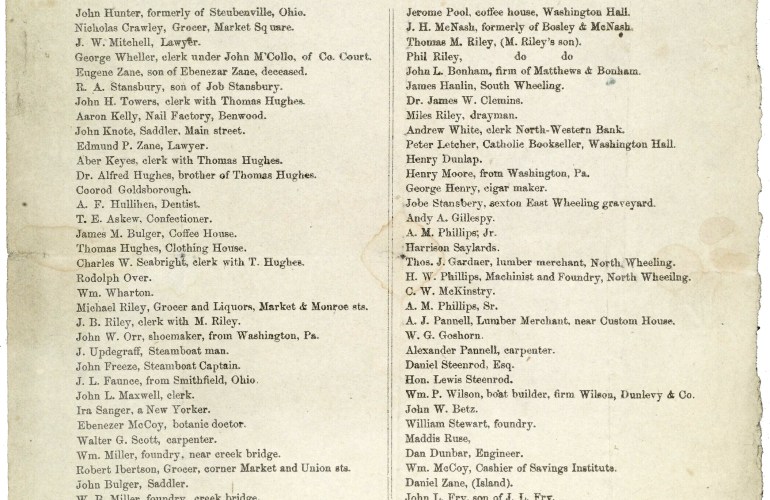
Artifact: Traitors in Wheeling
The town of Wheeling, located along the Ohio River in what was then the Virginia panhandle (today, West Virginia), was Virginia’s fourth largest city in 1860. Sandwiched between the free states of Ohio and Pennsylvania, it was largely populated by German immigrants with no affinity for Virginia’s Anglo-American planter class. When the Secession Convention in…