Union forces captured several flags at Philippi on June 3, 1861, but accounts vary regarding how many were taken, who they belonged to, what they looked like, and where they are now. One often-overlooked flag belonged to the Bath Cavalry, also known as the Bath Grays, a company raised in the mountainous region of Bath…
Author: Michael Kleen
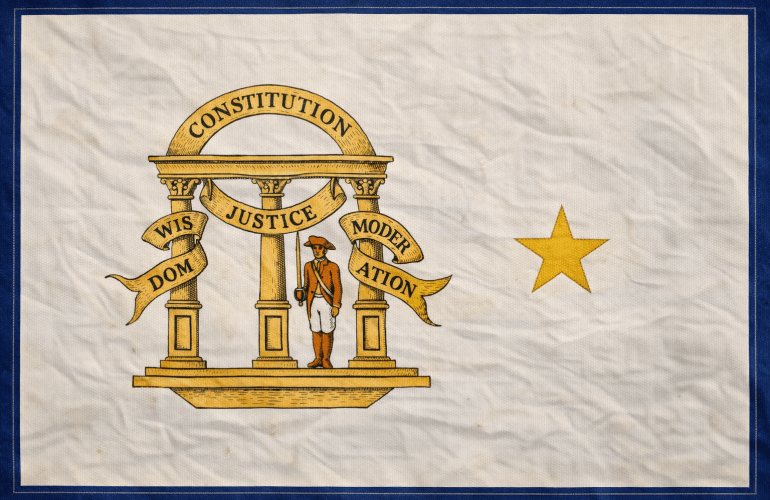
Flag of the First Georgia Regiment (Ramsey’s)
In 1905, Congress passed a resolution directing the War Department to return captured Confederate flags to their respective states. The United Confederate Veterans published a record of these flags called The Flags of the Confederate Armies, containing colorized photographs and short descriptions of the units that bore them in battle. Among them was the regimental…
Continue reading ➞ Flag of the First Georgia Regiment (Ramsey’s)
An Eyewitness Gives His Version of the Killing of Brig. Gen. Robert S. Garnett in the National Tribune
The following account of the death of Brig. Gen. Robert S. Garnett at Corrick's Ford on July 13, 1861 was written by Henry Clay Wheeler (1841-1924), Company E, 7th Indiana, who claimed to be among the party who fired at the general on that fateful day. It appeared in The National Tribune, a veterans' newspaper,…
Preview of our Interview with Dr. Alexander B. Rossino, Author of Six Days in September: A Novel of Lee’s Army in Maryland
A resident of Boonsboro, Maryland, Dr. Alexander B. Rossino earned his PhD in History at Syracuse University. In addition to being a frequent public speaker about Civil War history and regular contributor to Civil War News Magazine, Dr. Rossino is also the author of several books and articles, including Their Maryland: The Army of Northern…
Our Substack is Now Live
Why Substack? Our digital encyclopedia will always remain free, but offering a subscription service with additional research, data, and early access content will help to: Fund the operation and expansion of our digital encyclopedia. Allow us to add more storage space and native video support. Offer high-resolution scans of Civil War era publications like these.…
A Tale of Two Governors
During the American Civil War, Virginians found themselves divided not only by ideology and geography, but by government itself. From 1861 to 1864, two men, John Letcher and Francis Pierpont, each claimed to be the legitimate governor of Virginia. One led the Confederate state government from Richmond, while the other presided over the Unionist Reorganized…
A Richmond Unionist Witnesses Secession
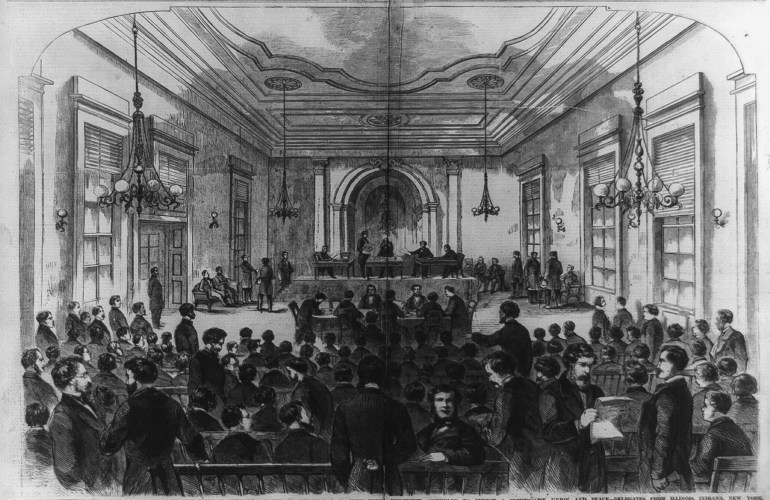
As Richmond erupted in celebration following Virginia’s vote to secede, one woman watched in silence--troubled, not triumphant. Elizabeth Van Lew's eyewitness account offers a rare, critical perspective on the fevered early days of the Confederacy. On Wednesday, April 17, 1861, at 10:00 a.m., 143 delegates from across the Commonwealth of Virginia gathered in the neoclassical…
Map and Overview of the Chesapeake front
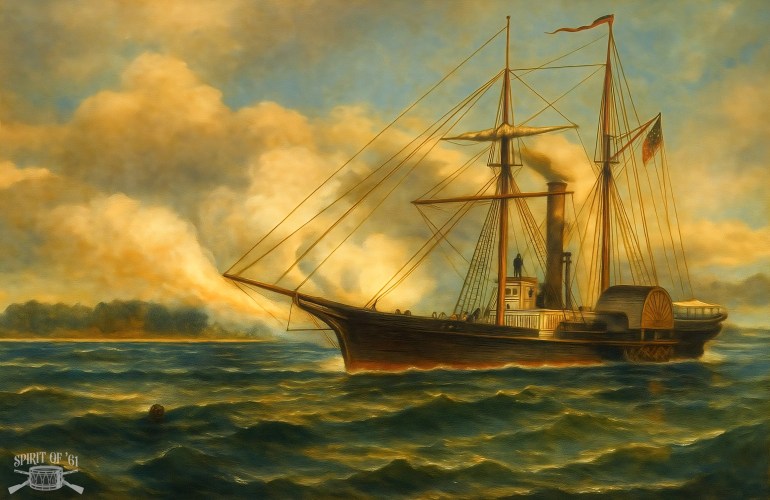
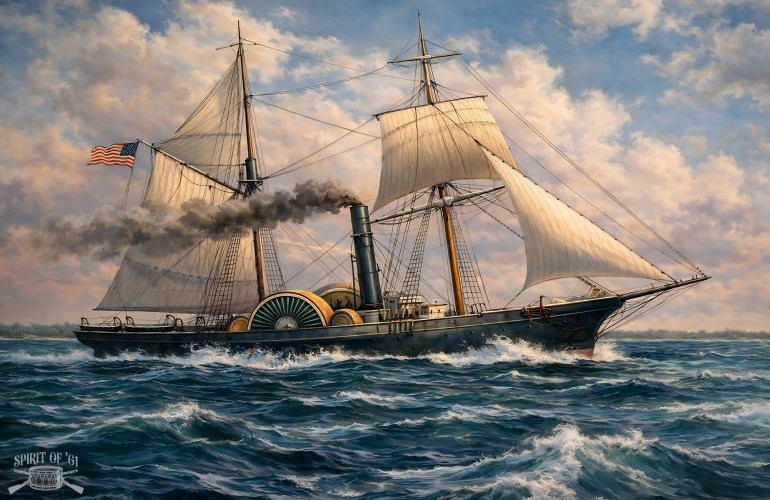
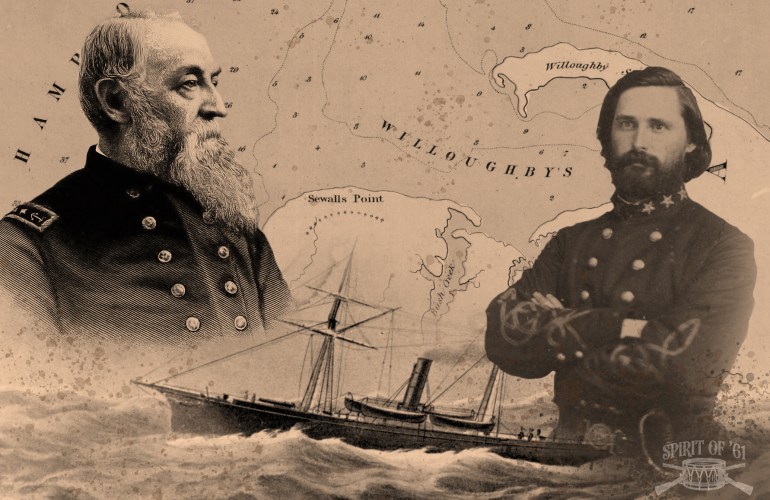
The Chesapeake Bay, a defining feature of Virginia's maritime border, stretches approximately 200 miles south from the mouth of the Susquehanna River in Maryland to Cape Henry and Cape Charles, Virginia. It is the largest estuary in the United States, providing an important avenue for domestic and international trade and commercial fishing. The 170-mile long…
The Battle of Rich Mountain, Part 1 (1999 Reenactment Video)
https://www.youtube.com/watch?v=n_-ygaZqJ6I I recently stumbled upon this amateur video taken at a reenactment of the July 11, 1861 Battle of Rich Mountain in what is today Randolph County, West Virginia. The video features an interview with Phyllis Baxter of the Rich Mountain Battlefield Foundation and some of the reenactors, as well as footage of the skirmish.…
Continue reading ➞ The Battle of Rich Mountain, Part 1 (1999 Reenactment Video)
Fort Pocahontas: Jamestown Island’s Forgotten Confederate Stronghold
In the early days of the Civil War, as Virginia seceded and Confederate forces rushed to secure key positions across the state, Jamestown Island—better known as the birthplace of English America—was drawn into the conflict. Between April and July 1861, the Confederacy quickly turned Jamestown Island’s strategic position on the James River into a forward…
Continue reading ➞ Fort Pocahontas: Jamestown Island’s Forgotten Confederate Stronghold