Photo by M.A. Kleen, Spirit61.info

Previous Belington / Laurel Hill Research

The Battle of Belington / Laurel Hill was fought from Sunday, July 7 to Thursday, July 11, 1861 between Union forces commanded by Brig. Gen. Thomas A. Morris and Confederate forces commanded by Brig. Gen. Robert S. Garnett in what is today Barbour County, West Virginia. It involved around 8,000 Union and Confederate soldiers. Over…

Divided Ground: Buckhannon’s Unionists Face a Confederate Incursion

On June 27, 1861, a Confederate foraging expedition descended on the unionist town of Buckhannon, scattering civilians and briefly seizing vital supplies along the Staunton-Parkersburg Turnpike. Though a small clash, the raid and the rumors it sparked pushed George B. McClellan to launch his campaign against Robert S. Garnett, setting the stage for the fight…

The Union, Right or Wrong: Preston and Monongalia Counties Choose a Side

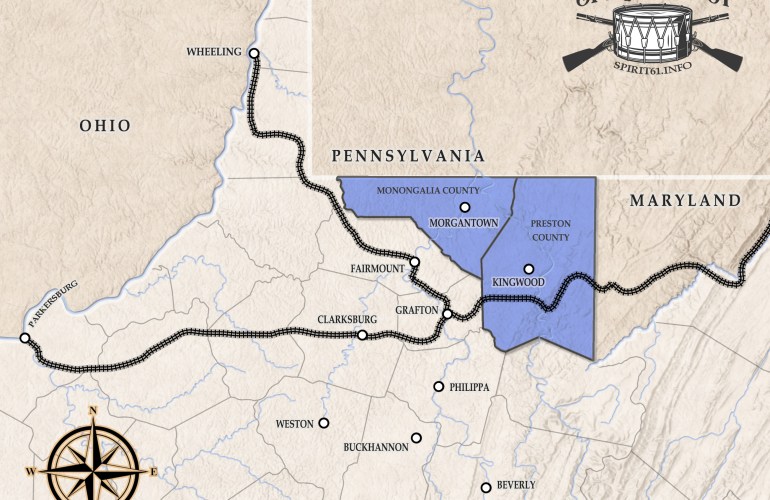
During the critical period of April-May 1861, Preston and Monongalia counties, in what was then northwestern Virginia, remained firmly in the Union camp. Both counties shared a northern border with Pennsylvania and, unlike their southern neighbors, organized no Confederate volunteer companies, though a few individuals may have enlisted in the Southern cause. Slavery was rare,…

Irregular War in Northwestern Virginia: Captain Cable’s Raid on Righter’s House

In June 1861, as Union forces secured the B&O Railroad after the rout at Philippi, a nighttime raid on a secessionist militia at Righter’s House erupted into violence and fiery retribution. The clash at Coon Run reveals how the fight for strategic ground in northwestern Virginia quickly devolved into a bitter war between neighbors. Following…

The Philippi Races: How a Rain-Soaked Surprise Secured Northwestern Virginia

In a rain-soaked dawn attack at Philippi, Union columns under Benjamin Kelley and Ebenezer Dumont scattered Col. George A. Porterfield’s inexperienced command, sending it fleeing in what became known as the “Philippi Races.” The brief fight secured the B&O lifeline and shattered secessionist momentum in northwestern Virginia at the very outset of the war. Events…

Second Virginia Infantry Regiment (U.S.)

From May to July 1861, the Second Virginia Infantry (U.S.) did not operate as a cohesive regiment. Instead, several of its companies acted independently in support of Maj. Gen. George B. McClellan’s campaign to secure northwestern Virginia and the Baltimore & Ohio (B&O) Railroad for the Union. The regiment did not fully come together until…

The Road to Philippi: Glover’s Gap and the Fight for the B&O Railroad in Northwestern Virginia

In the tense weeks following Virginia’s secession vote, rival unionist and secessionist forces in northwestern Virginia maneuvered for control of the Baltimore & Ohio Railroad. Skirmishes at Fetterman and Glover’s Gap produced some of the war’s earliest casualties and set the stage for the opening of McClellan's campaign in the region. On April 17, 1861,…

Photo by M.A. Kleen, Spirit61.info

First Blood in Western Virginia: Secession, Divided Loyalties, and the Death of Thornsbury Bailey Brown

In the tense weeks following the April 17, 1861 secession vote, communities across northwestern Virginia divided sharply as unionists and secessionists began organizing. The killing of Thornsbury Bailey Brown at Fetterman Bridge in May, often considered the first Union soldier killed in combat during the Civil War, showed how quickly the political crisis was spiraling…

Ancestral Findings Podcast – The Shot Heard in Philippi

I recently came across this neat episode of the Ancestral Findings Podcast focusing on Matilda Humphrey, the civilian who fired the first shots on the morning of June 3, 1861, alerting Porterfield's command and likely preventing an even worse disaster for the secessionists. It shows how seemingly small, unforeseen events can have major consequences in…