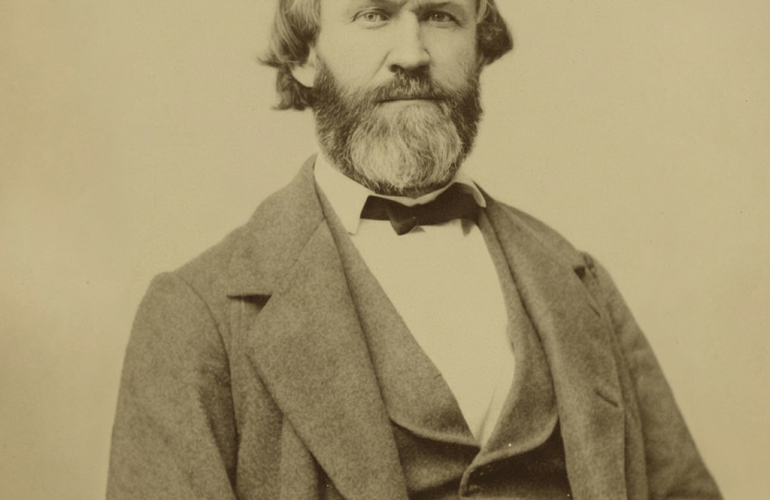
At the beginning of April, after only one month in office, President Abraham Lincoln (via Secretary of State William H. Seward) requested an urgent meeting with George W. Summers, a former Congressman from Kanawha County and leader among the unionists at the Virginia Convention in Richmond. Seward sent attorney Allan B. Magruder, brother of “prince John” Magruder, who was then commanding the defenses of Washington, DC., to Richmond to request Summers or another unionist representative accompany him back to the White House.
Summers sent John Brown Baldwin of Augusta County in his stead. Magruder and Baldwin arrived in DC on the morning of Thursday, April 4, 1861. Baldwin met with President Lincoln alone. On February 10, 1866, he testified before the Congressional Joint Committee on Reconstruction, clarifying the contents of their conversation, to the best of his recollection.
The meeting took place in Lincoln’s bedroom. Baldwin was taken aback when Lincoln suggested he had arrived “too late” and urged that the Virginia Convention be adjourned indefinitely, calling it a “standing menace.” Baldwin strongly countered this, arguing that the convention had a commanding unionist majority that was working to prevent secession. He warned the President that dissolving the convention would be seen as a failure by the unionists, leading to the formation of a new, secessionist-controlled convention that would promptly vote to leave the Union.
Baldwin implored President Lincoln to adopt a conciliatory policy to support Virginia’s unionists. He proposed a detailed plan for peace: Lincoln should issue a proclamation calling for a national convention to settle the disputes through votes rather than arms. To create a peaceful environment for this, Baldwin suggested a temporary withdrawal of forces from Fort Sumter and Fort Pickens as a gesture of goodwill.
He delivered a solemn and dire warning, stating with certainty that if a single gun were fired at Fort Sumter, the cause was lost, and Virginia would secede within forty-eight hours. He believed Lincoln had a brief window, no more than two weeks, to act and save the nation. Ultimately, Baldwin left the meeting with no pledge or promise from the President, only a sense of his own earnest attempt to avert the coming conflict.
The following is an excerpt of his testimony. It has been broken it up into smaller paragraphs for ease of reading. Sine die is a Latin phrase meaning “without day,” used to signify the final adjournment of a legislative session or legal proceeding without setting a date to reconvene. It marks the end of the session, usually resulting in the termination of any pending business.
Said he [Lincoln], “Why do you not all adjourn the Virginia Convention?”
Said I, “Adjourn it!—how? do you mean sine die?”
“Yes,” said he, “sine die; why do you not adjourn it; it is a standing menace to me, which embarrasses me very much.” Of course you will understand that I do not pretend to recollect the language at all, but this is about the substance of it.
Said I, “Sir, I am very much surprised to hear you express that opinion; the Virginia Convention is in the hands of Union men; we have in it a clear and controlling majority of nearly three to one; we are controlling it for conservative results; we can do it with perfect certainty, if you will uphold our hands by a conservative policy here. I do not understand why you want a body thus in the hands of Union men to be dispersed, or why you should look upon their sessions as in any respect a menace to you; we regard ourselves as co-operating with you in the objects which you profess to seek; besides,” said I, “I would call your attention to this view: If we were to adjourn that Convention sine die, leaving these questions unsettled in the midst of all the trouble that is on us, it would place the Union men of Virginia in the attitude of confessing an inability to meet the occasion; the result would be, that another Convention would be called as soon as legislation could be put through for the purpose.”
**Question.—** Was the Legislature of Virginia then in session in the same city, Richmond?
**Answer.—** Yes, sir; that is my impression. Said I, “As soon as the necessary legislation can be gotten through, another Convention would be called, and the Union men of Virginia could not, with a proper self-respect, offer themselves as members of that Convention, having had the full control of one, and having adjourned without having brought about any sort of settlement of the troubles upon us. The result would be, that the next Convention would be exclusively under the control of secessionists, and that an ordinance of secession would be passed in less than six weeks. Now, said I, sir, it seems to me that our true policy is to hold the position that we have, and for you to uphold our hands by a conservative, conciliatory, national course. We can control the matter, and will control it if you help us. And, sir, it is but right for me to say another thing to you, that the Union men of Virginia, of whom I am one, would not be willing to adjourn that Convention until we either effect some settlement of this matter or ascertain that it cannot be done. As an original proposition, the Union men of Virginia did not desire amendments to the Constitution of the United States; we were perfectly satisfied with the constitutional guarantees that we had, and thought our rights and interests perfectly safe. But circumstances have changed; seven States of the South, the cotton States, have withdrawn from us and have left us in an extremely altered condition in reference to the safe-guards of the Constitution. As things stand now, we are helpless in the hands of the North. The balance of power which we had before for our protection against constitutional amendment is gone. And we think now that we of the border States who have adhered to you against all the obligations of association and sympathy with the Southern States, have a claim on the States of the North which is of a high and very peculiar character. You all say that you do not mean to injure us in our peculiar rights. If you are in earnest about it there can be no objection to your saying so in such an authentic form as will give us constitutional protection. And we think you ought to do it, not grudgingly, not reluctantly, but in such a way as that it would be a fitting recognition of our fidelity in standing by you under all circumstances—fully, and generously, and promptly. If you will do it in accordance with what we regard as due to our position, it will give us a stand-point from which we can bring back the seceded States.”
I cannot follow the conversation through; but he asked me the question, “What is your plan?”
Said I, “Mr. President, if I had the control of your thumb and forefinger five minutes I could settle the whole question.”
“Well,” said he, “that would seem to be a simple process.”
Said I, “I can settle it as surely as there is a God in heaven, if you just give me the control of your thumb and forefinger five minutes. To let you understand how earnestly I believe it, as God is my Judge, if I could get the control of that thumb and forefinger for five minutes, I would be willing, unless my weak flesh should fail me, that you should take me out within the next five minutes and knock me on the head on Pennsylvania avenue.”
“Well,” said he, “what is your plan?”
Said I, “Sir, if I were in your place I would issue a proclamation to the American people, some what after this style: I would state the fact that you had become President of the United States as the result of a partisan struggle partaking of more bitterness than had usually marked such struggles; that, in the progress of that struggle, there had naturally arisen a great deal of misunderstanding and misrepresentation of the motives and intentions of both sides; that you had no doubt you had been represented, and to a large extent believed, to be inimical to the institutions and interests and rights of a large portion of the United States, but that, however, you might, in the midst of a partisan struggle, have been more or less (as all men) excited at times, occupying the position of President of the United States, you had determined to take your stand on the broad platform of the general Constitution, and to do equal and exact justice to all, without regard to party or section; and that, recognizing the fact without admitting the right, but protesting against the right, that seven States had undertaken to withdraw themselves from the Union, you had determined to appeal to the American people to settle the question in the spirit in which the Constitution was made—American fashion—by consultation and votes instead of by appeal to arms. And I would call a national convention of the people of the United States and urge upon them to come together and settle this thing. And in order to prevent the possibility of any collision or clash of arms interfering with this effort at a pacific settlement, I would declare the purpose (not in any admission of want of right at all, but with a distinct protest of the right, to place the forces of the United States wherever in her territory you choose) to withdraw the forces from Sumter and Pickens, declaring that it was done for the sake of peace, in the effort to settle this thing; and that you were determined, if the seceded States chose to make a collision, that they should come clear out of their way and do it. Sir, said I, if you take that position there is national feeling enough in the seceded States themselves and all over the country to rally to your support, and you would gather more friends than any man in the country has ever had.”
He said something or other, I do not recollect what, but it created the impression upon me that he was looking with some apprehension to the idea that his friends would not be pleased with such a step, and I said to him, “Mr. President, for every one of your friends whom you would lose by such a policy you would gain ten who would rally to you and to the national standard of peace and Union.”
Said he, rather impatiently, “That is not what I am thinking about. If I could be satisfied that I am right, and that I do what is right, I do not care whether people stand by me or not.”
Said I, “Sir, I beg your pardon, for I only know of you as a politician, a successful politician; and possibly I have fallen into the error of addressing you by the motives which are generally potent with politicians, the motive of gaining friends. I thank you that you have recalled to me the higher and better motive, the motive of being right; and I assure you that, from now out, I will address you only by the motives that ought to influence a gentleman.”
**Question.—** You drew a distinction between a politician and a gentleman?
**Answer.—** Yes, sir; he laughed a little at that. He said something about the withdrawal of the troops from Sumter on the ground of military necessity.
Said I, “that will never do, under heaven. You have been President a month to-day, and if you intended to hold that position you ought to have strengthened it so as to make it impregnable. To hold it in the present condition of force there is an invitation to assault. Go upon higher ground than that. The better ground than that is to make a concession of an asserted right in the interest of peace.”
“Well,” said he, “what about the revenue? What would I do about the collection of duties?”
Said I, “Sir, how much do you expect to collect in a year?”
Said he, “Fifty or sixty millions.”
“Why, sir,” said I, “four times sixty is two hundred and forty. Say $250,000,000 would be the revenue of your term of the presidency; what is that but a drop in the bucket compared with the cost of such a war as we are threatened with? Let it all go, if necessary; but I do not believe that it will be necessary, because I believe that you can settle it on the basis of a suggestion.”
He said something or other about feeding the troops at Sumter.
I told him that would not do. Said I, “You know perfectly well that the people of Charleston have been feeding them already. That is not what they are at. They are asserting a right. They will feed the troops, and fight them while they are feeding them. They are after the assertion of a right. Now, the only way that you can manage them is to withdraw from them the means of making a blow until time for reflection, time for influence which can be brought to bear, can be gained, and settle the matter. If you do not take this course, if there is a gun fired at Sumter—I do not care on which side it is fired—the thing is gone.”
“Oh,” said he, “sir, that is impossible.”
Said I, “Sir, if there is a gun fired at Sumter, as sure as there is a God in heaven the thing is gone. Virginia herself, strong as the Union majority in the Convention is now, will be out in forty-eight hours.”
“Oh,” said he, “sir, that is impossible.”
Said I, “Mr. President, I did not come here to argue with you; I am here as a witness. I know the sentiments of the people of Virginia, and you do not. I understood that I was to come here to give you information of the sentiments of the people, and especially of the sentiments of the Union men of the Convention. I wish to know before we go any further in this matter, for it is of too grave importance to have any doubt of it, whether I am accredited to you in such a way as that what I tell you is worthy of credence.”
Said he, “You come to me introduced as a gentleman of high standing and talent in your State.”
Said I, “That is not the point I am on. Do I come to you vouched for as an honest man, who will tell you the truth?”
Said he, “You do.”
“Then,” said I, “sir, I tell you, before God and man, that if there is a gun fired at Sumter this thing is gone. And I wish to say to you, Mr. President, with all the solemnity that I can possibly summon, that if you intend to do anything to settle this matter you must do it promptly. I think another fortnight will be too late. You have the power now to settle it. You have the choice to make, and you have got to make it very soon. You have, I believe, the power to place yourself up by the side of Washington himself, as the savior of your country, or, by taking a different course of policy, to send down your name on the page of history notorious forever as a man so odious to the American people that, rather than submit to his dominations, they would overthrow the best government that God ever allowed to exist. You have the choice to make, and you have, in my judgment, no more than a fortnight to make it in.”
That is about as much as I can gather out of the conversation now. I went to Alexandria that night, where I had telegraphed an acceptance of an invitation to make a Union speech, and made a speech to a large audience, which, I believe, was the last Union speech made in Virginia before the war; and I went on to Richmond and reported to those gentle-men.
John M. Botts, who would have his own conference with the President a few days later, claimed Lincoln had made an offer to Baldwin, in effect, to exchange Virginia’s loyalty for the evacuation or surrender of Fort Sumter in South Carolina. Baldwin denied this, saying he received “No pledge; no undertaking; no offer; no promise of any sort … I am as clear in my recollection as it is possible under the circumstances that he made no such suggestion.”
Judge Henry W. Thomas, George W. Summers, Alexander H. H. Stuart (Baldwin’s brother-in-law), Samuel Price (first lieutenant governor of West Virginia), and attorney Robert Whitehead all wrote letters testifying to the accuracy of Baldwin’s account, closely matching what he told them shortly after returning from his meeting with the President.
Following Virginia’s vote to secede, John Baldwin supported the Confederacy. He served briefly as colonel of the 52nd Virginia Infantry and later as a representative to the First Confederate Congress.
Discussion
Why do you think President Lincoln told Baldwin, “I am afraid you have come too late”? What did he mean by this, and what does it reveal about his perspective on the crisis?
Baldwin argued that adjourning the Virginia Convention would backfire and lead to secession. Do you find his reasoning persuasive? Explain why or why not, using evidence from his testimony.
Describe the plan that Baldwin proposed to President Lincoln. What were its key components, and what was he trying to achieve with it? Do you think it was a realistic plan at that point in history?
Baldwin describes his own memory as not being good with literal details but strong in recalling the “substance and the result.” How does this self-assessment affect your view of his testimony’s reliability?
Despite his strong unionist stance in this meeting, John Baldwin later served the Confederacy. What might have caused him to change his allegiance after Virginia seceded? Does his later service affect how you view his testimony about trying to prevent the war?
If Lincoln had made an offer to evacuate Fort Sumter in exchange for Virginia’s loyalty, as Botts claimed, should Baldwin have taken that deal? What might have been the consequences for Virginia and for the nation?
Sources
Baldwin, John Brown, et al. Interview Between President Lincoln and Col. John B. Baldwin, April 4th, 1861: Statements & Evidence. Staunton: “Spectator” Job Office, 1866.
Hildebrand, John R. The Life and Times of John Brown Baldwin 1820-1873: A Chronicle of Virginia’s Struggle with Slavery, Secession, Civil War, and Reconstruction. Staunton: Augusta County Historical Society, 2008.

 Spirit of '61