As 1861 dawned, the secession crisis was boiling over. South Carolina, Mississippi, Florida, Alabama, Georgia, Louisiana, and Texas had adopted resolutions declaring themselves free and independent states, and they met in Montgomery, Alabama to form a provisional government. Fire-eaters in Virginia agitated for the Old Dominion to join them. Virginia Governor John Letcher called the state legislature into special session in January, and over his objections, the legislature organized a state convention to be held in Richmond.
On February 4, as a peace conference organized by former U.S. President John Tyler and Governor Letcher opened in Washington, DC, Virginia voters headed to the polls to elect delegates to the Richmond Convention. This body of 152 men would debate, among other issues, secession from the United States.
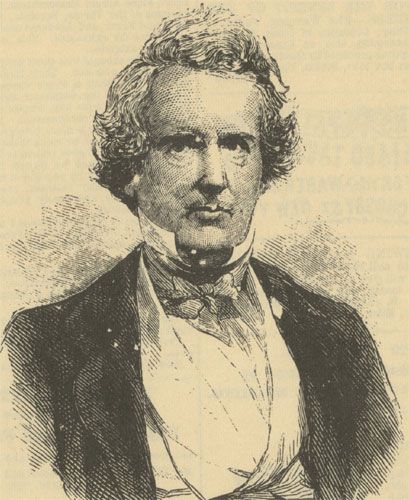
The delegates who met at noon on Wednesday, February 13, in the Mechanics Institute at Capitol Square in Richmond were, by a majority, conservative or conditional unionists who distrusted Abraham Lincoln but supported remaining in the Union. They elected 62-year-old John Janney (1798-1872) from Loudoun County as convention president. Janney, a former Whig, had helped found the Constitutional Union Party, which won a slim plurality of Virginia’s popular vote in the 1860 election. He was born into a Quaker family and held conflicting views on slavery. A slave owner himself, he once helped write a bill to abolish slavery in Virginia and supported repatriating free people of color to Africa.
A transcript of Janney’s acceptance speech follows. In it, he praised Rhode Island for expunging a statute “that which her own wisest and best citizens say is a disgrace to it.” While he failed to explain further, I believe he was referring to Rhode Island’s January 25, 1861, repeal of its personal liberty law (originally passed in 1848 and amended in 1854), which attempted to undermine the Fugitive Slave Act and hamper efforts to return escaped slaves. Rhode Island, which had sent delegates to the Washington Peace Conference, was attempting to appease Southern states into remaining in the Union.
“Gentlemen of the Convention, I did not realize the fact until within the last two hours that I might probably be called to this position, and I have, therefore, none of the products of my head to give you. But my heart is full, and from that pardon me for addressing you very briefly.
“I tender you my cordial and sincere thanks for the honor you have conferred upon me, and not only upon me, but upon the county which I in part represent here, in calling me to preside over the deliberations of this, by far the most important, Convention that has assembled in this Commonwealth since the year ’76.
“Gentlemen, I am without experience–I am without knowledge of parliamentary law, or the rules of order which govern bodies of this sort, and have, therefore, nothing in return for your kindness to promise you but fidelity and impartiality. Errors, I know, I must commit, but as they shall be errors of the head and not of the heart, in your kindness I shall find an excuse for them, and in the wisdom of this body their prompt correction.
“It is now, gentlemen, seventy-three years since a Convention of the people of this Commonwealth was assembled in this hall for the purpose of ratifying the Constitution of the United States, and one of the main objects of that instrument was to consolidate, not the Government, but the Union of these States. Causes which I do not mean to enumerate, causes which have passed and are daily passing into a history, which will set its seal upon them all, have brought that Constitution and this Union into imminent peril, and Virginia has come to-day to the rescue of them; and well she might. It is what the whole country expected at her hands, because that Constitution and that Union are two of the many proud monuments of her own glory. Her honored son who lies at Mount Vernon, the political Mecca of all future ages, was the President of the body that framed it; and another of her illustrious sons whose brow wore the crown with the civic wreath that will never fade, and who lies now in the county of Orange. was the chief architect of that instrument, and five of her own native sons have been called to the chief magistracy of the Government which they aided in founding. It cannot be then, gentlemen, that a government thus founded, thus administered by our own sons, can now be permitted to fall without bringing either reproach upon the wisdom of its founders, or upon our own virtue, intelligence and patriotism.
“Gentlemen, there is an old flag, the flag of the Union, which has been borne in triumph now for nearly a century through the battle and the breeze, and that flag now floats over this Capitol, with a star upon it representing this ancient Commonwealth of ours. God grant that it may remain there for ever, and I am sure that I but utter the sentiments of every man in this body, when I utter from the bottom of my heart that prayer. But, gentlemen, it must remain there with its crowning lustre undimmed and untarnished. We shall ask here for all the rights, and all the privileges, and full equality with the citizens of the Empire States of New York, Pennsylvania and Ohio; but in doing that we will scorn to demand one jot or tittle more than we are willing cheerfully to concede to the citizens of our little sister States, Delaware and Rhode Island. Rhode Island! Heaven bless her–a little State with a heart big enough for a whole Continent; and I pray God that the example which she set but the other day may be followed, and rapidly followed, by all her sisters of the North.
“Gentlemen, the responsibility resting upon this body is an awful one. When I agreed to be a candidate for this Convention–when I said to my constituents, if it was their pleasure to give to me their unsolicited suffrages for a seat in this body, I would serve them–I said it with fear and trembling. The people have said they will revise our work; but still, the consequences of our action here, although subject to that revision, may be full of good or full of evil. We may, I trust–and I trust in God we shall–to conduct our measures here, and bring them to such a conclusion, as that some of our sister States of the South who, for what they believe to be just cause, have wandered a little from their orbits, may be brought back into the old constellation, to give and receive light to and from their old sisters. I am not without hope that even old Massachusetts, when she comes to remember the past for she has a past as well as a present–when she comes to remember whose sword it was that was first torn from the scabbard upon her own soil, and never returned to the shield until her independence and liberty were secured, and remembers from whence he came, will waken up to a sense of justice, and, following the example of her sister, Rhode Island, will expunge from her statute book that which her own wisest and best citizens say is a disgrace to it.
“Gentlemen, this is no party Convention. It is our duty in considering the subjects that will come before us, to elevate ourselves into an atmosphere where party passion and party prejudice cannot live, and to conduct our proceedings in a manner, as I doubt not we shall, that will reflect credit upon all. I hope and trust that the result of our labors may redound to the good of the State and of the Union.”
John Janney, February 13, 1861
Discussion
Why does John Janney describe this as “the most important Convention” in Virginia since 1776? What parallels is he drawing between the Revolution and the crisis of 1861?
Knowing that Virginia would secede just two months later, how does this speech challenge the idea that Southern states rushed eagerly toward disunion?
Janney praises Rhode Island for repealing a law it considered a “disgrace.” Why would a Southern slaveholding politician see this as a hopeful sign? What issue is he indirectly addressing?
Janney says Virginia will demand “full equality” with Northern states but no more than it is willing to grant smaller states. What does this tell us about how Virginians viewed their place in the Union?

 Spirit of '61
2 thoughts on “165 Years Ago: Virginia’s Secession Convention Convenes in Richmond”