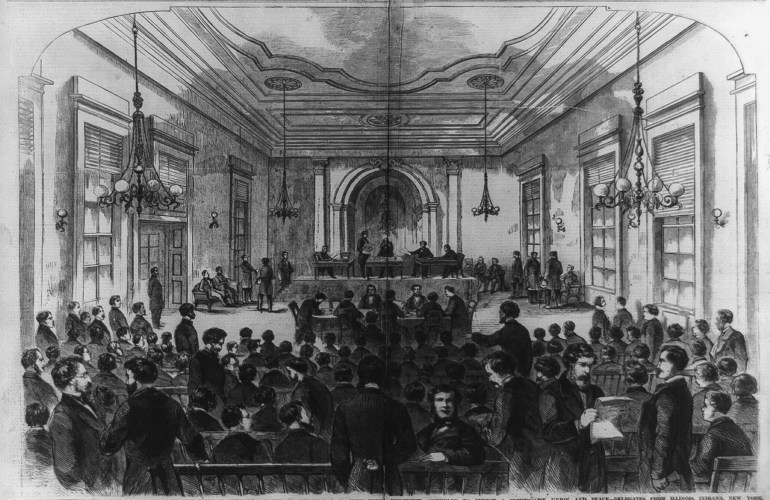
As February 1861 dawned, there appeared to be no resolution in sight to the secession crisis. Abraham Lincoln’s inauguration was still a month away. South Carolina, Mississippi, Florida, Alabama, Georgia, Louisiana, and Texas had adopted resolutions declaring themselves free and independent states and were, at that very moment, meeting in Montgomery, Alabama, to discuss the formation of a confederation.
Elections were underway to choose delegates to a convention in Richmond that would decide whether Virginia would secede. Was there any way to resolve the crisis peacefully? That was the earnest hope of former U.S. President John Tyler and Virginia Governor John Letcher. Perhaps there was still time for the states to come together and avert war.
On Monday, February 4, 1861, a Peace Conference called by Virginia officially opened at Willard’s Hall (behind the Willard Hotel) in Washington, D.C. Noticeably absent were delegates from the seceded states. Arkansas, Michigan, Wisconsin, Minnesota, California, and Oregon also sent none. In total, 131 members gathered, representing 21 states (14 free and 7 slave).
Seventy-year-old John Tyler was elected president of the convention. Its proceedings were conducted behind closed doors, excluding the press, so no complete account of what transpired survives. Tyler’s speech accepting the mantle of president, however, was printed in the Richmond Dispatch on February 7, and in other prominent newspapers. What follows is a transcript of that address:
Gentlemen: I fear you have committed a great error in appointing me to the honorable position you have assigned me. A long separation from all deliberative bodies has rendered the rules of their proceedings unfamiliar to me, while I should find, in my own state of health, variable and fickle as it is, a sufficient reason to decline the honor of being your presiding officer. But, in times like these, one has but little option left him. Personal considerations should weigh but lightly in the balance. The country is in danger—it is enough. One must take the place assigned him in the great work of reconciliation and adjustment.
The voice of Virginia has invited her co-States to meet her in council. In the initiation of this Government that same voice was heard and complied with, and the results of seventy odd years have fully attested the wisdom of the decisions then adopted. Is the urgency of her call now less great than it was then? Our Godlike fathers created, we have to preserve. They built up through their wisdom and patriotism monuments which have eternalized their names. You have before you, gentlemen, a task equally grand, equally sublime, quite as full of glory and immortality. You have to snatch from ruin a great and glorious Confederation—to preserve the Government and to renew and invigorate the Constitution. If you reach the height of this great occasion your children’s children will rise up and call you blessed.
I confess, myself, to be ambitious of sharing in the glory of accomplishing this grand and magnificent result. To have our names enrolled in the Capitol, to be respected by future generations with grateful applause. This is an honor higher than the mountain; more enduring than monumental alabaster. Yes, Virginia’s voice, as in the olden time, has been heard. Her sister States meet her this day at the council board. Vermont is here, bringing with her the memories of the past, reviving in the memories of all, her Ethan Allen, and his demand for the surrender of Ticonderoga in the name of the great Jehovah and the American Congress.
New Hampshire is here—her fame is illustrated by memorable annals, and still more lately as the birthplace of him who won for himself the name of “Defender of the Constitution,” and who wrote that letter to John Taylor, which has been enshrined in the hearts of his countrymen. Massachusetts is not here. Some member said she is coming.—I hope so, said Mr. Tyler, and that she will bring with her her daughter Maine. I did not believe that it could well be that the voice which, in other times, was so familiar to her ears, had been addressed to her in vain.
Connecticut is here, and she comes, I doubt not, in the spirit of Roger Sherman, whose name, with our very children, has become a household word, and who was, in life, the embodiment of that practical sense which befits the great lawgivers and constructions of governments, Rhode Island, the land of Roger Williams, is here—one of the two last States, in her jealousy of the public liberty, to give in her adhesion to the Constitution, and among the earliest to hasten to its rescue The great Empire State of New York, represented thus far but by one delegate, is daily expected in fuller force to join in the great work of healing the discontents of the times, and restoring the reign of fraternal feeling.
New Jersey is also here, with the memories of the past covering her all over. Trenton and Princeton live immortal in story. The plains of the last, incrimsoned with the hearts’ blood of Virginia’s sons. Among her delegation, I rejoice to recognize a gallant son of a signer of the immortal Declaration, which announced to the world that thirteen Provinces had become thirteen Independent and Sovereign States.
And here, too, is Delaware, the land of the Bayards and Roneys, whose soil at Brandywine was moistened by the blood of Virginia’s youthful Monroe.
Here is Maryland, whose massive columns wield into line with those of Virginia in the contest for glory, and whole State-House at Annapolis was the theatre of the spectacle of a successful commander, who after liberating his country glady unqirthed his sword and laid it down upon the altar of that country.—Then comes Pennsylvania, rich in revolutionary lore, bringing with her the deathless names of Franklin and Morris, and I trust ready to renew from the belfry of Independence Hall, the chimes of the old bell which announced freedom and independence in former days.
All hail to North Carolina with her Mecklenburg declaration in her hand, standing erect on the ground of her own probity and firmness in the cause of the public liberty, and represented in other attributes by her Marion, and in the assembly by her distinguished son at no great distance from me.
Four daughters of Virginia also cluster around the council board on the invitation of their ancient mother—the eldest, Kentucky, whose sons, under that intrepid warrior Anthony Wayne, gave freedom of settlement to the territory of her sister, Ohio, and extending his hand daily and hourly across La Belle Riviere, to grasp the hand of some one of kindred blood, of the noble States of Indiana and Illinois and Ohio, who have grown up into powerful States, already grand, potent, and almost imperial.
Tennessee is not here, but is coming—prevented from being here only by the floods which have swollen her rivers. When she arrives she will wear the badges on her warrior crest of victories won in company with the great West on many an ensanguined plain, and standards torn from the hands of the conquerors at Waterloo.
Missouri, and Iowa, and Michigan, Wisconsin, and Minnesota, still linger behind, but it may be hoped that their hearts are with us in the great work we have to do. The eyes of the whole country are turned to this hall, and to this assembly in expectation and hope.
I trust, gentlemen, that you may prove yourselves worthy of the great occasion. Our ancestors probably committed a blunder in not having fixed upon every fifth decade for a call of a general Convention to assemble and reform the Constitution. On the contrary they have made the difficulties next to insurmountable to accomplish amendments to an instrument which was perfect for five million of people, not wholly so as to thirty millions.
Your patriotism will surmount the difficulties, however great, if you will accomplish but one triumph in advance, and that is a triumph over party. And what is party when compared to the task of rescuing one’s country from danger? Do that and one long, loud shout of joy and gladness will resound throughout the land.
John Tyler, February 4, 1861
In his opening address, Tyler sought to lift the proceedings above partisanship and impress upon the delegates the gravity and historic potential of their task. He cast the convention as a last effort to preserve the Union through “reconciliation and adjustment.” Tyler explicitly tied the moment to the Founding era, arguing that just as the nation’s founding fathers created the Constitution, it now fell to their descendants to preserve and renew it.
Tyler’s rhetoric leaned heavily on reverential imagery and historical memory. He invoked Revolutionary War heroes, founding documents, and sacred national spaces to remind delegates of shared sacrifice and a common inheritance. He sought to shame division, sanctify compromise, and persuade his audience that preserving the Union was not merely a political necessity, but a sacred historical obligation.
In the end, the three-week conference proposed a seven-point constitutional amendment that differed little from the Crittenden Compromise. The central issue of slavery in the territories was addressed by extending the Missouri Compromise line to the Pacific Ocean, with no provision for newly acquired territory. The U.S. Senate rejected the proposal, and the delegates returned home feeling as though nothing had been accomplished.
Discussion
Why did John Tyler emphasize the Founding Fathers so heavily in his speech, and how might that appeal have resonated differently with Northern and Southern delegates?
In what ways did Tyler’s repeated references to shared sacrifice attempt to minimize sectional differences? Was this approach realistic given the divisions of 1861?
What does Tyler’s speech suggest about how Americans in 1861 understood the Constitution: as a fixed document, or one that needed renewal and adjustment?
If you were a delegate at the Peace Convention, what part of Tyler’s speech would you have found most persuasive (or least persuasive) and why?

 Spirit of '61