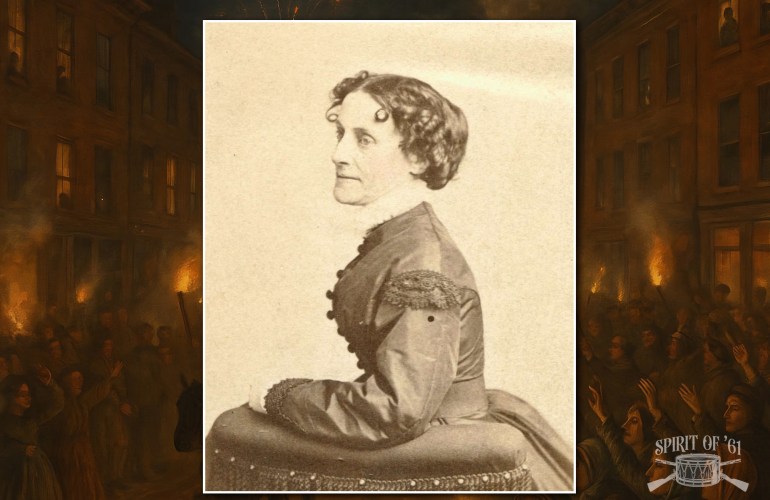
As Richmond erupted in celebration following Virginia’s vote to secede, one woman watched in silence–troubled, not triumphant. Elizabeth Van Lew’s eyewitness account offers a rare, critical perspective on the fevered early days of the Confederacy.
On Wednesday, April 17, 1861, at 10:00 a.m., 143 delegates from across the Commonwealth of Virginia gathered in the neoclassical Capitol building to debate whether to withdraw from the United States. Seven Southern states: South Carolina, Mississippi, Florida, Alabama, Georgia, Louisiana, and Texas had already left the Union. They had formed a “Confederate States of America” and invited the states of the Upper South, including Virginia, to join them.
Finally, after hours of intense debate and high drama, the delegates in Richmond called the roll: the motion to secede passed by a vote of 88 to 55. Moments later, a man burst from the Capitol and announced the result to the crowd gathered outside. Supporters of secession flooded the streets, waving flags and torches and carrying a banner that read, “Resistance to Tyranny is Obedience to God.”
The mood was euphoric. One woman wrote that “a stranger, suddenly transplanted to the city, without a knowledge of preceding facts, would have imagined the people in a state of intoxication or insanity.” The convention’s president, John Janney, himself a unionist, wrote to his sister, “May God in his mercy grant it for the dry storm is raging and madness rules the hour.”
John Janney was not alone in his feelings of apprehension. Although a majority of Richmonders supported secession, a small minority did not. Among them was Elizabeth Van Lew. Born into a wealthy, slaveholding family, Van Lew became an abolitionist after receiving a Quaker education in Philadelphia. As the war dragged on, she and other like-minded individuals would go on to form a Union spy ring.
She later reminisced about those days in April 1861:
“Think of a community rushing gladly, unrestrainedly, eagerly, into a bloody civil war! Imagine how the spirit of evil reigned; the bitter breathing of the fostered hate, the fierce resolve to give to this, proven the sword to find its fury. I know one day I could speak for my country; the next was threatened with death. Surely madness was upon the people! … Public feeling swept all before it, nothing could gainsay it.”
On the night of April 19, secession supporters held a torchlit parade through Richmond’s main thoroughfares, led by the Richmond Armory Band and marshals on horseback. The Richmond Dispatch crowed, “Nothing that ever transpired here has served to infuse so much enthusiasm in the people of all classes, conditions and colors.”
“Along the whole line of march the houses were brilliantly illuminated, and the sidewalks were crowded with admiring and sympathizing spectators, among whom were many ladies, who expressed their approbation by waving their handkerchiefs. The immense moving mass, with their blazing torches—the brilliant and beautifully-arranged lights gleaming from the window panes of almost every house—the incessant play of Roman candles, sky-rockets, and numerous other styles of pyrotechnics, shooting far up into the vault of Heaven and bursting into a thousand beautiful scintillations, presented a spectacle the splendor of which has never been equalled in this city. As far as the eye could reach the moving mass of fire surged along and lighted up with its lurid glare every object with almost the brightness of day.”
Richmond Dispatch (Richmond, VA) 20 April 1861.
Elizabeth Van Lew watched the procession from her garden on Grace Street in the Church Hill neighborhood, just steps from the site where Patrick Henry had once declared, “Give me liberty or give me death!” As other women waved handkerchiefs and cheered with ecstatic fervor, Elizabeth’s thoughts turned instead to the violence of the French Revolution.
“Such a sight! The transparencies with their painted hags; the wicked and blasphemous, … the women on foot, the multitude, the mob, the whooping, the tin-pan music, and the fierceness of a surging, swelling revolution. This I witnessed. I thought of France and as the procession passed, I fell upon my knees under the angry heavens, clasped my hands and prayed, “Father, forgive them for they know not what they do!” Mobs went to private houses to hang the true of heart. Loyalty now was called treason, and cursed. If you spoke in your parlor or chamber to your next of kin, you whispered. You looked under the lounges and beds. The threats, the scowls, the frowns of an infuriated community; who can write of them? I have had brave men shake their fingers in my face and say terrible things. We had threats of being driven away, threats of fire, and threats of death. Surely madness was upon the people.”
A Yankee spy in Richmond: the Civil War diary of “Crazy Bet” Van Lew.
Elizabeth’s words reveal a deep fear for her own safety and that of her fellow Unionists in a community consumed by fury. Loyalty to the Union is branded as treason, and speaking openly invites threats of arson, death, or expulsion. Friends and neighbors whisper in private, terrified of being discovered, while mobs target homes and some openly call for the slaughter or hanging of Northerners, regardless of their ties to the South. For Elizabeth, this is not a moment of triumph but a descent into madness.
Despite her fears, Elizabeth Van Lew chose to remain in Richmond. She was not killed or driven from her home. Until 1865, she worked openly to assist prisoners held in Libby Prison, while secretly running the “Richmond Underground,” recruiting both black and white couriers to infiltrate Confederate circles and relay critical intelligence to Union commanders. Her intermittent journal, which remarkably survived the war, offers a rare and valuable perspective on the events of that tumultuous period.
Sources
Richmond Dispatch (Richmond, VA) 20 April 1861.
Robertson, James I., Jr. “The Virginia State Convention of 1861” in Virginia at War, 1861. Ed. by William C. Davis and James I. Robertson. Lexington: University Press of Kentucky, 2005.
Ryan, David D. A Yankee spy in Richmond: the Civil War diary of “Crazy Bet” Van Lew. Mechanicsburg, PA: Stackpole Books, 2001.
Thomason, John W., Jr. Jeb Stuart. New York: Scribner’s Sons, 1930.

 Spirit of '61