In the late spring and early summer of 1861, all eyes were on northeastern Virginia as both sides contemplated their first moves in a war they predicted would be over in a single climactic battle. The small skirmishes that took place on the road to First Manassas were few in number but received outsized attention due to their proximity to the nation’s capital. In the coming weeks, we will be taking a deep dive into this front.
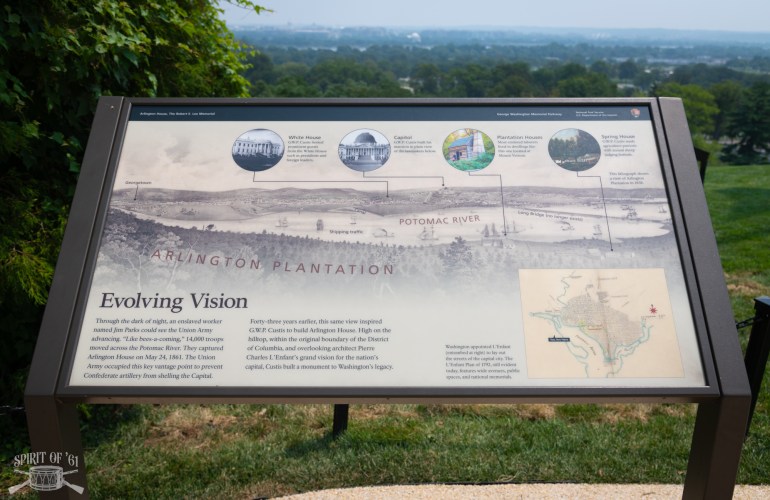
After the Richmond Secession Convention voted to secede in April 1861, war planners in Washington, DC were obviously concerned about security around the national capital. Arlington House, home of Robert E. Lee, freshly appointed commander of Virginia’s militia forces, was located on Arlington Heights, a bluff directly across the Potomac River. The U.S. Capitol Building and White House were easily seen from this vantage point, and well-placed siege artillery could rain destruction down onto the streets below.
Alexandria, among Virginia’s largest port cities (pop. 12,652 in 1860), was located a few miles downriver. River traffic flowed from Washington, DC to the Chesapeake Bay, carrying mail, supplies, troops, and vital military orders. Both President Abraham Lincoln and General Winfield Scott considered it absolutely essential to secure the Potomac River at these points as soon as possible. Fifty-seven-year-old Brig. Gen. Joseph K. Mansfield, commander of the short-lived Military Department of Washington, proposed establishing a bridgehead on the southern side of the Potomac River, and Scott agreed. Scott drew up orders to seize Arlington Heights as early as May 3rd.
That opportunity came after midnight on May 24, 1861, shortly following the referendum that ratified Virginia’s secession. Ten volunteer regiments, two U.S. cavalry companies, and a battery of artillery crossed the river and occupied Arlington Heights and Alexandria without opposition. Col. Elmer E. Ellsworth of the 11th New York “Fire Zouaves” was shot and killed by a civilian, James Jackson, proprietor of the Marshall House, in Alexandria. Virginia forces, possibly due to lack of arms and inferior numbers, did not contest the move but withdrew to Fairfax Court House and Centreville.
As soon as Union troops crossed the river, they set to work erecting a series of forts to defend the bridges over the Potomac (the first were forts Runyon and Corcoran). The main camp outside Alexandria was located on Shuter’s Hill (or Shooter’s Hill), present-day location of the George Washington Masonic National Memorial. On May 27th, Irvin McDowell, a close friend of General Winfield Scott and Secretary of the Treasury Salmon P. Chase, was appointed to command the new Department of Northeastern Virginia, despite serving in the U.S. Army mainly as a staff officer with a background in logistics and supply. He established his headquarters at Arlington House.
Between late May and mid-July, Union forces gathered in this corner of northeast Virginia, while Confederate forces consolidated at Centreville, with an advanced outpost at Fairfax Court House. The area in-between became a no man’s land in which several skirmishes were fought. Under pressure from Washington, on July 16th, Irvin McDowell advanced his ill-prepared army toward Manassas Junction and met the Confederates along Bull Run. The story of the Battle of Bull Run or First Manassas is well-known. The scope of our encyclopedia is the military activity between Virginia’s secession and the Battle of Bull Run. These events have been largely overshadowed by that famous battle and deserve far more attention from historians than they’ve received.
The struggle to control the lower Potomac River was a critical stage in the Civil War’s opening chapter. Over the coming weeks, we will be taking a deep dive into the skirmishes and engagements that proceeded the First Battle of Bull Run, from the deadly ambush at Vienna, to the first shots fired between Virginia and U.S. forces at Aquia Creek. I hope you join us for this exciting historical journey.

 Spirit of '61