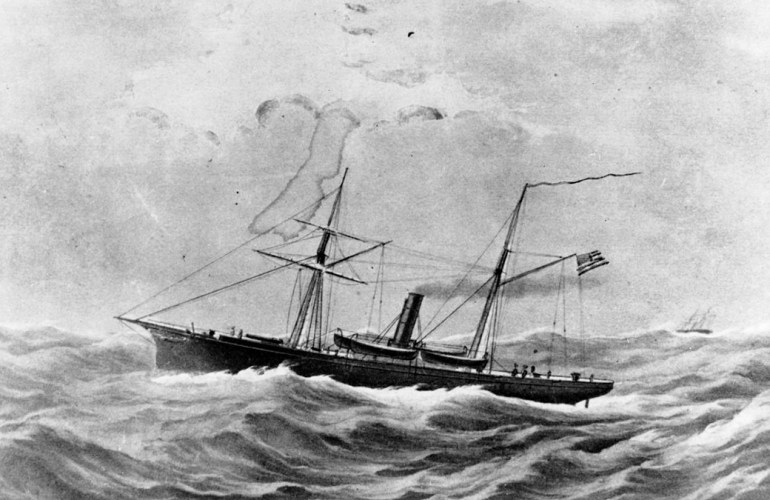
The Action at Carter’s Creek was fought on Monday, June 24, 1861 between Union forces commanded by Lt. Daniel L. Braine and Confederate forces commanded by Capt. Isaac Currell in present-day Lancaster County on Virginia’s Northern Neck. The brief exchange of fire resulted in a Confederate victory when the Union landing party was driven off with two casualties.
Newspaper articles and official reports gave detailed accounts of the event from multiple perspectives. It took place near the house of a man identified as James or William Gresham, near the mouth of Carter’s Creek, a tributary of the Rappahannock River. But more details were lacking. Where exactly was Gresham’s house located, and who was he?
I contacted the Lancaster Virginia Historical Society to see what specifics I could learn, and what they sent me was very revealing. The house where this skirmish took place, and which was heavily damaged by cannon fire, is called “Pop Castle,” and it still exists. In fact, you can rent it on Air B&B. It was added to the Virginia Landmarks Register in 1988 and the National Register of Historic Places a year later.

Pop Castle, built in 1855, is a two-story, Tidewater-type cottage embellished with Greek Revival and Italianate details with two exterior chimneys. It was built over an earlier building that stood at the site of an eighteenth century ferry across the Rappahannock River.
The details of Gresham’s life are murky. He was born in 1810 and suffered from ill health later in life, dying at the age of 52 in 1862. His name was James W. (William?) Gresham. He owned a large plantation with 65 slaves, according to the 1860 U.S. Census slave schedules. On May 1, 1862, he wrote a letter to Union authorities complaining that three of his slaves, Dick, William, and Daniel, fled aboard the USS Young Rover on the 7th of April and asked for their return.
His 88-year-old mother, Mary, lived in the house with his family. She is mentioned in several newspaper articles.
Several sources alluded to Gresham as being a Unionist or Union sympathizer. I haven’t found any evidence of his political leanings. The May 23, 1861 secession vote in Lancaster County was, according to the Richmond Dispatch, 433 in favor, zero opposed, so it seems unlikely that he was a Unionist.
In the course of writing this post, I came across two more detailed accounts of the Carter’s Creek incident in the Richmond Whig that will hopefully allow me to flesh out the events of that day and corroborate the other statements and reports. Check back for future updates.

 Spirit of '61