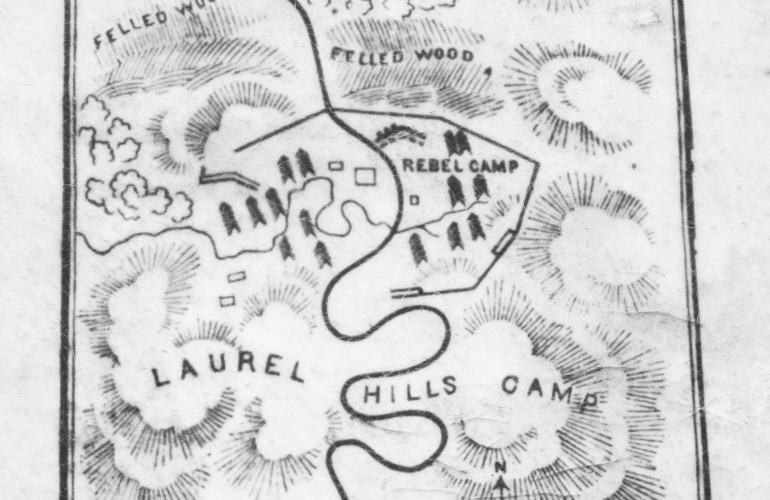
A few days ago, I shared a map of the Confederate camp at Laurel Hill in Barbour County, West Virginia drawn by a Union spy named William Fletcher. I found the map on an interpretive sign at the Laurel Hill Battlefield. Though flawed, the map is the only detailed representation of the Confederate camp I have ever seen.
But who was William Fletcher, and what were the circumstances surrounding the map’s creation?
Almost by coincidence, I came across the book The Soldier of Indiana in the War for the Union (1866), edited by Catharine Merrill. It contains a narrative of a scouting mission to Laurel Hill by “W.B.F.” and the exact drawing, though it’s clearly not the original.
The author states that Colonel Ebenezer Dumont of the 7th Indiana Infantry Regiment asked for men to scout the rebel camp, and he volunteered. However, there is no one by the name “William Fletcher” among the 7th’s officers or enlisted men in the published unit roster.
According to “The Civil War Journals of William B. Fletcher” in Indiana Magazine of History (1961), Dr. William Baldwin Fletcher enlisted as a hospital surgeon, but was made a fife major instead when his medical appointment wasn’t forthcoming. He served as an aide to Colonel Dumont.
In his 1866 narrative, Fletcher states that he drew a rough sketch of the Laurel Hill camp from “a bluff on the banks of Valley River, from the top of which I could look into the Rebel camp.” He must have been referring to the Tygart Valley River. “The Rebel camp was perhaps five hundred yards in a direct line below and to the east.” It was at night.
He later drew a more complete sketch from memory and his notes in the presence of General McClellan himself.
So we can see why there are some errors in the map — the direction of the creek and orientation of the compass in particular. It was dark and he was approximately 500 yards away, although he did sneak closer for a better look. He was working from a hastily drawn sketch that he drew at night.
Still, it’s pretty remarkable that this drawing survives and it’s an invaluable resource for historians trying to piece together what happened at the Battle of Laurel Hill, a nearly forgotten bit of Civil War history.

 Spirit of '61