1861
Monday, February 4
Virginia-led Peace Conference convenes in Washington, DC, chaired by former President John Tyler and attended by 131 members representing 21 states. The seceded states send no representatives.
Wednesday, February 13
The Virginia Convention of 1861 opens in Richmond with 152 delegates to debate secession.
Thursday, April 4
Initial vote on secession in the Virginia Convention fails 88 to 45. John B. Baldwin, a private citizen and delegate to the Virginia Convention representing Virginia unionists, meets in secret with President Abraham Lincoln at the White House in Washington, DC to allegedly discuss exchanging Virginia’s loyalty for the surrender of Fort Sumter. He leaves empty-handed.
Sunday, April 7
Former congressman and Virginia unionist John Minor Botts meets with President Abraham Lincoln in Washington, DC to discuss how to keep Virginia in the Union, but again, this discussion leads nowhere.
Friday, April 12, 4:30 a.m.
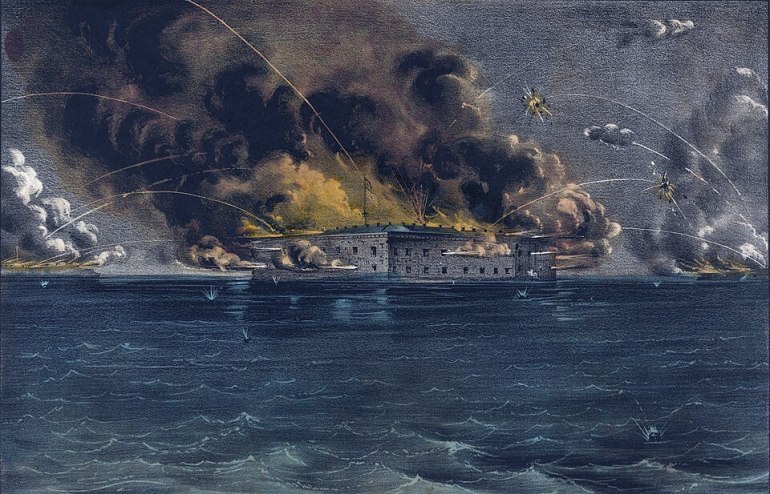
Confederate batteries around Fort Sumter in Charleston, South Carolina open fire on the fort. Virginian Edmund Ruffin claims to have fired the first shot, but this is disputed.
Saturday, April 13
Fort Sumter surrenders. A “Committee of Three” from the Virginia Convention, consisting of delegates William B. Preston, George Wythe Randolph, and Alexander H. H. Stuart, meets with President Abraham Lincoln to ascertain what policy Lincoln plans to pursue in regard to the Confederate States. Lincoln reiterates that he had outlined his policy in his inaugural address and regrets “that they did not understand it.” He pledges to take no aggressive action but will retain federal property and “repel force by force.”
Monday, April 15
President Abraham Lincoln issues Proclamation 80 calling for an army of 75,000 volunteers to “maintain the honor, the integrity, and the existence of our National Union” and “to repossess the forts, places, and property which have been seized from the Union.” Virginia Governor John Letcher refuses to comply.
Tuesday, April 16
Henry A. Wise and other fire-eaters organize a “Spontaneous People’s Convention” or “Spontaneous Southern Rights Convention” in Metropolitan Hall, Richmond to aggressively push Virginia toward secession.
Wednesday, April 17
Delegates at the Virginia Convention vote in favor of secession, 88 to 55. Secession supporters fill the streets of Richmond carrying flags, torches, and a banner proclaiming “Resistance to Tyranny is Obedience to God.”
Thursday, April 18
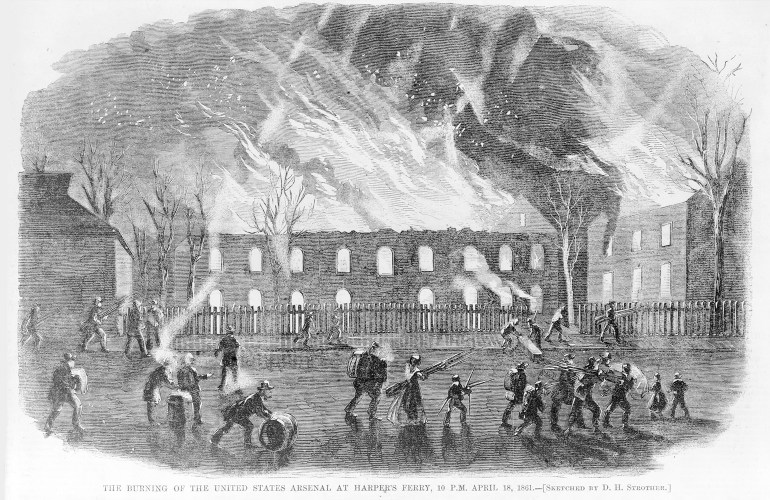
Union troops set fire to and evacuate Harpers Ferry Arsenal. Virginia militia seize most of its equipment.
Friday, April 19
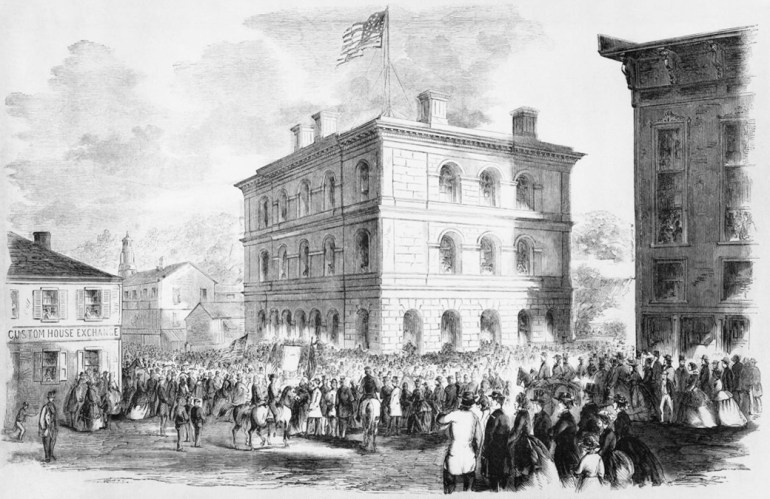
Secession supporters in Richmond sieze the U.S. Customs House. That night, a torchlit parade marches through Richmond’s main streets, led by the Richmond Armory Band and marshals on horseback.
Saturday, April 20
54-year-old Col. Robert E. Lee resigns his commission in the U.S. Army.
Sunday, April 21
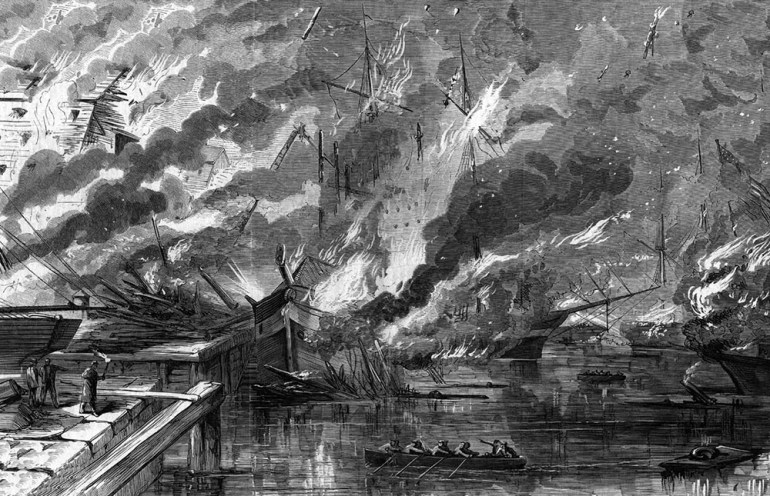
Shortly after midnight, Union forces attempt to destroy Gosport Navy Yard, but Virginia militia capture its dry dock and approximately 1,085 cannon of various sizes. Also, “Pawnee Sunday.” Richmond militia mobilizes to confront the USS Pawnee, rumored to be steaming toward the capital in pursuit of the captured munitions. The threat is illusiory.
Tuesday, April 23
Robert E. Lee in Richmond accepts command of Virginia’s Provisional Army and Navy with the rank of major general.
Thursday, April 25
Virginia Convention passes a resolution expressing a desire to enter into an alliance with the Confederate States and place control of Virginia’s militia in the hands of the Confederate president, and invites the Confederate government to move its capital to Richmond.
Saturday, April 27
In Proclamation 82, U.S. President Abraham Lincoln extends the naval blockade of seven original Confederate States to include the ports of Virginia and North Carolina.
Tuesday, May 7
Provisional Confederate Congress enacts a law admitting Virginia into the Confederacy. The USS Yankee exchanges fire with a Virginia shore battery at Gloucester Point.
Monday, May 13
Pro-Union delegates from 27 western Virginia counties open a convention at Washington Hall in Wheeling, Virginia to debate a response to the secession crisis.
Sunday, May 19
The USS Thomas Freeborn and Monticello exchange fire with a Confederate shore battery at Sewell’s Point.
Wednesday, May 22
Two members of the unionist Grafton Guards confront secessionist pickets at a bridge over the Tygart Valley River near Fetterman, Virginia. Thornsbury Bailey Brown is shot and killed.
Thursday, May 23
Virginia voters overwhelmingly ratify the Ordinance of Secession, 125,950 to 20,373, although this support was not uniform throughout the state. That morning, at Fort Monroe, Union General Benjamin Butler orders the 1st Vermont Regiment to occupy the town of Hampton in an effort to disrupt the secession vote. The vote resums as soon as they leave. Late that evening, District of Columbia militia secure the Potomac River bridges to prevent them from being burned. Sergeant John Thomas Ball and Private George F. Kirby are taken prisoner at Chain Bridge, becoming the first uniformed Confederate prisoners of war.
Friday, May 24
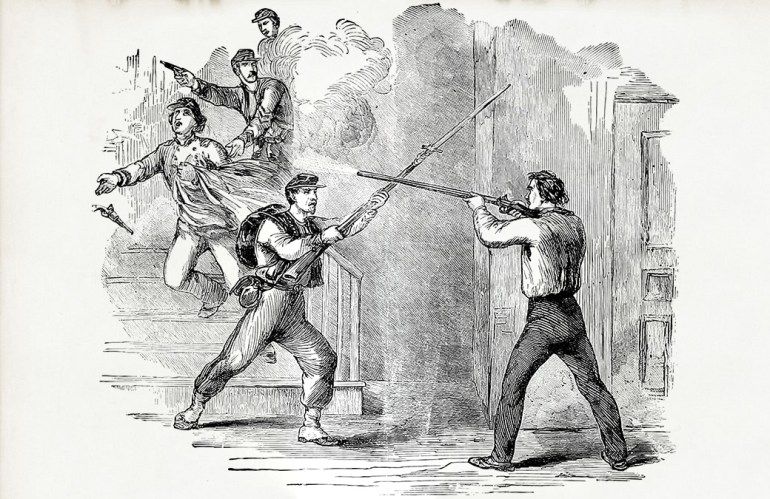
A large force of Union troops crosses the Potomac River into northern Virginia, securing Arlington Heights and Alexandria. Col. Elmer Ellsworth of the 11th New York “Fire Zouaves” is shot dead by the proprietor of the Marshall House Hotel. Ellsworth is the first Union officer to die in the Civil War.
Saturday, May 25
Confederates in northwest Virginia destroy railroad bridges along the B&O Railroad and Northwestern Virginia Railroad.
Sunday, May 26
Department of Ohio commander Maj. Gen. George B. McClellan orders the 1st Virginia Infantry Regiment (U.S.), 14th Ohio Infantry Regiment, and 16th Ohio Infantry Regiment across the Ohio River into Virginia.
Monday, May 27
Union Brig. Gen. Irvin McDowell is appointed to command the new Department of Northeastern Virginia. U.S. cavalrymen surprise two Confederate soldiers, Privates Peyton Anderson and William Lillard of the Rappahannock Cavalry, on picket duty along the Falls Church Road, about two miles northeast of Fairfax Court House. Lillard is captured, while Anderson, though wounded, escapes. On the Virginia Peninsula, Union troops from Fort Monroe occupy Newport News Point and establish Camp Butler.
Tuesday, May 28
A Union patrol surprises an irregular secessionist band at Glover’s Gap along the Baltimore & Ohio Railroad, killing 65-year-old Stephen Roberts.
Wednesday, May 29
Confederate President Jefferson Davis arrives in Richmond.
Wednesday, May 29 to Sat., June 1
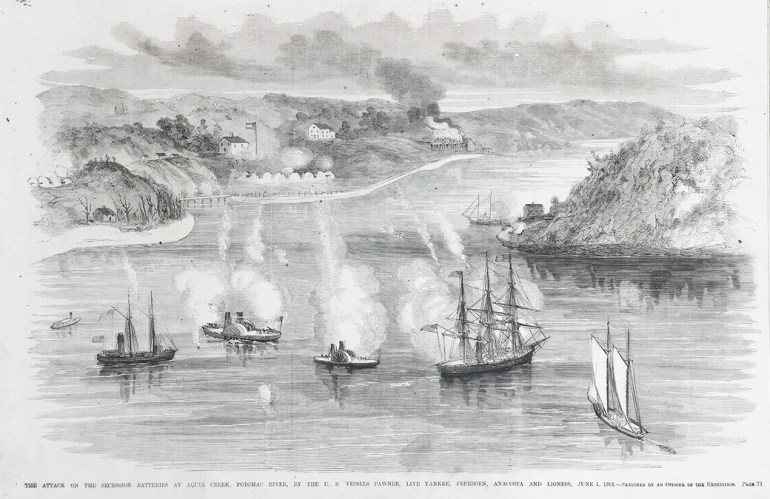
The USS Thomas Freeborn, USS Anacostia, USS Resolute, and USS Pawnee exchange fire with a Confederate shore battery at Aquia Creek in the Potomac River.
Thursday, May 30
Union troops occupy Grafton in northwestern Virginia unopposed.
Saturday, June 1
The 2nd U.S. Cavalry Regiment surprises Confederate militia and cavalry at Fairfax Court House. Capt. John Q. Marr is the first Virginia officer to be killed in battle in the Civil War.
Sunday, June 2
43-year-old Confederate Brig. Gen. Pierre Gustave Toutant-Beauregard arrives at Manassas Junction to take command of the Alexandria Line, later known as the Army of the Potomac.
Monday, June 3
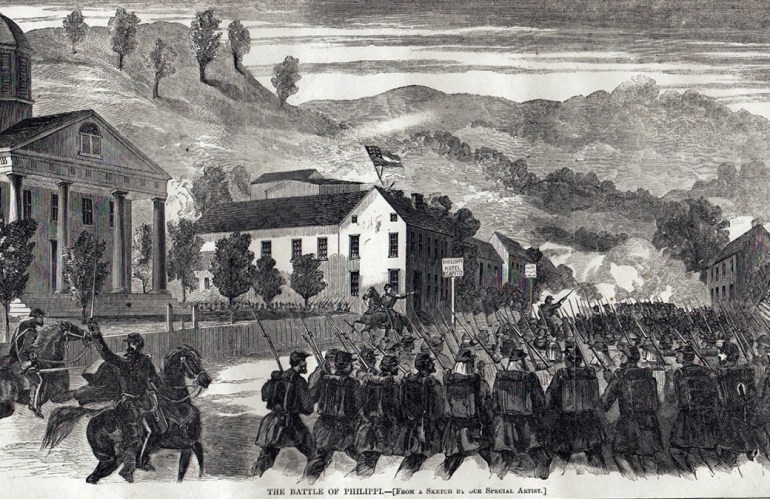
Union Brig. Gen. Thomas A. Morris routes Confederate forces commanded by Col. George A. Porterfield in Philippi in northwestern Virginia.
Wednesday, June 5
The converted revenue cutter USS Harriet Lane exchanges fire with Confederate shore batteries at Pig Point at the mouth of the James River.
Thursday, June 6
Governor John Letcher signs General Orders, No. 25, transferring control of Virginia’s Provisional Army and Navy to the Confederate government.
Saturday, June 8
Detachments of the 1st North Carolina Infantry and the Richmond Howitzers skirmish with the 2nd New York Infantry around New Market Bridge on the Virginia Peninsula.
Monday, June 10
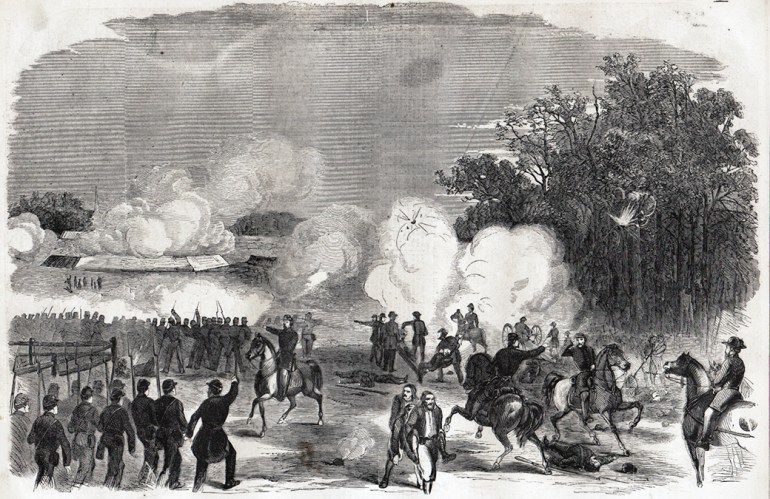
Union Brig. Gen. Benjamin F. Butler orders a disastrous attack on Confederate Col. John B. Magruder’s forces on the Virginia Peninsula at Big Bethel.
Tuesday, June 11
The Second Wheeling Convention opens in Wheeling with 100 delegates representing 34 counties to form a unionist Restored Government of Virginia.
Thursday, June 13
Col. Lewis “Lew” Wallace and the 11th Indiana Infantry Regiment drive Confederate forces away from Romney, Virginia. At Harper’s Ferry, Confederate Brig. Gen. Joseph E. Johnston begins evacuating his army south to Winchester, destroying the bridges across the Potomac in the process.
Monday, June 17
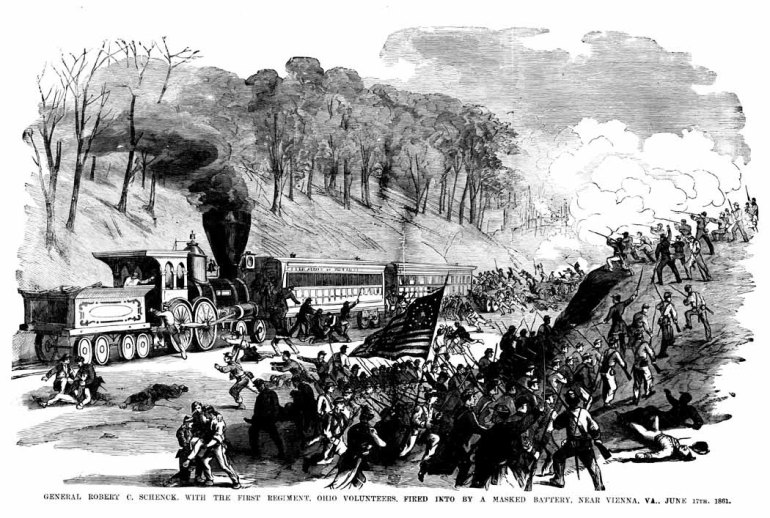
South Carolina troops commanded by Col. Maxcy Gregg ambush the 1st Ohio Infantry Regiment as it rides train cars towards Vienna, Virginia, inflicting heavy casualties.
Wednesday, June 19
Troops from the 3rd Tennessee and 13th Virginia Infantry Regiments burn the railroad bridge over the Potomac River at New Creek. The Virginia Convention (2nd Session) formally adopts the Constitution of the Confederate States.
Thursday, June 20
The Second Wheeling Convention unanimously elects Francis H. Pierpont as Governor of the Restored Government of Virginia, arguing that Governor John Letcher and other state officials had forfeited their offices by embracing secession.
Friday, June 21
Men from the 20th Ohio Volunteer Infantry surround the house of secessionist Peter Righter at the Marion/Harrison County line and a firefight erupts.
Monday, June 24
A landing party from the USS Star (Monticello) is ambushed by Virginia militia at Pop Castle near Carter’s Creek on the Northern Neck.
Wednesday, June 26
A patrol from the 11th Indiana gets into a running gunfight with a patrol from 7th Virginia Cavalry at Frankfort’s Ford and Patterson’s Creek. Capt. Richard Ashby is mortally wounded.
Thursday, June 27
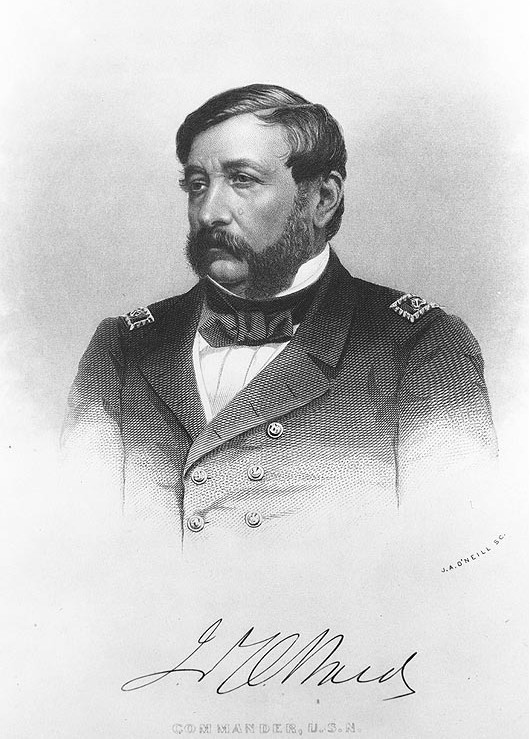
Commander James H. Ward’s Potomac Flotilla conducts an amphibious landing under hostile fire at Mathias Point. Ward is mortally wounded.
Saturday, June 29
Union forces ambush a Confederate cavalry patrol along the Cheat River, killing Lt. Robert McChesney in present-day Tucker County, West Virginia.
Sunday, June 30
The 7th Ohio Infantry enters Weston, Virginia and seizes gold earmarked for construction of the Trans-Allegheny Lunatic Asylum to prevent it from falling into Confederate hands. It is used to help fund the Unionist Restored Government of Virginia. In Northeastern Virginia, a 14-man Confederate patrol runs into pickets from the 4th Pennsylvania along the Little River Turnpike near Shuter’s Hill and a sharp fight erupts.
Tuesday, July 2
Col. Thomas J. Jackson conducts a fighting withdrawal against Union forces commanded by Maj. Gen. Robert Patterson at Hoke’s Run.
Thursday, July 4
Union forces across the Potomac River in Maryland exchange fire with a small Confederate force on the opposite bank at Harpers Ferry.
Friday, July 5
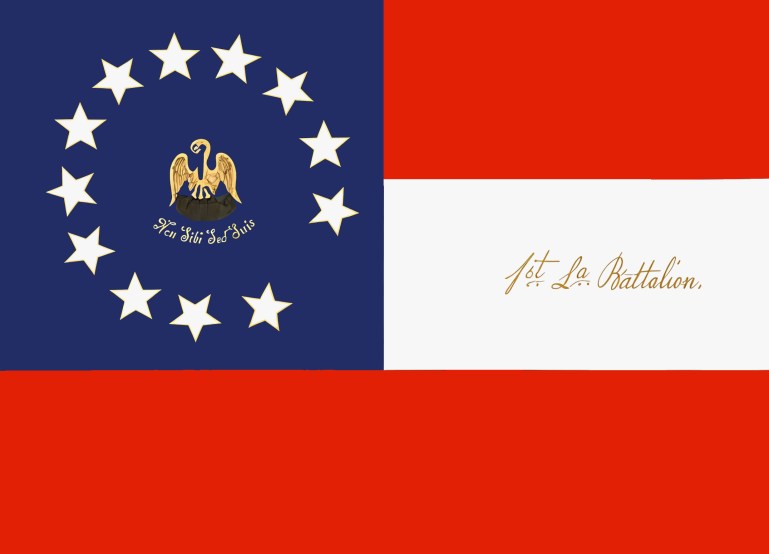
Lt. Col. Charles D. Dreux is killed in a failed ambush along Cedar Lane near Smith’s Farm in present-day Newport News, Virginia.
Saturday, July 6
Union Brig. Gen. Newton Schleich orders a reconnaissance of Middle Fork Bridge east of Buckhannon on the road to Rich Mountain, resulting in a small but bloody skirmish.
Sunday, July 7
A Confederate scouting party exchanges fire with George McClellan’s advancing vanguard at Middle Fork Bridge. Thomas A. Morris’ Brigade reaches Yeager’s farm in front of Robert S. Garnett’s camp at Laurel Hill and skirmishing ensues. Elements of the 17th Ohio Infantry skirmish with Wise Legion cavalry at Glenville in Gilmer County.
Thursday, July 11
Union forces commanded by Brig. Gen. William Rosecrans flank and surprise Confederates at the Battle of Rich Mountain.
Friday, July 12
Confederate forces led by Maj. John Bell Hood skirmish with Union forces led by Lt. Oscar von Heringen at Cedar Lane in present-day Newport News, Virginia.
Saturday, July 13
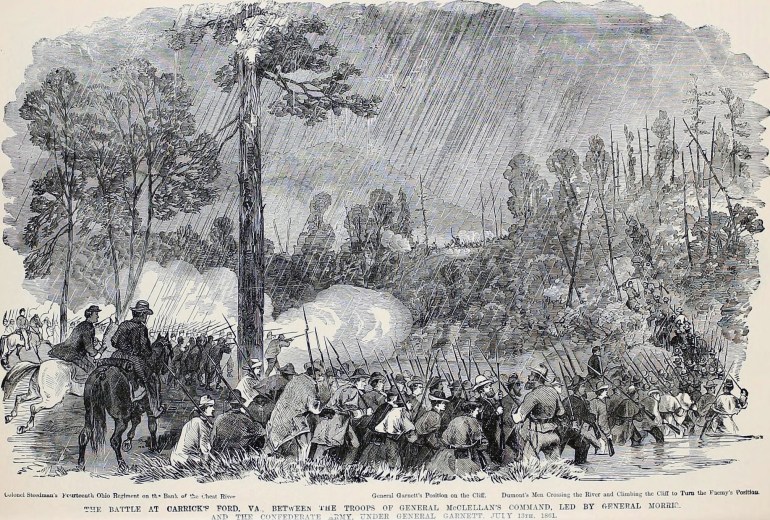
Confederate Brig. Gen. Robert S. Garnett is killed directing his men across Corrick’s Ford on Shavers Fork of the Cheat River. Farther west, Union forces route Confederates at Barboursville along the Guyandotte River.
Sunday, July 14
Two companies of Pennsylvania “Bucktails” get into a skirmish with Confederate cavalry at New Creek Depot.
Wednesday, July 17
In western Virginia, Confederates led by Lt. Col. George S. Patton, Sr. inflict a painful defeat on Ohio troops invading the Kanawha Valley at Scary Creek. In northeastern Virginia, Confederate Col. Robert E. Rodes’ 5th Alabama Infantry fights a delaying action against Union Col. Thomas A. Davies’ Second Brigade near Farr’s Crossroads.
Thursday, July 18
Brig. Gen. James Longstreet’s brigade repels a Union reconnaissance in force across Bull Run Creek at Blackburn Ford.
Friday, July 19
Confederate guerillas ambush a patrol from Burdsall’s Dragoons along the Greenbrier River in Pocahontas County, West Virginia, inflicting heavy casualties.
Updated: 9 October 2025
Created: 26 June 2023
 Spirit of '61