Lower Potomac Front – Numbers and Losses

Fifty-eight. That’s how many days passed between the Union Army crossing the Potomac River into northeastern Virginia and the First Battle of Manassas (Bull Run). During those nearly two months, the Union and Confederate armies shadowboxed in that corner of Virginia, hampered by undisciplined and inexperienced soldiers while probing for enemy weaknesses. The exact number…

Who Was the First Civil War Soldier Killed in Action in Virginia?

In the tense opening days of the Civil War, a single gunshot would mark the first true casualty of battle—but whose name deserves that grim distinction? Between riots, duels, and chaotic skirmishes, the first soldier killed in action is a title claimed by many, but only one truly fits the definition. Because of its proximity…

When did Virginia join the Confederacy?

Determining precisely when Virginia joined the Confederacy is a complex issue. President Abraham Lincoln’s administration maintained that the Union was "indivisible" and that secession was illegal. According to this view, a state could not leave the Union under any circumstances. Therefore, those taking up arms against the federal government were considered rebels or insurrectionists, while…

Deep Dive into the Lower Potomac Front

In the late spring and early summer of 1861, all eyes were on northeastern Virginia as both sides contemplated their first moves in a war they predicted would be over in a single climactic battle. The small skirmishes that took place on the road to First Manassas were few in number but received outsized attention…

“No Meat Hurt”: Letter from John C. Higginbotham

Portrait of John C. Higginbotham of Buchkannon. West Virginia & Regional History Center, Morgantown, WV Soon after Virginia voted to secede, John Carleton Higginbotham (1842-1864), an 18-year-old student at Lynchburg College, returned home to fight for the Confederacy. His father, William Thomas Higginbotham (1821-1892), was a prominent landowner in Upshur County and owned nearly 10…

The Fate of Burdsall’s Men

On Friday, July 19, 1861, a seven-man patrol from Captain Henry W. Burdsall's Independent Company of Ohio Cavalry was ambushed along the West Fork of the Greenbrier River, near present-day Durbin, West Virginia, in Pocahontas County. Confederate reports claimed that all but one of the men were killed, but the reality was different. One man…

What Units Fought at the Battle of Scary Creek?

Uncover the full story of the Battle of Scary Creek as we piece together the most accurate records of involved units and casualty figures available. The Battle of Scary Creek holds significance as one of the earliest substantial engagements prior to the First Battle of Bull Run. Although involving only about 2,100 men, it included…

What Happened at Poca? Unpacking the Truth

Was the skirmish at the mouth of the Pocatalico River on July 16, 1861 a bold cavalry charge or blown out of proportion? Conflicting accounts tell vastly different tales, leaving us to sift through exaggerations and incomplete records to understand what really happened in this lesser-known prelude to the Battle of Scary Creek. A dramatic…

Action at Carter’s Creek – Location Revealed

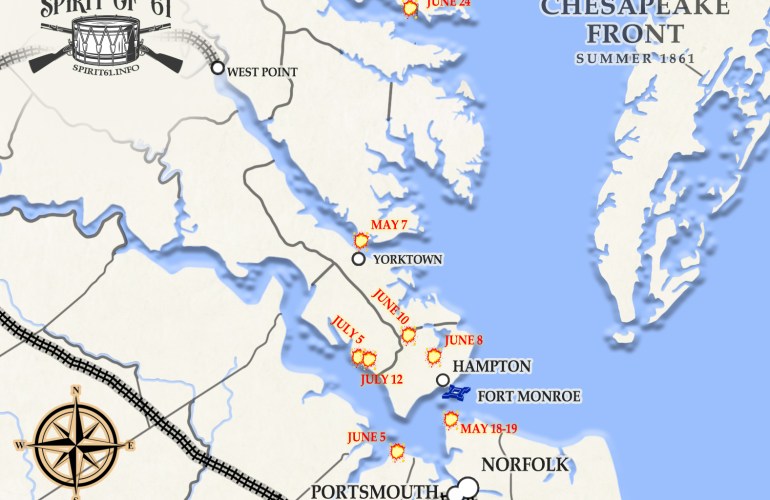
The Action at Carter’s Creek was fought on Monday, June 24, 1861 between Union forces commanded by Lt. Daniel L. Braine and Confederate forces commanded by Capt. Isaac Currell in present-day Lancaster County on Virginia's Northern Neck. The brief exchange of fire resulted in a Confederate victory when the Union landing party was driven off…

Big Bethel by the Numbers – Union

Based on a careful analysis, it’s reasonable to conclude that the Union force had approximately 4,518 men on the field that day. The Battle of Big Bethel, June 10, 1861, on the Virginia Peninsula was unequivocally the first pitched battle of any magnitude in the American Civil War. Approximately 6,000 Union and Confederate soldiers participated,…