Using Artificial Intelligence to Enhance Civil War Portraits
The growth of Artificial Intelligence (A.I.) in recent years has opened up an exciting new field. When used properly and responsibly, it can be of invaluable assistance to researchers and historians looking for new ways to bring the past to life. Our policy on A.I. is to solely employ it for purposes that complement, not…

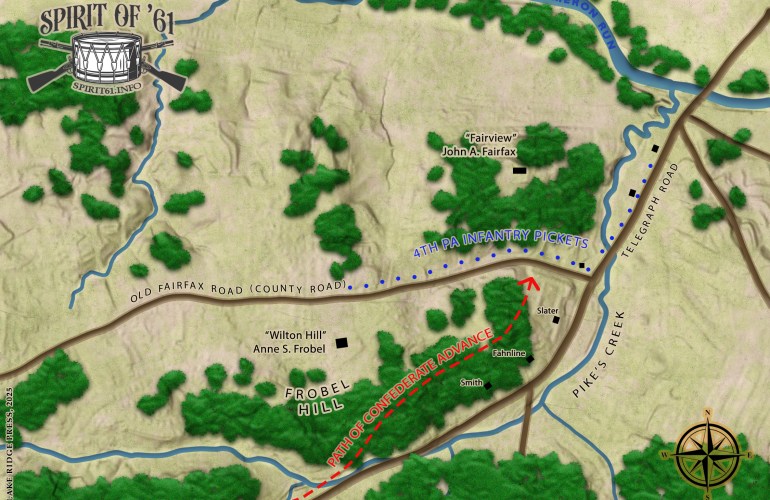
Mapping the Action at Pike’s Creek

At the end of June 1861, a small expedition of Alabama and Virginia troops scouted the southern approaches to Shuter's Hill and Alexandria, which Union forces had occupied since May. Captain Walter H. Weems’ force included 48 men from the 6th Alabama Infantry Regiment and 10 cavalrymen from the Governor’s Mounted Guard and Goochland Cavalry.…

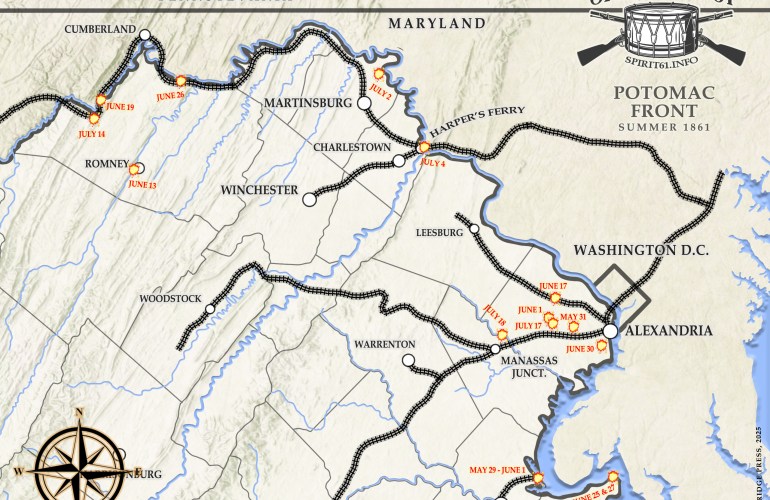
Map and Overview of the Potomac Front, May 1-July 20, 1861

In 1861, control of the Potomac River was critical to both Union and Confederate strategies, as it formed a key geographic boundary. While the Union secured the upper river and gained a foothold in northeastern Virginia, Confederate coordination between the Shenandoah and Manassas Junction led to victory at Bull Run and enabled a temporary blockade…

Map of the Battle of Scary Creek

The Battle of Scary Creek was fought on Wednesday, July 17, 1861 between Union forces commanded by Brig. Gen. Jacob D. Cox and Confederate forces commanded by Brig. Gen. Henry A. Wise in Putnam County, West Virginia. It resulted in a Confederate victory, but ultimately had no affect on the overall campaign. Union forces captured…

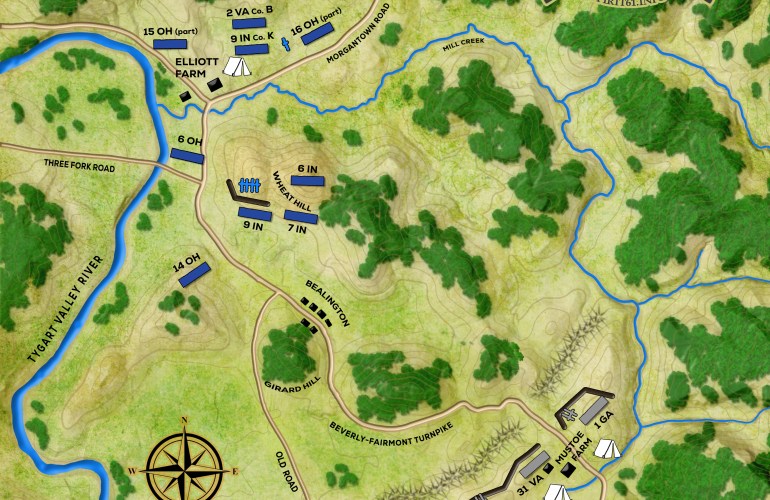
Revised Map of Laurel Hill Battle

Daily Commercial (Cincinnati) 18 July 1861 The Battle of Belington (Laurel Hill) was fought from Sunday, July 7 to Thursday, July 11, 1861 between Union forces commanded by Brig. Gen. Thomas A. Morris and Confederate forces commanded by Brig. Gen. Robert S. Garnett in what is today Barbour County, West Virginia. It involved around 8,000…

Illustration of James H. Ward

Connecticut-born James Harmon Ward (1806-1861) was a dyed in the wool Yankee steeped in his region's maritime tradition. He graduated from the American Literary Scientific and Military Academy at Norwich, Vermont in 1823 and entered the U.S. Navy as a midshipman. His varied naval career included interdicting illegal slave traders off the African coast and…

Illustration of Philip St. George Cocke

Philip St. George Cocke (1809–1861) was born along the James River in what is today Fluvanna County, Virginia to John Hartwell and Ann Blaws Barraud Cocke. As a member of Virginia's planter class, he was educated at the University of Virginia and attended the U.S. Military Academy at West Point, graduating in 1834. He briefly…

Virginia Fronts Spring-Summer 1861. Spirit61.info

Map of Virginia’s Military Fronts, Spring-Summer 1861

Maneuvers and battles in Virginia prior to the Battle of First Manassas, July 21, 1861, were centered around control of major waterways. Virginia had three main waterways that defined its antebellum borders: the Ohio, Potomac, and Chesapeake rivers. While the men who fought in the Civil War wouldn’t have recognized these as “fronts” or used…