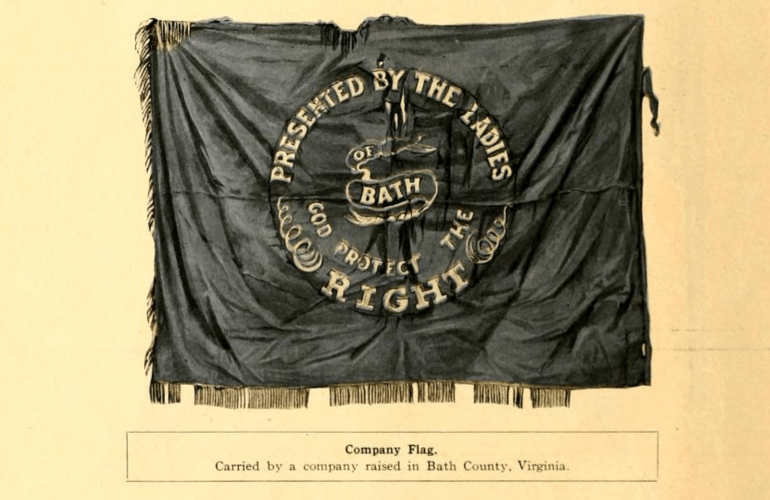
Union forces captured several flags at Philippi on June 3, 1861, but accounts vary regarding how many were taken, who they belonged to, what they looked like, and where they are now. One often-overlooked flag belonged to the Bath Cavalry, also known as the Bath Grays, a company raised in the mountainous region of Bath…
artifacts
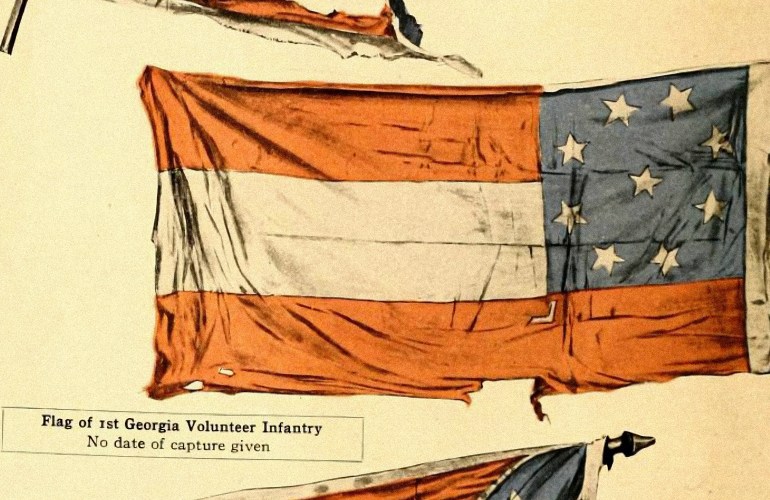
Flag of the First Georgia Regiment (Ramsey’s)
In 1905, Congress passed a resolution directing the War Department to return captured Confederate flags to their respective states. The United Confederate Veterans published a record of these flags called The Flags of the Confederate Armies, containing colorized photographs and short descriptions of the units that bore them in battle. Among them was the regimental…
Continue reading ➞ Flag of the First Georgia Regiment (Ramsey’s)
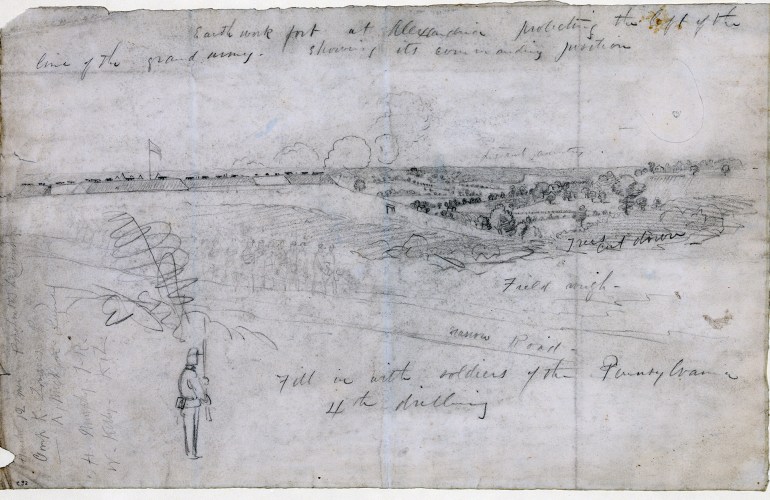
Earthwork Fort at Alexandria Protecting the Left of the Line of the Grand Army
This unfinished pencil drawing by famed artist Alfred Rudolph Waud (1828-1891) depicts Fort Ellsworth on Shuter’s (or Shooter’s) Hill, west of Alexandria in late June / early July 1861. Illustration has been enhanced to show details. Library of Congress Prints and Photographs Division. Click on the image to expand. The illustration is titled, Earthwork fort…
Continue reading ➞ Earthwork Fort at Alexandria Protecting the Left of the Line of the Grand Army
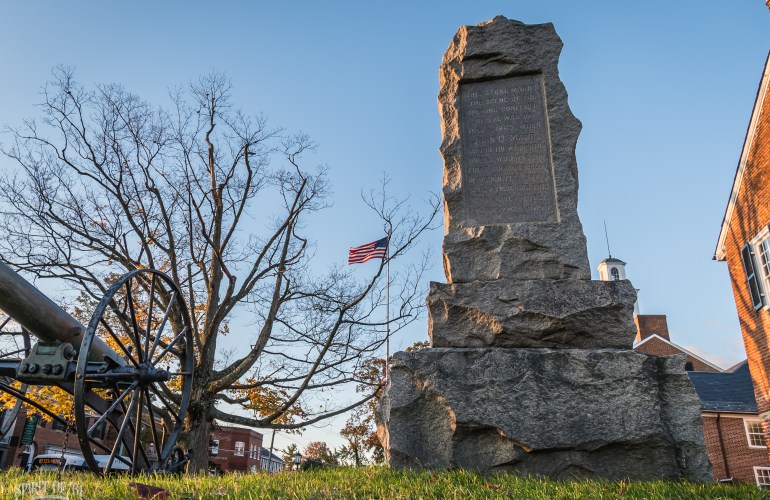
What Happened to Fairfax County’s John Q. Marr Monument?
John Q. Marr’s fatal encounter with Union cavalry in Fairfax Court House on June 1, 1861, marked a bloody opening salvo of the Civil War, yet the debate over his legacy—and the monument that once bore his name—continues over a century later. For over a century, a granite monument stood near the old Fairfax County…
Continue reading ➞ What Happened to Fairfax County’s John Q. Marr Monument?
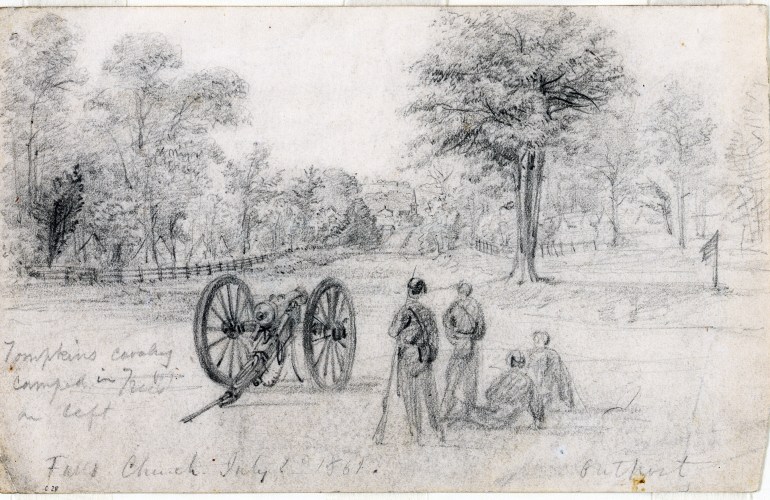
Outpost Watching Falls Church, Virginia, 1861
This pencil drawing by famed artist Alfred Rudolph Waud (1828-1891) depicts a Union artillery piece and camp of 2nd United States Cavalry, Company B, led by Lieutenant Charles H. Tompkins, near Falls Church, Virginia on July 1, 1861. Exactly one month earlier, Tompkins led a chaotic reconnaissance on Fairfax Court House, in which several of…
Continue reading ➞ Outpost Watching Falls Church, Virginia, 1861
A PROCLAMATION BY THE GOVERNOR OF VIRGINIA
John Letcher, governor of Virginia, 1860–1864. Library of Congress Prints and Photographs Division The following proclamation by the Virginia governor, John Letcher (1813-1884), appeared in the Richmond Whig, Thursday, April 18, 1861, as well as other newspapers around the state in response to U.S. President Abraham Lincoln's calling for a volunteer army to suppress the…
Continue reading ➞ A PROCLAMATION BY THE GOVERNOR OF VIRGINIA
New Issue of Frank Leslie’s Illustrated Newspaper
Frank Leslie's Illustrated Newspaper was published in New York from 1855 to 1922 and produced many volumes of compiled illustrated histories of the American Civil War. Its correspondents and illustrators got close to the action, so close, in fact, that one of their freelance correspondents, James R. O'Neill, was killed during the Battle of Baxter…
Continue reading ➞ New Issue of Frank Leslie’s Illustrated Newspaper
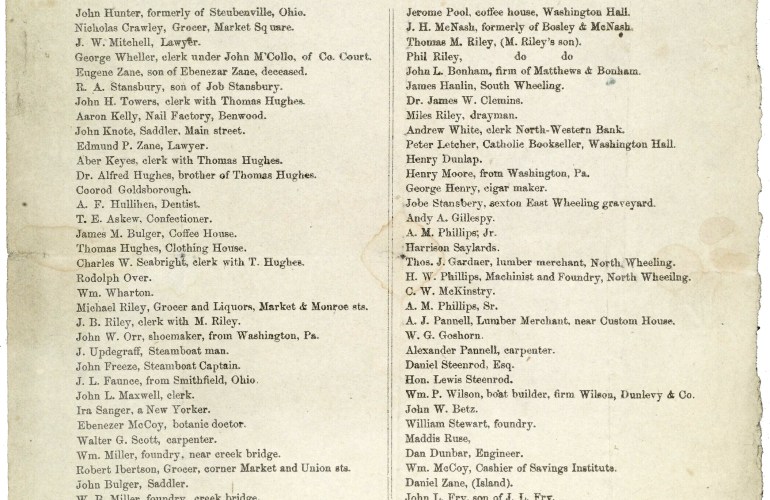
Artifact: Traitors in Wheeling
The town of Wheeling, located along the Ohio River in what was then the Virginia panhandle (today, West Virginia), was Virginia’s fourth largest city in 1860. Sandwiched between the free states of Ohio and Pennsylvania, it was largely populated by German immigrants with no affinity for Virginia’s Anglo-American planter class. When the Secession Convention in…
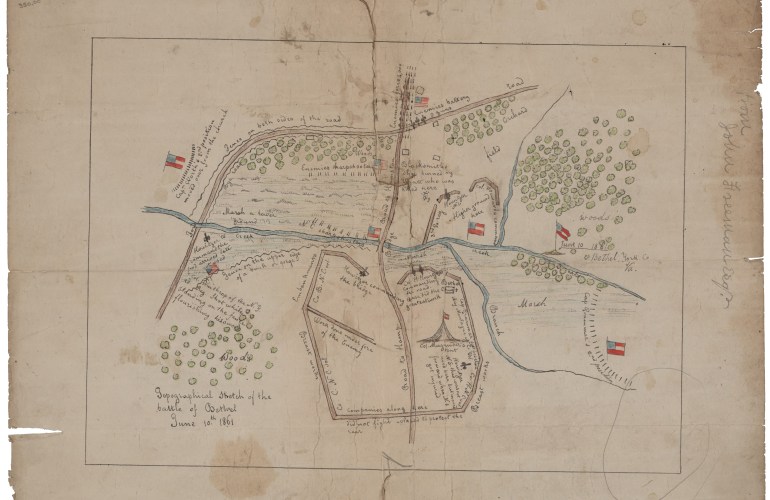
Topographical Sketch of the Battle of Bethel, June 10th 1861
The Battle of Big Bethel (or Great Bethel) was fought on Monday, June 10, 1861 between Union forces commanded by Brig. Gen. Ebenezer Peirce and Confederate forces commanded by Col. John B. Magruder and Col. Daniel Harvey Hill in what is today Hampton, Virginia. It was among the American Civil War’s first pitched battles. Until…
Continue reading ➞ Topographical Sketch of the Battle of Bethel, June 10th 1861
Three New Issues of Harper’s Weekly Added
Harper’s Weekly, A Journal of Civilization was published in New York City from 1857 to 1916. Though imperfect, as most print media was in the late nineteenth century, Harper’s Weekly records the important events of America’s Civil War. It contains many wonderful illustrations that give modern readers a glimpse into that critical period’s military and…
Continue reading ➞ Three New Issues of Harper’s Weekly Added