Sunday, July 7, 1861
On July 7, 1861, Union and Confederate forces clashed in a brief but intense skirmish at Glenville, West Virginia, as part of the larger struggle for control of northwestern Virginia. Though neither side suffered casualties, the engagement highlighted the growing Union presence in the region and foreshadowed larger battles to come.
Narrative
The Skirmish at Glenville was fought on Sunday, July 7, 1861 between Union forces commanded by Col. John M. Connell and Confederate forces commanded by Col. Robert Alexander Caskie in present-day Gilmer County, West Virginia.
It had been two months and 11 days since Union Maj. Gen. George B. McClellan invaded northwestern Virginia, and additional volunteer regiments arrived weekly to reinforce him. It had been over a month since Confederate forces fled from Philippi. Their commander, Col. George A. Porterfield, was replaced with Robert E. Lee’s adjutant general, Brig. Gen. Robert S. Garnett. He proceeded to fortify positions at Laurel Hill and Rich Mountain in Barbour and Randolph counties to guard the two main mountain roads leading into the Shenandoah Valley.
As Maj. Gen. McClellan maneuvered his forces into position in front of Laurel Hill and Rich Mountain to confront Garnett, he spread his forces across what was then northwestern Virginia, protecting vital transportation routes and providing legitimacy for the fledgling Unionist Restored Government of Virginia in Wheeling.
Members of the 17th Ohio Volunteer Infantry Regiment, led by Col. John M. Connell, initially enlisted for three months in and around Lancaster, Ohio in April 1861. They were sent to Parkersburg, Virginia (today, West Virginia) along the Ohio River to root out secessionist militias in Jackson County. In early July, Maj. Gen. George B. McClellan attached the 17th Ohio to Brig. Gen. William S. Rosecrans’ brigade. They then marched approximately 94 miles east to Buckhannon, to guard supply trains.
As elements of the 17th Ohio were moving through the small town of Glenville along the Little Kanawha River, 42 miles west of Buckhannon, they were attacked by the 1st Cavalry Regiment, Wise Legion commanded by Col. Robert Alexander Caskie. Glenville, population 398 in 1860, was the seat of Gilmer County.
Accurate reports of the skirmish are difficult to find, but evidently it continued the next day. Connell’s men were able to get a scout through to Buckhannon, and Maj. Gen. McClellan sent the 7th and 10th Ohio regiments to relieve them. The Confederates, realizing they were about to be outnumbered and with no reinforcements of their own in sight, hastily withdrew. There were no reported casualties on either side.
Opposing Forces
Confederate
Col. Robert Alexander Caskie, Commanding
| Unit | Commander(s) | Strength | Killed | Wounded | Captured |
|---|---|---|---|---|---|
| 1st Cavalry Regiment, Wise Legion | Col. Robert Alexander Caskie | 160 |
Union
Col. John M. Connell, Commanding
| Unit | Commander(s) | Strength | Killed | Wounded | Captured |
|---|---|---|---|---|---|
| 17th Ohio Infantry Regiment, Co. C, D, J, and K | Lt. Col. Francis B. Pond | 360 |
Timeline
June 13-15, 1861: Brig. Gen. Robert S. Garnett is placed in command of Confederate forces in northwestern Virginia. He proceeds to fortify positions at Laurel Hill and Rich Mountain in Barbour and Randolph counties to guard the two main mountain roads.
July 2, 1861: Union Maj. Gen. George B. McClellan occupies Buckhannon in Upshur County, approx. 23 miles from the Confederate encampment at Rich Mountain.
July 6, 1861: The 17th Ohio Infantry Regiment is ordered to Buckhannon to guard supply trains.
July 7, 1861: Union forces arrive in front of Rich Mountain and Laurel Hill.
Location
GPS Coordinates — 38.93425, -80.8376
Primary Sources
News Articles
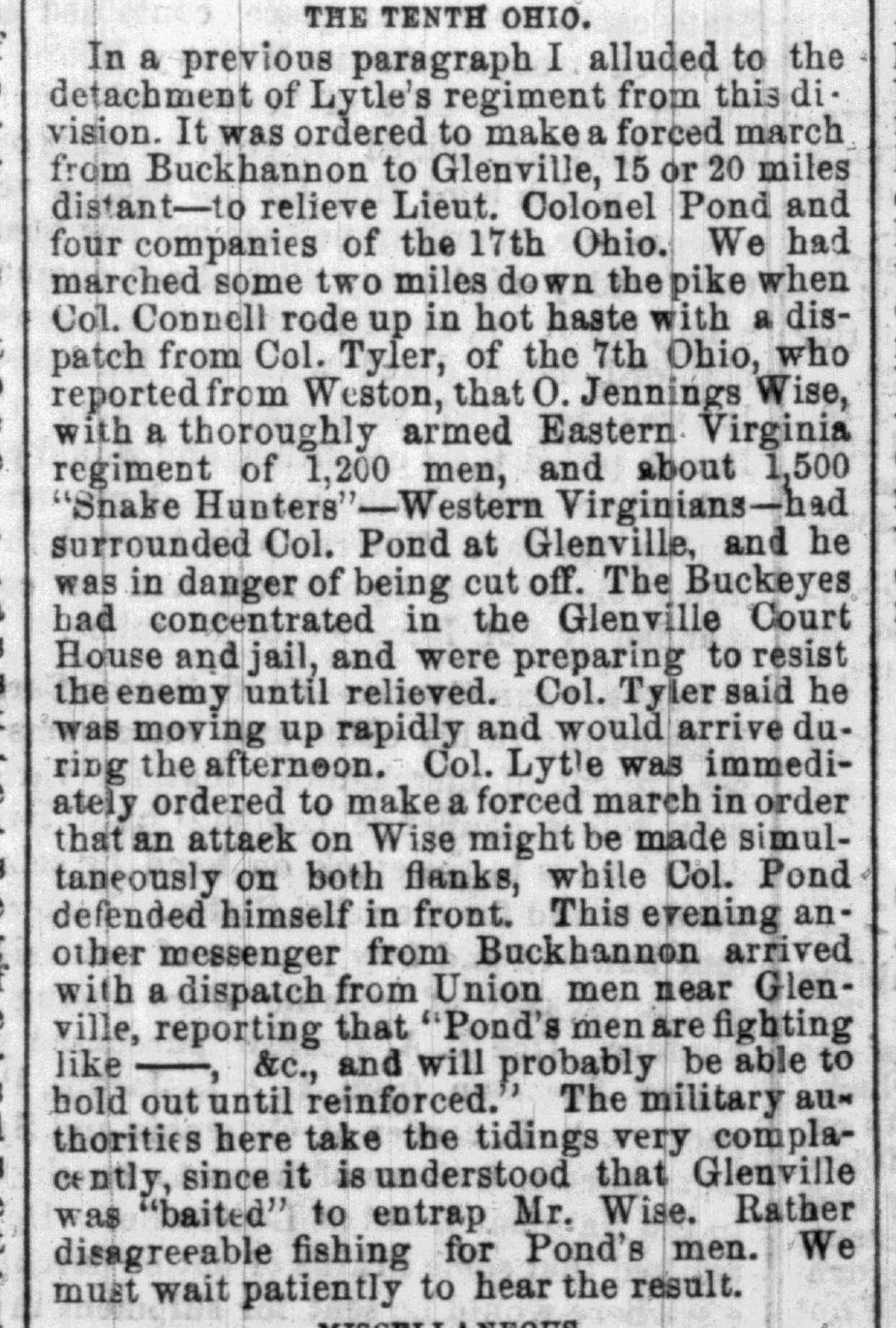
Cincinnati Daily Commercial (Cincinnati, OH) 18 July 1861.
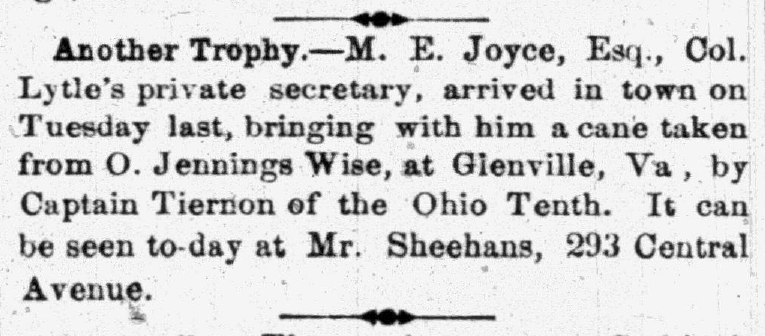
Cincinnati Daily Gazette (Cincinnati, OH) 18 July 1861.

Cleveland Morning Leader (Cleveland, OH) 22 July 1861.
Reports and Letters
- Jul. 5 Report of Maj. Gen. George B. McClellan
- Jul. 6 Report of Maj. Gen. George B. McClellan
- Jul. 7 Report of Maj. Gen. George B. McClellan (1st)
- July 8th Report of Colonel John M. Connell, Seventeenth Ohio Infantry
Sources
Lowry, Terry. The Battle of Scary Creek: Military Operations in the Kanawha Valley April – July 1861. Charleston: Quarrier Press, 1982, 1998.
Stutler, Boyd B. West Virginia in the Civil War. Charleston: Education Foundation, Inc., 1966.
Updated: 15 March 2025
Created: 25 March 2021
 Spirit of '61