Thursday, June 27, 1861
In June 1861, a Confederate cavalry patrol skirmished with unionist Home Guards in Northwest Virginia, in a brief but chaotic exchange of fire. Though no casualties were reported, the encounter highlighted the fluid and unpredictable nature of the war in a region caught between opposing loyalties.
Narrative
The Action at Buckhannon occurred on Thursday, June 27, 1861 between a patrol from the Churchville Cavalry commanded by Capt. Franklin F. Sterrett and unionist Home Guards commanded by Col. Henry F. Westfall in Buckhannon, Upshur County, West Virginia. Though no one was hurt, the short fight and the rumors it sparked pushed George B. McClellan to launch his final campaign against Robert S. Garnett.
In mid-June 1861, Upshur County became the center of military activity in northwestern Virginia. Its county seat, Buckhannon, sat astride the Staunton-Parkersburg Turnpike and served as a hub for other improved roads leading to Weston and Clarksburg. Situated between the Union and Confederate armies, control of this crossroads was key to securing freedom of movement throughout the region.
Like many counties in northwest Virginia, Upshur was a unionist stronghold where voters opposed secession by a 7-to-3 supermajority. While most of its antebellum militia officers actively undermined mobilization orders from Richmond, there were notable exceptions, including the mayor of Buckhannon, Col. L. L. D. Loudin. He supported the county’s only secessionist company, the Upshur Grays.
Local unionists like Sylvester Bunyan (S.B.) Phillips recruited volunteer companies for the Union army, and others, including Watson Westfall, Henry F. Westfall, and Daniel D. T. Farnsworth, organized a network of pro-Union Home Guard units. After the victory at Philippi, unionist confidence soared, causing prominent local secessionists to flee.
On June 6, urged on by Congressman John S. Carlile, who was helping to establish a loyal state government in Wheeling, Department of the Ohio commander Maj. Gen. George B. McClellan telegraphed his superiors: “Recent developments show that it is absolutely necessary to muster in Virginia troops between Grafton and Parkersburg for service in that State.” Permission came swiftly, and recruits began assembling in Clarksburg, Carlile’s hometown.
Provisional Confederate President Jefferson Davis arrived in Richmond at the end of May, and on June 8, Virginia Governor John Letcher formally handed over control of the state’s secessionist volunteers. Davis retained Robert E. Lee as a military advisor. To command forces in northwest Virginia, he selected Lee’s adjutant, Robert Selden Garnett.
After arriving at Huttonville, Garnett began drilling and organizing his small army. He developed a strategy to block the two main turnpikes crossing the Alleghenies into the Shenandoah Valley, establishing his headquarters at Laurel Hill in Barbour County on the Beverly-Fairmont Turnpike. To fortify Rich Mountain overlooking the Staunton-Parkersburg Turnpike, he placed Lt. Col. Jonathan M. Heck in command of the 25th Virginia Infantry Regiment.
As the Confederates dug in at Laurel Hill and Rich Mountain, Brig. Gen. Thomas A. Morris, commanding the Union expedition in McClellan’s absence, hesitated. Although his forces had a significant numerical advantage, they were spread thin protecting key railroad points and, critically, lacked the wagons needed for a sustained offensive. However, after receiving (false) intelligence that rebels were active near Buckhannon, Morris was prompted to act, ordering Col. James B. Steedman to lead a column to the town. It consisted of Steedman’s 14th Ohio Infantry Regiment, three companies from the 15th Ohio, and a section of artillery.
Leaving before dawn, the column began its twenty-mile trek from Philippi to Buckhannon over rough, narrow roads meandering through the hills. The nervous 90-day volunteers expected an attack at any moment, but the “seceshers” were nowhere to be seen. After marching all day, the sight of Buckhannon lifted the column’s spirits, and they were greeted with enthusiastic cheers from Upshur County’s Unionists.
Steedman’s stay in Buckhannon was cut short when a courier from Philippi raced into camp the following afternoon. Morris heard a rumor that former Virginia governor Henry A. Wise was preparing to attack Philippi. The Union army worried more about Wise and his “legion” in the Kanawha Valley than they did about Garnett’s troops encamped mere miles away. Steedman’s men left their provisions, including nine barrels of salt pork, with the Home Guard and hastily returned to Philippi.
Dissatisfied with his army’s progress, McClellan crossed the Ohio River into Virginia in late June. The reinforcements he brought increased Union forces in northwest Virginia to around twenty thousand men—more than enough to dislodge Garnett from his mountain fortresses. The “Young Napoleon” arrived at Grafton on June 23 and remained for nearly a week to resolve supply and logistical issues before advancing.
On June 25, as S. B. Phillips’ company headed to Clarksburg to be mustered into the Union army, Lt. Col. Jonathan M. Heck on Rich Mountain received orders to lead a foraging expedition to Buckhannon. The next morning, Heck’s column, with a portion of his regiment and all their wagons, began its slow descent from the mountain along the Staunton-Parkersburg Turnpike. It was likely no coincidence that the Confederates waited until Phillips’ company was well on its way to Clarksburg before making their move.
Scouting ahead was Capt. Francis F. Sterrett’s Churchville Cavalry, followed by three infantry companies and a twenty-wagon train overseen by Col. Rudolph Turk. After marching approximately eighteen miles, passing through the covered bridge over the Middle Fork River, the column stopped for the evening near Sand Run, five miles outside of Buckhannon. There, Sterrett’s troopers split into small patrols to scout the surrounding roads.
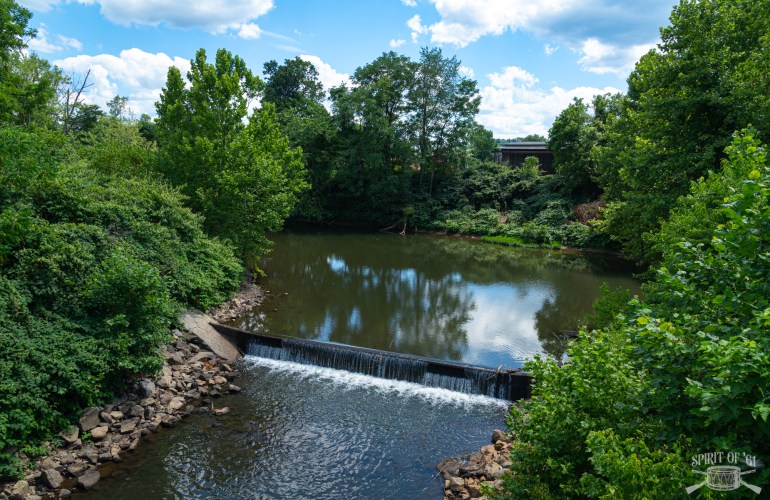
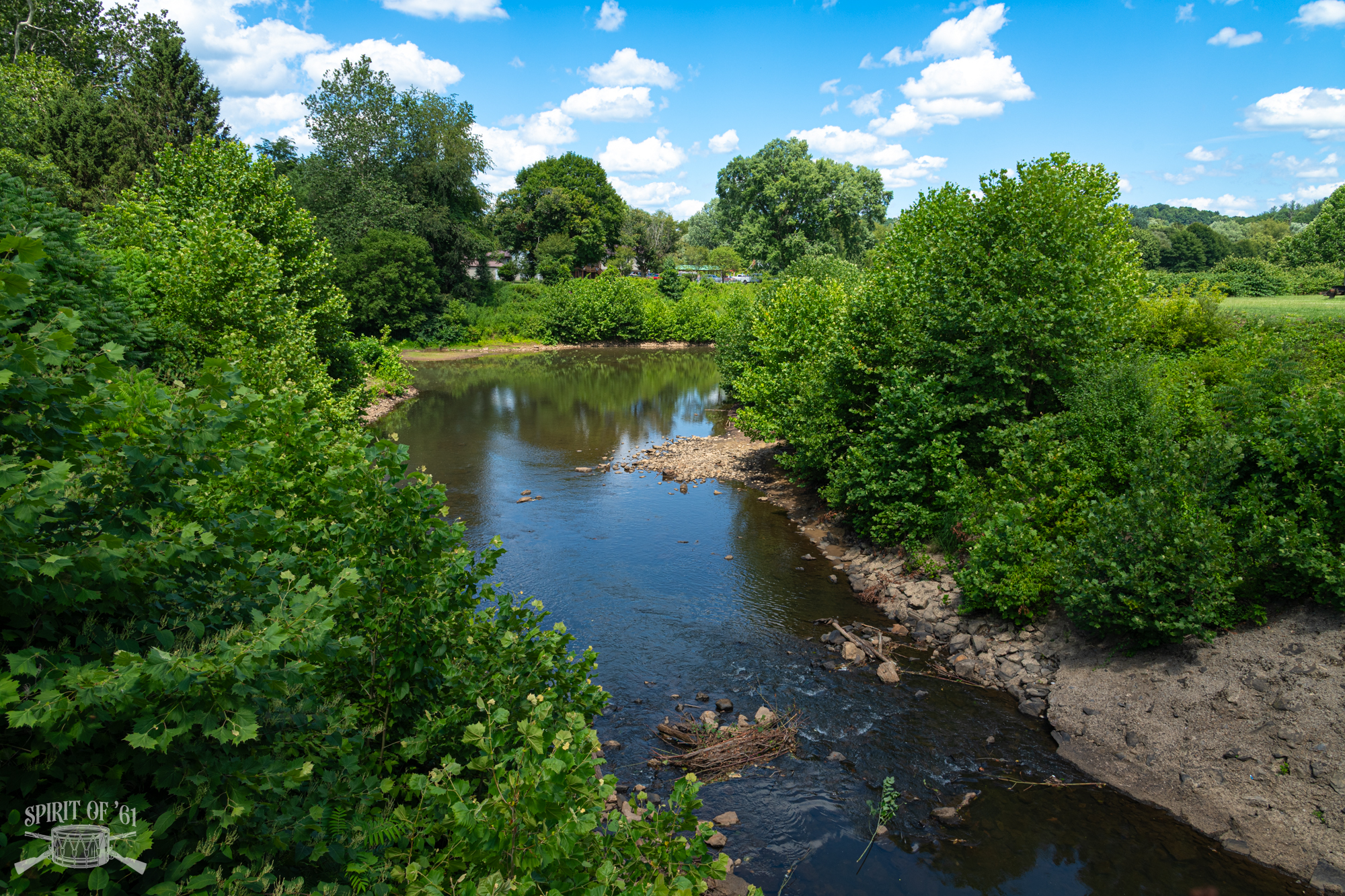
The fight began at daybreak on June 27. The town of Buckhannon was situated south of an elongated oxbow of the Buckhannon River, which was bisected by a millrace that powered Ridgeway’s gristmill. As the mill ground meal, about a dozen of Sterrett’s troopers stood guard. Suddenly, shots rang out from the thick underbrush of a nearby stand of trees.
The Home Guard likely fired flintlock muskets and squirrel guns with an effective range of under one hundred yards, while Sterrett’s men, armed with pistols and shotguns, had an even shorter range. “There was no damage done by either party, the enemy being ambushed in a thick wood in an unapproachable position,” Heck later reported. The Home Guard remained just long enough to demonstrate its resolve, then fled.
As Heck’s infantry and wagons hurried toward Buckhannon, terror gripped Upshur County’s unionists. Whole families took to the hills, and when Heck’s men entered Buckhannon, they found it a ghost town. A search uncovered the provisions left by the 14th Ohio more than a week earlier. Soon, curious civilians returned and opened their stores, from whom Heck’s men “purchased from the citizens a sufficient quantity of corn, bacon, oats, quartermaster and ordnance stores, (a small quantity of powder and lead,) to load all the wagons we had with us.”
The Confederates captured two Home Guard members, Arthur G. Kiddy and James L. Jennings, as they fled up the macadamized Clarksburg Turnpike. According to Kiddy, Colonel Turk arrested the pair and brought them to Buckhannon. After being searched, the prisoners were then taken to jail in Beverly, where they and others were forced to clean the streets with cast-iron balls chained to their legs. Contrary to some reports, they were not forced to dig trenches at Camp Garnett on Rich Mountain.
Early that afternoon, Heck’s teamsters packed their wagons, and the column, loaded with provisions, two prisoners, and a reclaimed horse, turned back toward Rich Mountain. After camping along the east bank of the Middle Fork River, they returned to Camp Garnett on the morning of June 28. A Home Guard company led by a Capt. Boyles followed, sniping at the column. Sterrett’s troopers turned them back at the Middle Fork River, suffering only one casualty in the process—a horse shot in the hip.
Unionists, abetted by Congressman John S. Carlile, greatly exaggerated the encounter, falsely reporting a major Union victory to bolster support for the new loyal state government in Wheeling. However, when word reached McClellan that Confederates had occupied Buckhannon, he was spurred to action. He immediately ordered his army to advance into Upshur County, beginning his campaign against Robert Garnett in earnest.
Opposing Forces
Confederate
Lt. Col. Jonathan McGee Heck, Commanding
| Unit | Commander(s) | Strength | Killed | Wounded | Captured |
|---|---|---|---|---|---|
| 25th Virginia Inf. Reg. | Lt. Col. Jonathan M. Heck | 275 | 0 | 0 | 0 |
| Churchville Cavalry | Capt. Franklin F. Sterrett | 15 | 0 | 0 | 0 |
Union
Col. Henry F. Westfall, Commanding
| Unit | Commander(s) | Strength | Killed | Wounded | Captured |
|---|---|---|---|---|---|
| Home Guard | Lt. Col. Watson Westfall Capt. Boyles | 25-40 | 0 | 0 | 2 |
Timeline
May 28, 1861: Confederate Col. George A. Porterfield withdraws from Grafton south to Philippi. Brig. Gen. Thomas A. Morris takes immediate command of all Union forces in the field in northwestern Virginia.
June 3, 1861: Union troops under Morris surprise and nearly surround Porterfield’s command at Philippi, but the Confederates escape to Beverly on the Tygart Valley River.
June 11, 1861: Second Wheeling Convention opens in Wheeling, Virginia on the Ohio River. Delegates meet to determine a new, pro-Union Restored Government of Virginia.
June 13-15, 1861: Brig. Gen. Robert S. Garnett is placed in command of Confederate forces in northwestern Virginia. He proceeds to fortify positions at Laurel Hill and Rich Mountain in Barbour and Randolph counties to guard the two main mountain roads, and sends Lt. Col. Jonathan M. Heck to Rich Mountain.
June 14, 1861: Companies from the 14th and 15th Ohio regiments camp at Buckhannon, but are quickly withdrawn due to rumors of an attack.
June 25, 1861: Garnett orders Lt. Col. Heck to take his wagons on a foraging expedition to Buckhannon.
Location
GPS Coordinates — 38.99578, -80.22095
Primary Sources
News Articles
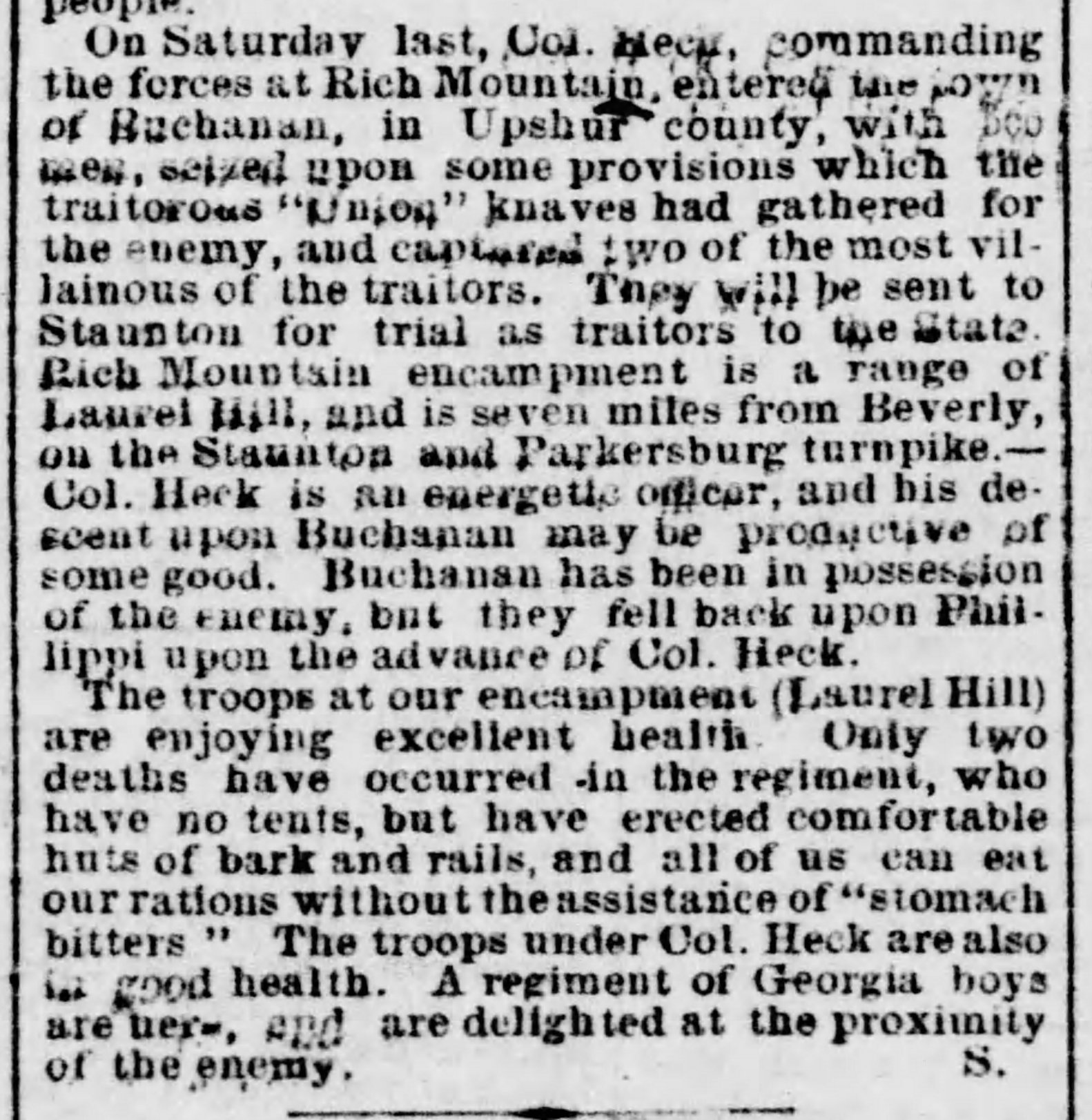
Daily Dispatch (Richmond) 6 July 1861.
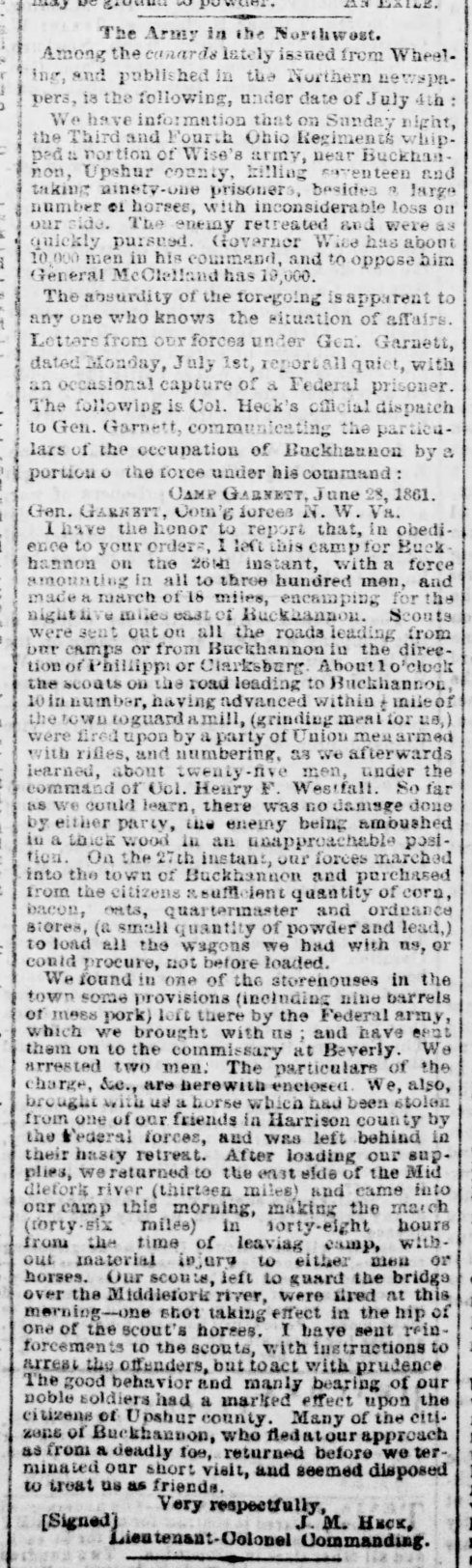
Daily Dispatch (Richmond) 9 July 1861.
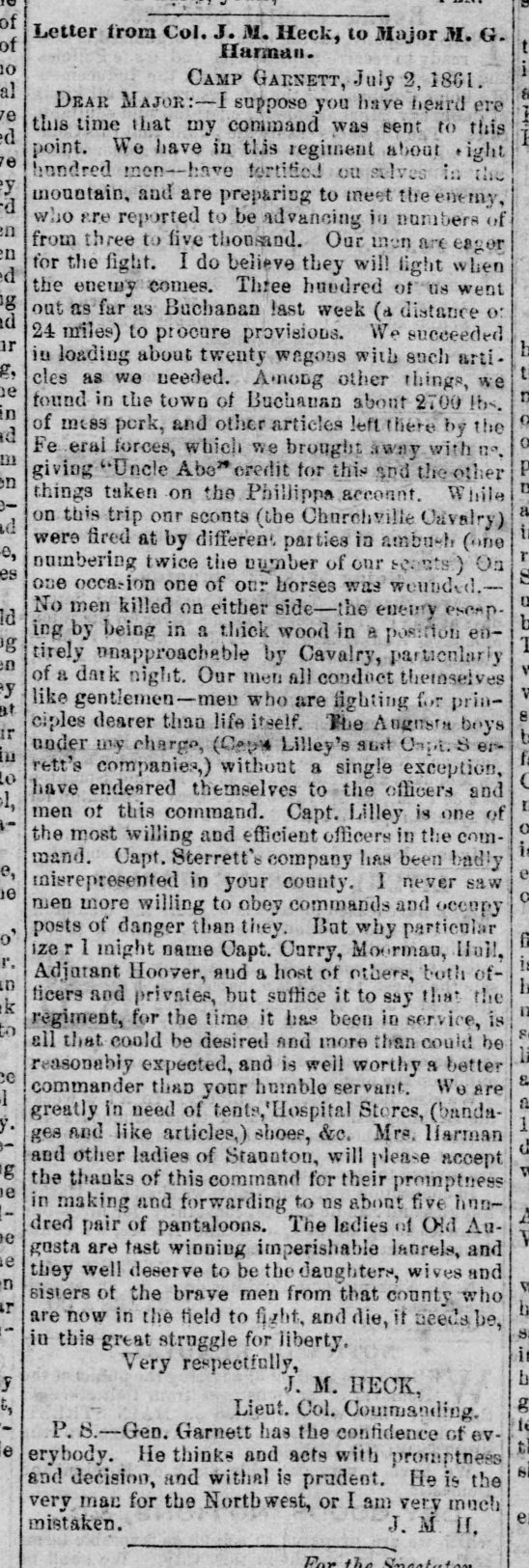
Staunton Spectator (Staunton) 9 July 1861.
Reports and Letters
- June 19 Letter from Charles W. Russell to L. P. Walker
- June 29 Report of Brig. Gen. William S. Rosecrans, U. S. Army
- 1861 Report of Lt. Col. Jonathan McGee Heck, Twenty-fifth Virginia Infantry
Diaries and Memoirs
Bird, Jacob, ed. and Arthur G. Kiddy. Narrative of Two Perilous Adventures Recently Made into Dixie’s Land. Also an Account of Six Months’ Imprisonment in a Secession Jail. Pittsburgh: W. S. Haven, 1862.
Phillips, Marcia L. My Poor Dear Syl: The Upshur County Civil War Diary and Letters of Marcia Louise Sumner Phillips. Buckhannon: Upshur County Historical Society, 2013.
Westfall, Henry F. Diary of Henry F. Westfall, 1861, transcript by Beatrice Arnold Giffin in Robert F. Kidd Library Archives, Glenville State University, Glenville, WV.
Secondary Sources
Cutright, William Bernard. The History of Upshur County, West Virginia: From its Earliest Exploration and Settlement to the Present Time. Buckhannon: By the author, 1907.
Heselberger, Fritz. Yanks from the South! The First Land Campaign of the Civil War: Rich Mountain, West Virginia. Baltimore: Past Glories, 1987.
Hornbeck, Betty. Upshur Brothers of the Blue and Gray. Parsons: McClain Printing Company, 1967.
Kleen, M. A. “’A Kind of Dreamland’: Upshur County, WV at the Dawn of Civil War, April–July 1861.” Ohio Valley History 25 (Spring 2025): 13-31.
Updated: 27 March 2026
Created: 27 February 2024
 Spirit of '61