Tuesday, July 16, 1861
In July 1861, as Union forces advanced into the Kanawha Valley, a Confederate cavalry charge at Pocatalico River set the stage for the looming Battle of Scary Creek. But was this bold skirmish the victory it was claimed to be, or merely a fleeting clash amplified by Confederate hopes?
Narrative
The Action at Pocatalico was fought on Tuesday, July 16, 1861 between Union forces commanded by Col. Charles A. De Villiers and Confederate forces commanded by Col. John N. Clarkson in Putnam County, West Virginia. It ended in a draw, with minimal casualties.
As 34-year-old Maj. Gen. George Brinton McClellan (1826-1885), head of the U.S. Military Department of the Ohio, began his campaign to secure northwest Virginia, he was initially reluctant to send troops into the Kanawha River Valley. Local Unionists assured him they could manage the secessionist threat, but when former Virginia governor Henry A. Wise established a base camp near Charleston with around 2,700 Confederate troops, McClellan was compelled to take action.
In early July 1861, Wise briefly occupied the town of Ripley in Jackson County but withdrew after the 21st Ohio crossed the river to confront him. Despite near-misses between the opposing forces, no fighting had occurred yet. McClellan ordered Brig. Gen. Jacob Dolson Cox, Jr. (1828-1900) to take command of Union troops in the area and “Drive Wise out and catch him if you can.”
To accomplish this task, Cox had the 1st and 2nd Kentucky (U.S.) and the 11th, 12th, and 21st Ohio Infantry regiments, along with two brass rifled 6-pounder guns and a small cavalry unit—totaling about 3,000 men. Cox divided his forces into three columns to advance into the Kanawha Valley, with orders to reunite at Red House and confront Wise at Charleston. On July 13th, the 2nd Kentucky engaged and scattered a small Confederate force at Barboursville, delaying its arrival.
That same afternoon, Cox arrived at Red House with four companies of the 11th Ohio, the 12th and 21st Ohio regiments, and four cannon (two without caissons or cannoneers). Red House was approximately 31 miles up river from his starting point at Point Pleasant. The following day, Col. Jesse S. Norton took Companies F, G, and H of the 21st Ohio on a reconnaissance mission along the south bank of the Kanawha River to the mouth of Scary Creek. There they encountered the Kanawha Riflemen, Putnam Border Rifles, Bailey’s Company, and a section of artillery. The Confederate artillery fired warning shots and Norton’s men retreated.
Meanwhile, half of the 1st Kentucky (U.S.) arrived at Red House, commanded by Lt. Col. David Alexander Enyart, and that evening Cox sent them and the remainder of the 21st Ohio to reinforce Norton. Shortly after they departed, however, due to darkness and inexperience, a misinterpreted order resulted in a friendly-fire incident that left three dead and several wounded.
From Red House, Cox’s next destination was the mouth of the Pocatalico, seven miles upriver. The Confederates burned the bridge over the Pocatalico, but at that time of year the river was so dry that it was easily forded. Confederate vedettes contested the advance. “The progress thus far has been steady, but for the last day it has been in the face of constant skirmishing,” wrote Cox. Thomas Vandyne/Vandine of Company H, 11th Ohio was wounded in the hip and died a few weeks later.
The 11th Ohio was first to reach the west bank of the Pocatalico River on the 16th along with Capt. Charles S. Cotter’s two rifled 6-pounders, and they began scouting the area for a campsite. General Wise’s aide-de-camp, Col. John N. Clarkson, and Capt. John P. Brock’s and Capt. Albert J. Beckett’s cavalry companies were picketing on the east side of the river.
Evidently, as a portion of the 11th Ohio descended the large hill overlooking the Pocatalico, Clarkson spotted them and determined to drive them off. He divided his force, leaving one half at the base of the hill, and charged with the other half. “I proceeded to the hill near the Mouth of the Polka … and then came into contact with some three hundred of the enemy which we charged with success killing eight of the enemy agreeable to the best information I could receive, and routing the remainder, driving them to their camp without any loss to my command…” Brock reported.
Few, if any, Union accounts of this incident exist. Cox does not mention it in his published reports and a brief description appearing in the Cincinnati Daily Times is far less dramatic. It read, “Soon after the Eleventh halted a company of rebel horsemen, acting as scouts, came to the river bank opposite and poured a volley of balls into their camp, without, however, injuring anyone. The Eleventh returned fire, emptying one saddle…”
It’s unlikely any Union soldiers were killed or wounded without it being mentioned in the press. On the Confederate side, one private was wounded in the hand, one horse killed, and several horses were wounded.
Never-the-less, Wise reiterated Brock’s version of events in a report to Richmond, bragging that all he needed was more arms and ammunition and “I will drive them into the Ohio River and across…” The next day, Wise’s men would win a significant victory at Scary Creek, but his imagined offensive would never materialize. Wise evacuated Charleston on July 24th.
Opposing Forces
Confederate
Col. John N. Clarkson, Commanding
| Unit | Commander(s) | Strength | Killed | Wounded | Captured |
|---|---|---|---|---|---|
| Rockingham Valley Rangers | Capt. John P. Brock | 49 | 0 | 1 | 0 |
| Beckett’s Border Guards | Capt. Albert J. Beckett | 70 | 0 | 0 | 0 |
| 119 | 0 | 1 | 0 |
Union
Brig. Gen. Jacob D. Cox, Jr., Commanding
| Unit | Commander(s) | Strength | Killed | Wounded | Captured |
|---|---|---|---|---|---|
| 11th OH Infantry Regiment | Col. Charles A. De Villiers | 400 | 0 | 0 | 0 |
| Cotter’s Ind. Battery Ohio Light Artillery | Capt. Charles S. Cotter | 2 guns, 51 men | 0 | 0 | 0 |
| 426 | 0 | 0 | 0 |
Timeline
July 11, 1861: Union Brig. Gen. Jacob D. Cox, Jr. crosses the Ohio River with five regiments to drive Brig. Gen. Henry A. Wise’s brigade out of the Kanawha Valley.
July 13, 1861: Lt. Col. George W. Neff and five companies of the 2nd Kentucky (U.S.) defeat Confederate forces at Barboursville, (West) Virginia. Cox arrives at Red House.
July 14, 1861: Members of the 1st Kentucky (U.S.) and 21st Ohio regiments are involved in a friendly fire incident that kills three and wounds several others.
July 16, 1861: Cox’s advanced units reach the Pocatalico River.
Location
GPS Coordinates — 38.48217, -81.81638
Primary Sources
News Articles

Cincinnati Daily Gazette (Cincinnati, OH) 20 July 1861.
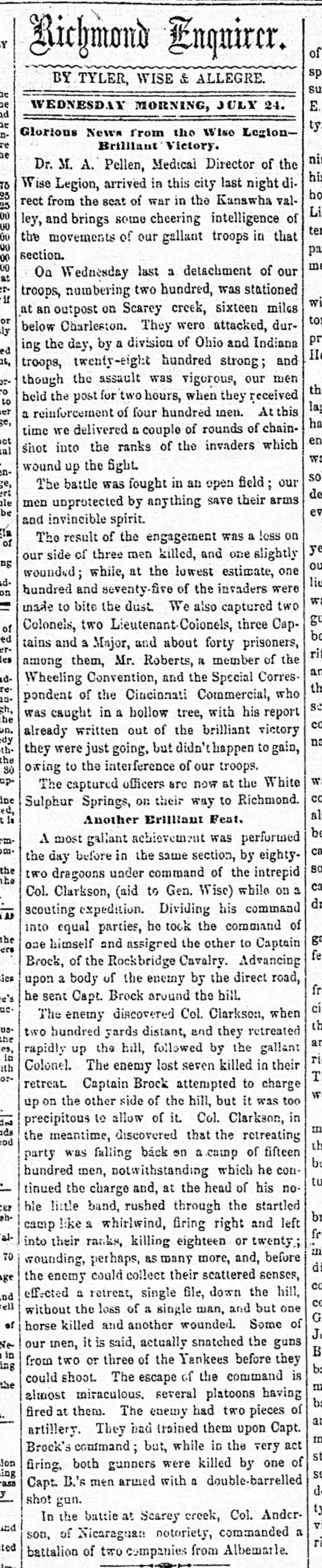
Richmond Enquirer (Richmond, VA) 26 July 1861.
Reports and Letters
- July 11 Report of Jacob D. Cox, District of the Kanawha
- Jul. 14 Report of Maj. Gen. George B. McClellan (2nd)
- July 14 Report of Jacob D. Cox, District of the Kanawha
- July 16 Report of Jacob D. Cox, District of the Kanawha
- July 17 Report of Brig. Gen. Henry A. Wise, C.S. Army
Memoirs
Cox, Jacob Dolson. Military Reminiscences of the Civil War. Vol. I. New York: Charles Scribner’s Sons, 1900.
Secondary Sources
Driver, Robert J., Jr. 10th Virginia Cavalry. Lynchburg: H.E. Howard, Inc., 1992.
Lowry, Terry. The Battle of Scary Creek: Military Operations in the Kanawha Valley April – July 1861. Charleston: Quarrier Press, 1982, 1998.
Phillips, David L. War Diaries: The 1861 Kanawha Valley Campaigns. Leesburg: Gauley Mount Press, 1990.
Updated: 15 March 2025
Created: 25 October 2024
 Spirit of '61