Friday, July 19, 1861
Amid the rugged terrain of Cheat Mountain, a deadly ambush at Hanging Rock left soldiers on edge as Confederate guerrillas vanished into the wilderness. This small but impactful action marked a dramatic moment in the struggle for control over northwestern Virginia’s strategic mountain passes.
Narrative
The Action at Greenbrier River was fought on Friday, July 19, 1861 between Union forces commanded by Sgt. William D. Gault and a Confederate irregular unit in present-day Pocahontas County, West Virginia. The ambush, along with similar actions by Confederate guerrillas, not only inflicted heavy casualties but also paralyzed Union forces on Cheat Mountain, halting their advance and effectively creating a stalemate until the fall.
The death of Brigadier General Robert S. Garnett and the crippling of the Army of the Northwest at Corrick’s Ford temporarily ended organized Confederate resistance in northwestern Virginia. A flurry of letters and dispatches from Confederate commanders urged someone to hold Cheat Mountain Pass, but the 14th Indiana Infantry Regiment secured it first. Cheat Mountain, strategically positioned astride the Staunton-Parkersburg Turnpike about 80 miles northwest of Staunton, gave the Union uncontested control of more than 10,000 square miles of Trans-Alleghany Virginia.
Under Colonel Nathan Kimball, the 14th Indiana began constructing Cheat Summit Fort (also known as Fort Milroy) on July 16 at the 4,000-foot summit of Cheat Mountain. They were soon joined by Captain Cyrus O. Loomis’ Battery A, 1st Michigan Light Artillery, and Captain Henry W. Burdsall’s Independent Company of Ohio Cavalry, also called Burdsall’s Dragoons.
In northwestern Virginia, where most residents were Unionists, the Union Army was welcomed with recruits, supplies, and intelligence. However, resistance stiffened as the troops moved deeper into the interior. Virginians unaffiliated with formal military units began harassing Union forces by cutting telegraph wires and sniping from mountain crags and dense forests.
This guerrilla activity became so pernicious that on June 23, Major General George B. McClellan issued an open letter condemning such tactics. He warned that anyone firing on sentries or pickets, burning bridges, or harassing Unionists “will be dealt with in their persons and property according to the severest rules of military law.”
By July 19, 1861, Confederate Brigadier General Henry R. Jackson reported from Monterey that the “débris of General Garnett’s command are constantly pouring in.” To counter Union advances, Jackson formed a composite unit of cavalry and militia under Major Alexander C. Jones of the 44th Virginia Infantry, a Virginia Military Institute graduate. Their mission was to patrol the Staunton-Parkersburg Turnpike near Cheat Mountain and monitor Union movements. A group of 80 riflemen were to “annoy the enemy from the hills and bushes.”
That same day, a seven-man patrol from Burdsall’s Dragoons, led by Sergeant William D. Gault, rode south along the Staunton-Parkersburg Turnpike toward the Greenbrier River. On the south side of the Greenbrier’s East Fork stood Travellers Repose, a well-known inn and post office marking the no man’s land between Union and Confederate positions.
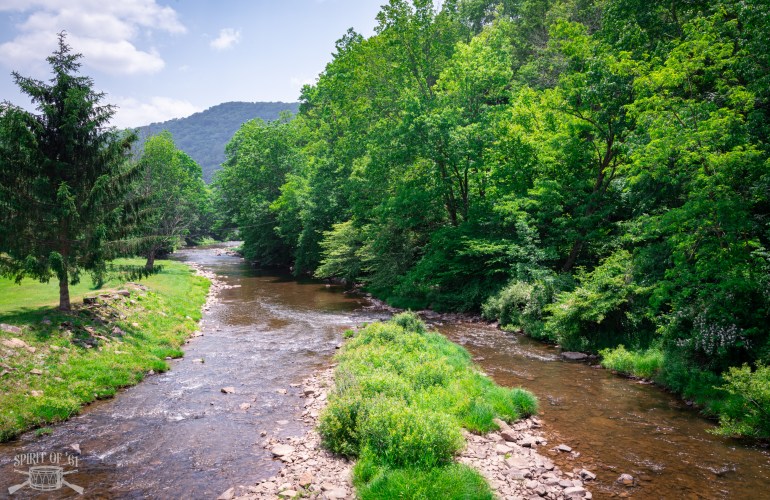
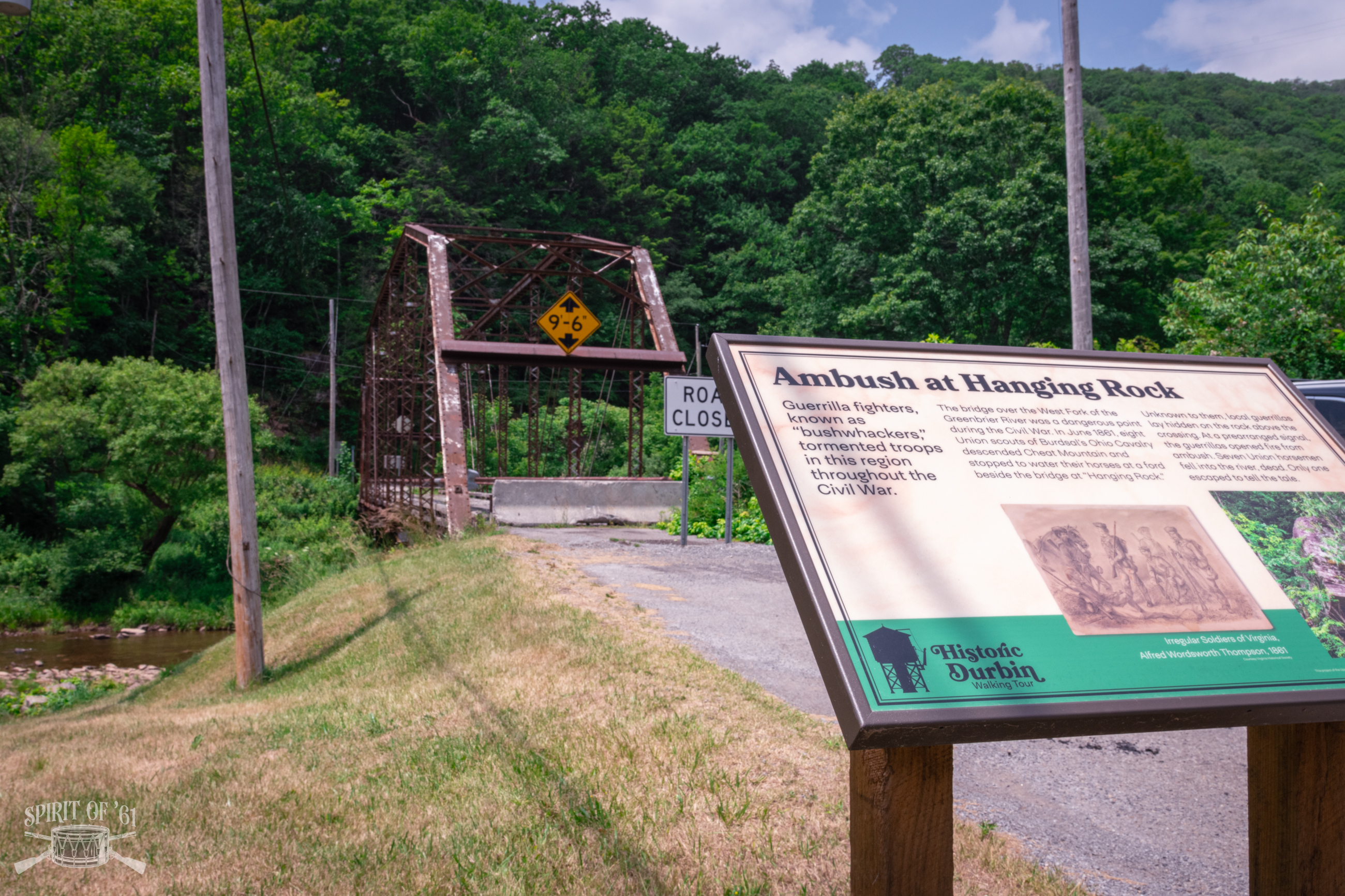
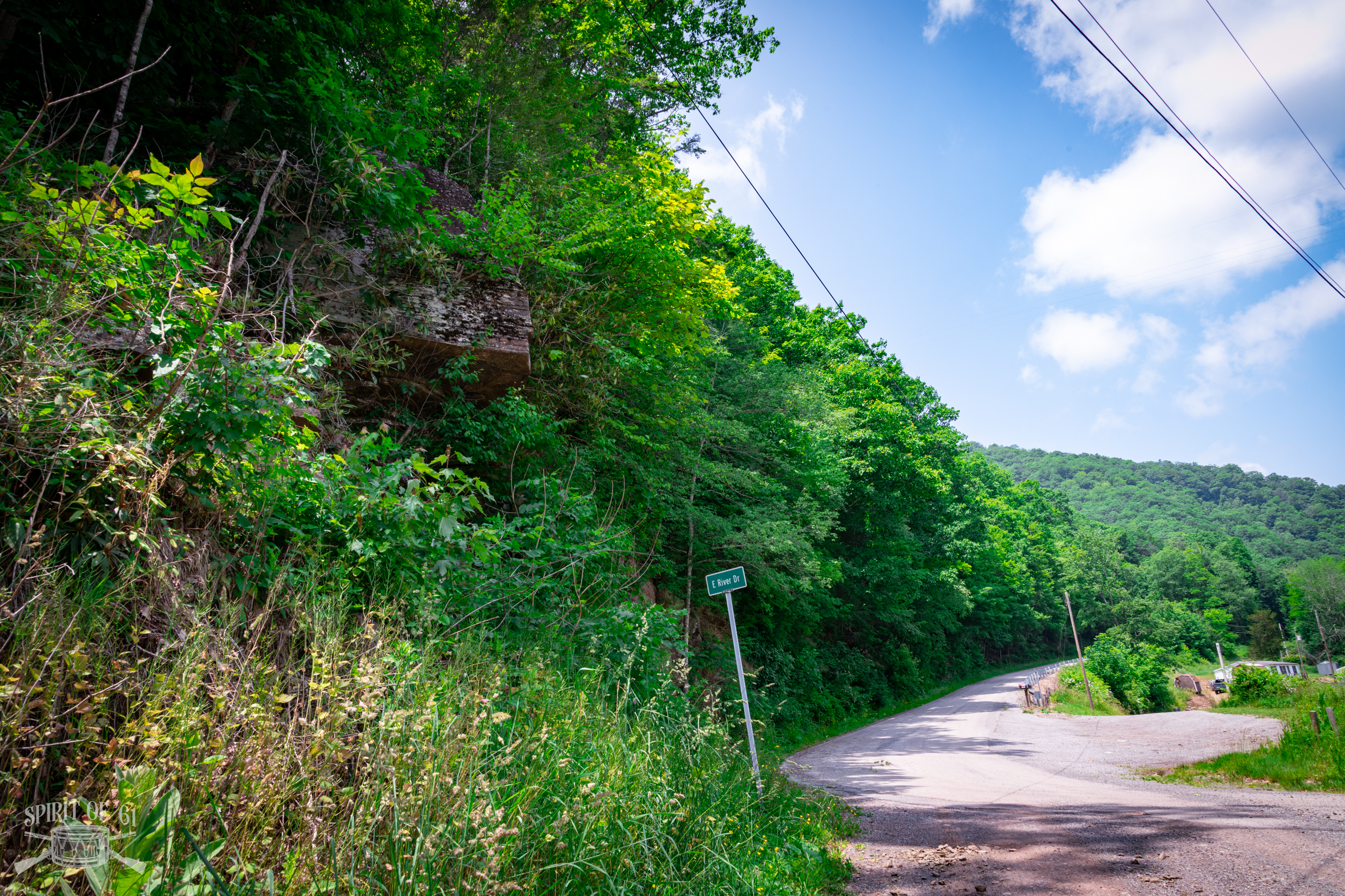
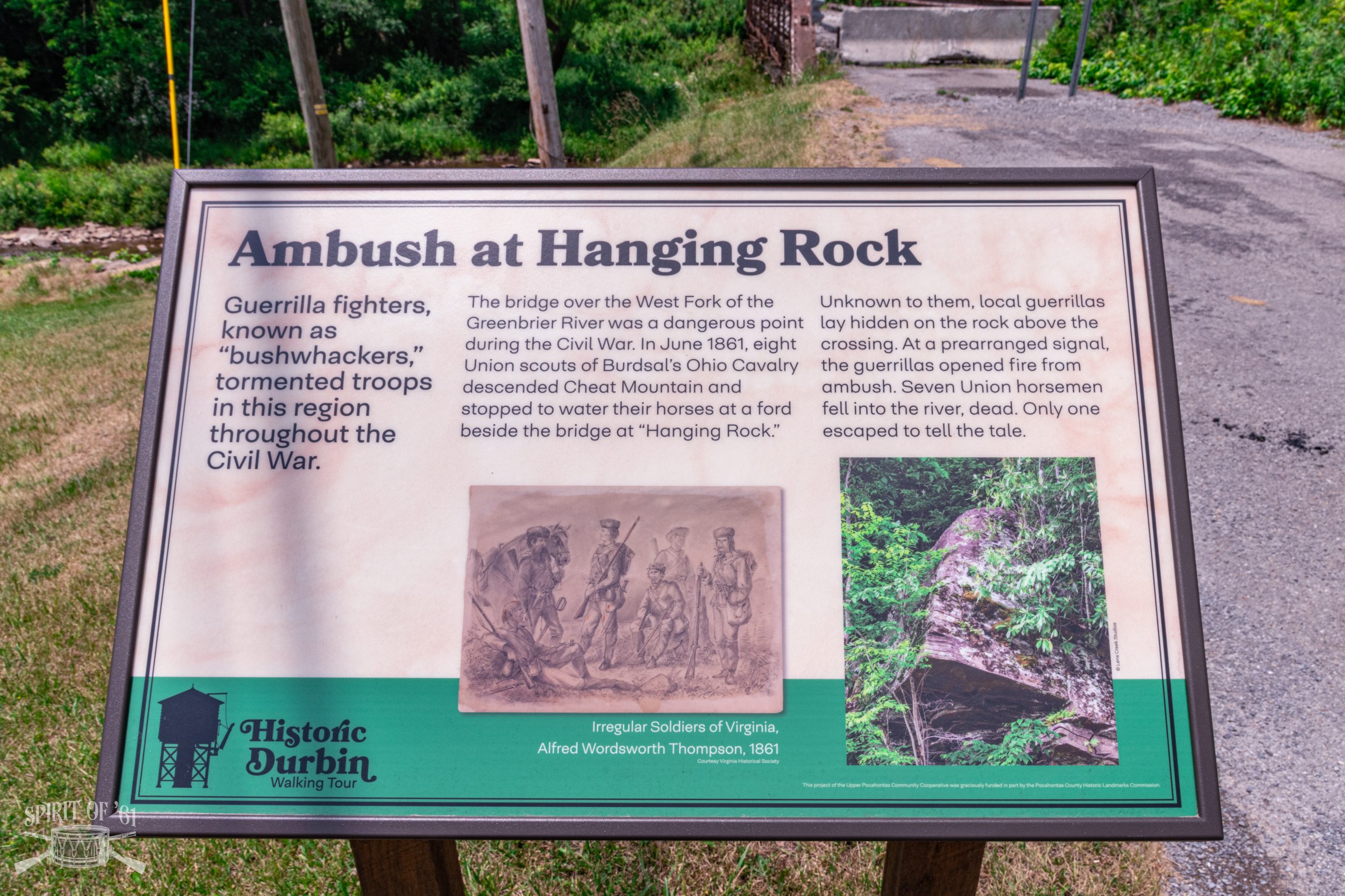
Turning back north, the patrol approached the bridge over the Greenbrier River’s West Fork near modern-day Durbin. Just north of the bridge was a rocky outcrop known as Hanging Rock. Unbeknownst to the patrol, approximately ten Confederate guerrillas, likely Major Jones’ riflemen, were hidden in the wooded hills nearby. Among them was 47-year-old Ewing C. Devier from Highland County.
As the river was low, Burdsall’s Dragoons crossed downstream from the bridge and stopped to water their horses. The hidden riflemen opened fire, killing Sergeant Gault and wounding Privates Seeley E. Mensch, William A. Kennedy, and Bernard Straight. Kennedy reportedly was shot in the hand while raising his carbine to return fire. After the war, historian William T. Price wrote a florid account of the incident based on Devier’s 1862 recollection, inaccurately claiming six or seven horsemen were killed, including two who died in each other’s arms.
Brigadier General Jackson also exaggerated the ambush’s success, reporting that “[The enemy’s] scouts have been roaming the country on this side of it, and yesterday a party of nine of them were taken in ambush by a party of our scouts, who killed seven of them and wounded the eighth.” In reality, after firing a few shots, the bushwhackers melted into the wilderness, not staying to verify the number of dead or wounded.
Two uninjured dragoons remained with the wounded while the third raced back to Cheat Mountain to report the ambush. Colonel Kimball immediately dispatched Lieutenant Nathan Willard and 50 men from Company E (“Crescent Guards”) along with a wagon to recover the casualties. The regiment’s surgeon, Joseph G. McPheeters, met the returning party on the road and escorted Private Mensch to a house where he tried to make him comfortable. Despite the efforts, Mensch, who had been shot in the back, died shortly after midnight.
In the long term, the Greenbrier River ambush had little strategic impact, though it made Union forces more cautious about advancing further until the fall. Just days later, news of the Union defeat at Bull Run led General Winfield Scott to recall McClellan to Washington, D.C., with Brigadier General William Rosecrans replacing him. No more battles occurred in northwestern Virginia until late August.
Opposing Forces
Confederate
Maj. Alexander C. Jones, Commanding
| Unit | Commander(s) | Strength | Killed | Wounded | Captured |
|---|---|---|---|---|---|
| Highland and Pocahontas County Militia | unknown | 9-10 | 0 | 0 | 0 |
Union
Capt. Henry W. Burdsall, Commanding
| Unit | Commander(s) | Strength | Killed | Wounded | Captured |
|---|---|---|---|---|---|
| H.W. Burdsall’s Ind. Company Ohio Cavalry (Burdsall’s Dragoons) | Sgt. William D. Gault | 7 | 2 | 2 | 0 |
Timeline
July 11, 1861: Confederate Lt. Col. John Pegram surrenders his entire command when he finds himself cut off from the Army of the Northwest after the Battle of Rich Mountain.
July 13, 1861: Union forces score a decisive victory over the Confederate Army of the Northwest at the Battle of Corrick’s Ford in Tucker County and kill its commander, Brig. Gen. Robert S. Garnett. Several thousand Confederate soldiers are captured or scatter into the mountains.
July 16, 1861: Union forces begin establishing Fort Milroy at White Top on Cheat Mountain in Randolph County, astride the Staunton-Parkersburg Turnpike.
July 19, 1861: A seven-man patrol from Burdsall’s Dragoons is ambushed while scouting near the Greenbrier River.
Location
GPS Coordinates — 38.54995, -79.83146
Primary Sources
News Articles
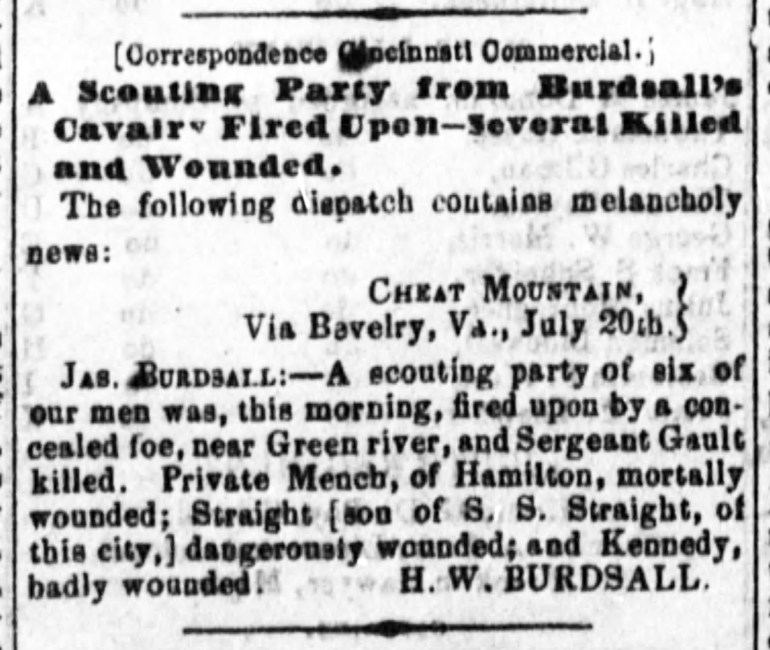
[Correspondence Cincinnati Commercial.]
A Scouting Party from Burdsall’s Cavalry Fired Upon–Several Killed and Wounded.
The following dispatch contains melancholy news:
CHEAT MOUNTAIN,
Via Beverly, Va., July 20th
JAS. BURDSALL:–A scouting party of six of our men was, this morning, fired upon by a concealed foe, near Green river, and Sergeant Gault killed. Private Mench, of Hamilton, mortally wounded; Straight [son of S. S. Straight, of this city,] dangerously wounded; and Kennedy, badly wounded.
H.W. BURDSALL
Daily Ohio Statesman (Columbus) 23 July 1861.
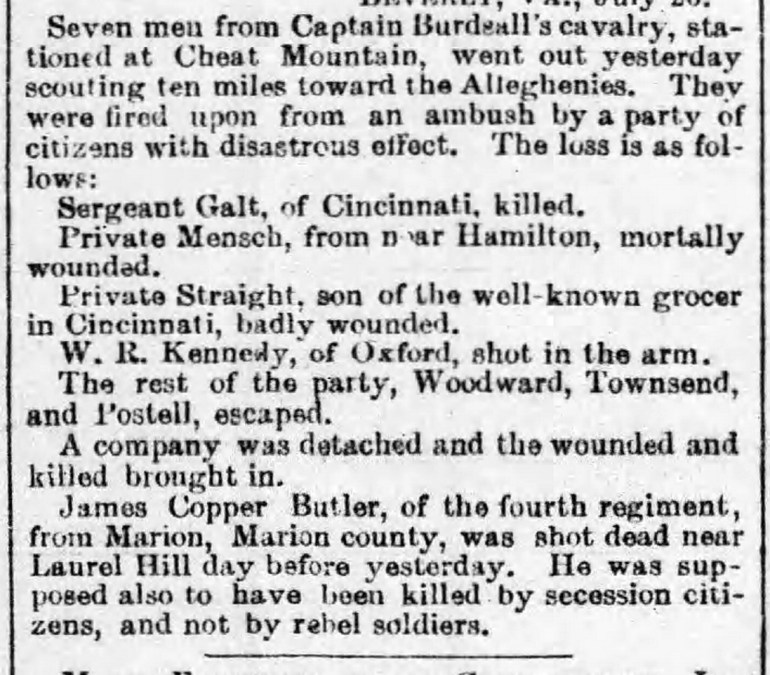
Seven men from Captain Burdsall’s cavalry, stationed at Cheat Mountain, went out yesterday scouting ten miles toward the Alleghenies. They were fired upon from an ambush by a party of citizens with disastrous effect. The loss is as follows:
Sergeant Galt, of Cincinnati, killed.
Private Mensch, from near Hamilton, mortally wounded.
Private Straight, son of the well-known grocer in Cincinnati, badly wounded.
W.R. Kennedy, of Oxford, shot in the arm.
The rest of the party, Woodward, Townsend, and Postell, escaped.
A company was detached and the wounded and killed brought in.
James Copper Butler, of the fourth regiment, from Marion, Marion county, was shot dead near Laurel Hill day before yesterday. He was supposed also to have been killed by secession citizens, and not by rebel soldiers.
The Courier-Journal (Louisville) 23 July 1861.
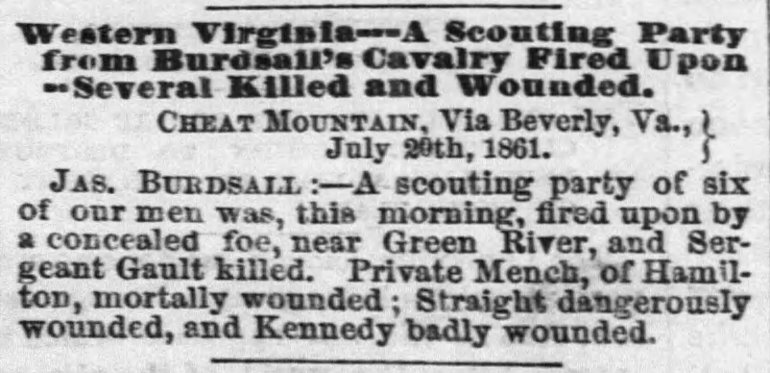
Western Virginia — A Scouting Party from Burdsall’s Cavalry Fired Upon–Several Killed and Wounded.
CHEAT MOUNTAIN, Via Beverly, Va.,
July 20th, 1861.
JAS. BURDSALL:–A scouting party of six of our men was, this morning, fired upon by a concealed foe, near Green river, and Sergeant Gault killed. Private Mench, of Hamilton, mortally wounded; Straight [son of S. S. Straight, of this city,] dangerously wounded; and Kennedy, badly wounded.
H.W. BURDSALL
Chicago Tribune (Chicago) 23 July 1861.
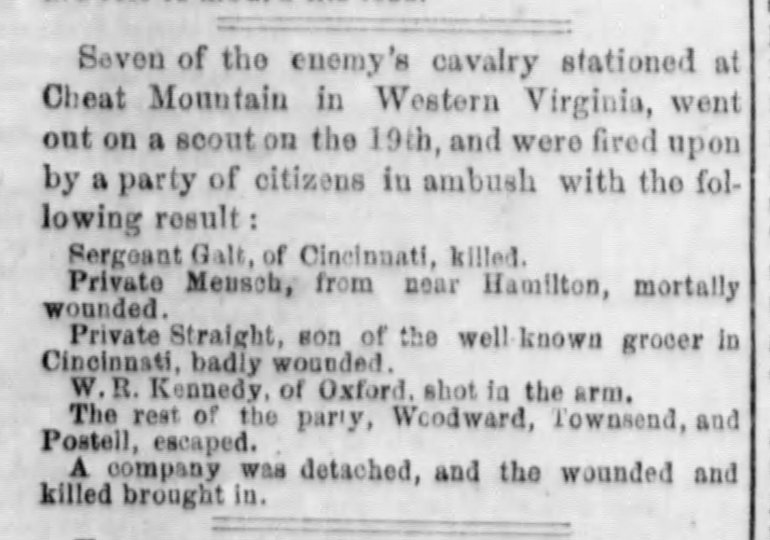
Seven of the enemy’s cavalry stationed at Cheat Mountain in Western Virginia, went out on a scout on the 19th, and were fired upon by a party of citizens in ambush with the following result:
Sergeant Galt, of Cincinnati, killed.
Private Mensch, from near Hamilton, mortally wounded.
Private Straight, son of the well known grocer in Cincinnati, badly wounded.
W.R. Kennedy, of Oxford, shot in the arm.
The rest of the party, Woodward, Townsend, and Postell, escaped.
A company was detached, and the wounded and killed brought in.
The Daily Delta (New Orleans) 27 July 1861.
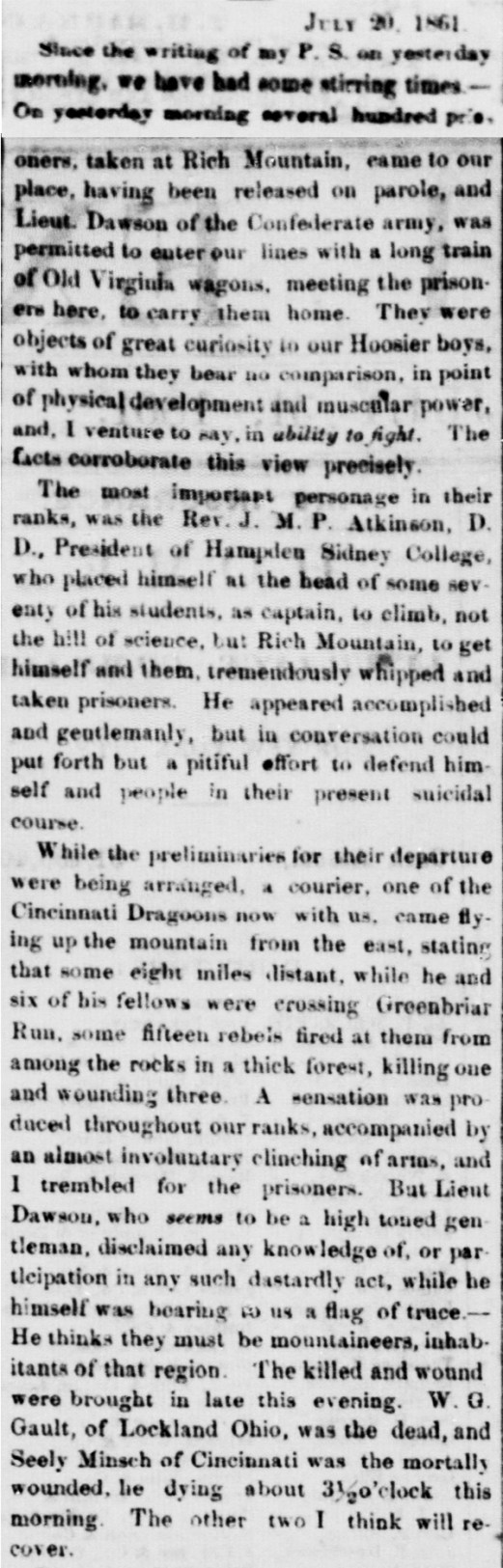
July 20, 1861
Since the writing of my P.S. on yesterday morning, we have had some stirring times. — On yesterday morning several hundred prisoners, taken at Rich Mountain, came to our place, having been released on parole, and Lieut. Dawson of the Confederate army, was permitted to enter our lines with a long train of Old Virginia wagons, meeting the prisoners here, to carry them home. They were objects of great curiosity to our Hoosier boys, with whom they bear no comparison, in point of physical development and muscular power, and I venture to say, in ability to fight. The facts corroborate this view precisely. …
… While the preliminaries for their departure were being arranged, a courier, one of the Cincinnati Dragoons now with us, came flying up the mountain from the east, stating that some eight miles distant, while he and six of his fellows were crossing the Greenbriar Run, some fifteen rebels fired at them from among the rocks in a thick forest, killing one and wounding three. A sensation was produced throughout our ranks, accompanied by an almost involuntary clinching of arms, and I trembled for the prisoners. But Lieut Dawson, who seems to be a high toned gentleman, disclaimed any knowledge of, or participation in any such dastardly act, while he himself was bearing to us a flag of truce. — He thinks they must be mountaineers, inhabitants of that region. The killed and wound were brought in late this evening. W.G. Gault, of Lockland Ohio, was the dead, and Seely Minsch of Cincinnati was the mortally wounded, he dying about 3 1/2 o’clock this morning. The other two I think will recover.
The Daily Wabash Express (Terre Haute) 31 July 1861.
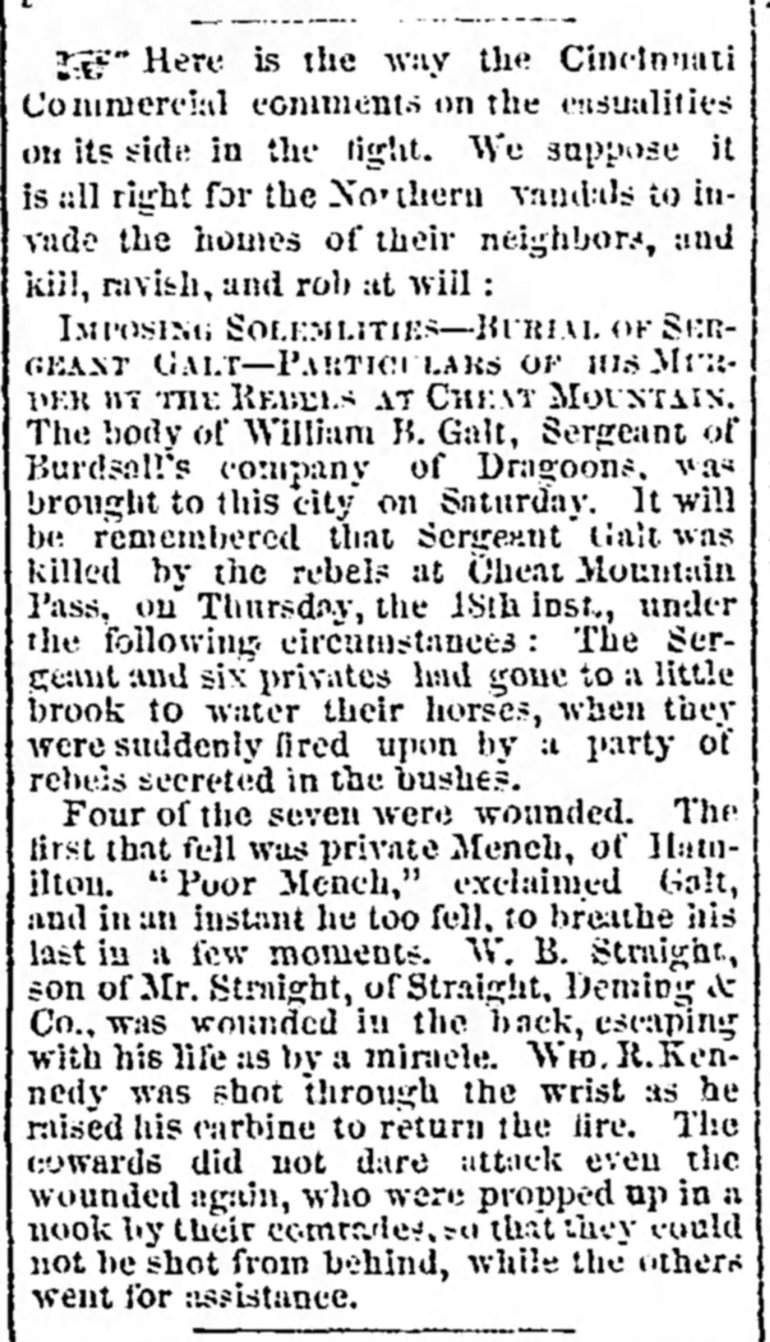
Here is the way the Cincinnati Commercial comments on the casualties on its side in the fight. We suppose it is all right for the Northern vandals to invade the homes of their neighbors, and kill, ravish, and rob at will:
IMPOSING SOLEMLITIES–BURIAL OF SERGEANT GALT–PARTICULARS OF HIS MURDER BY THE REBELS AT CHEAT MOUNTAIN. The body of William B. Galt, Sergeant of Burdsall’s company of Dragoons, was brought to this city on Saturday. It will be remembered that Sergeant Galt was killed by the rebels at Cheat Mountain Pass, on Thursday, the 18th inst., under the following circumstances: The Sergeant and six privates had gone to a little brook to water their horses, when they were suddenly fired upon by a party of rebels secreted in the bushes.
Four of the seven were wounded. The first that fell was private Mench, of Hamilton. “Poor Mench,” exclaimed Galt, and in an instant he too fell, to breathe his last in a few moments. W.B. Straight, son of Mr. Straight, Deming & Co., was wounded in the back, escaping with his life as by a miracle. Wm. R. Kennedy was shot through the wrist as he raised his carbine to return fire. The cowards did not dare attack even the wounded again, who were propped up in a nook by their comrades, so that they could not be shot from behind, while the others went for assistance.
The Louisville Daily Courier (Lousville) 1 August 1861.
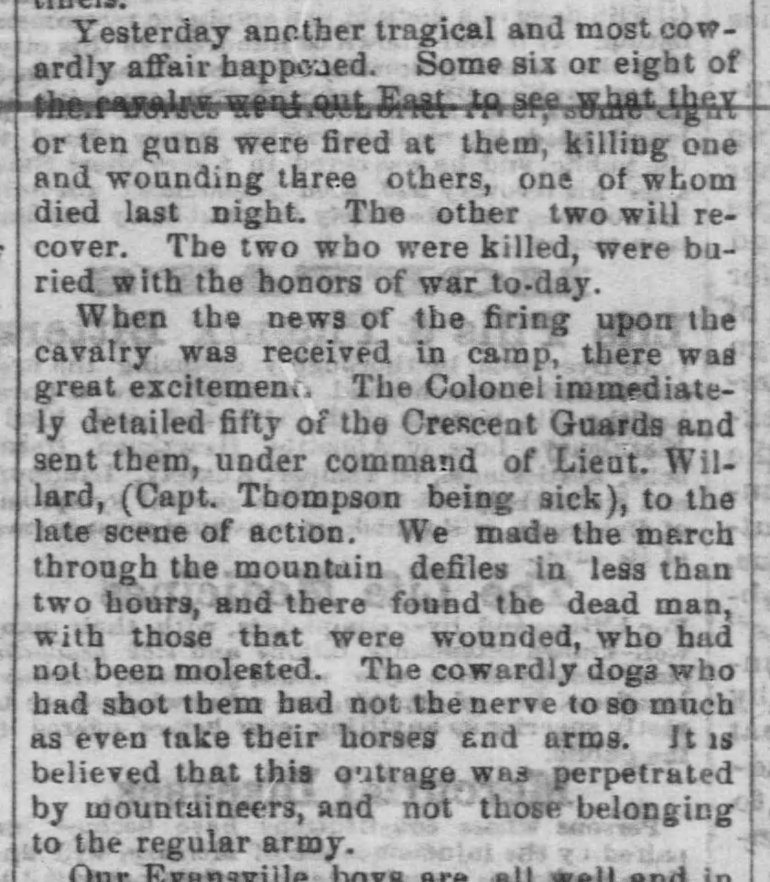
Yesterday another tragical and most cowardly affair happened. Some six or eight of the cavalry went out East to see what they … [illegible] … their horses at Greenbrier River, some eight or ten guns were fired at them, killing one and wounding three others, one of whom died last night. The other two will recover. The two who were killed, were buried with the honors of war to-day.
When the news of the firing upon the cavalry was received in camp, there was great excitement. The Colonel immediately detailed fifty of the Crescent Guards and sent them, under command of Lieut. Willard, (Capt. Thompson being sick), to the late scene of action. We made the march through the mountain defiles in less than two hours, and there found the dead man, with those that were wounded, who had not been molested. The cowardly dogs who had shot them had not the nerve to do so much as even take their horses and arms. It is believed that this outrage was perpetrated by mountaineers, and not those belonging to the regular army.
The Evansville Daily Journal (Evansville) 2 August 1861.
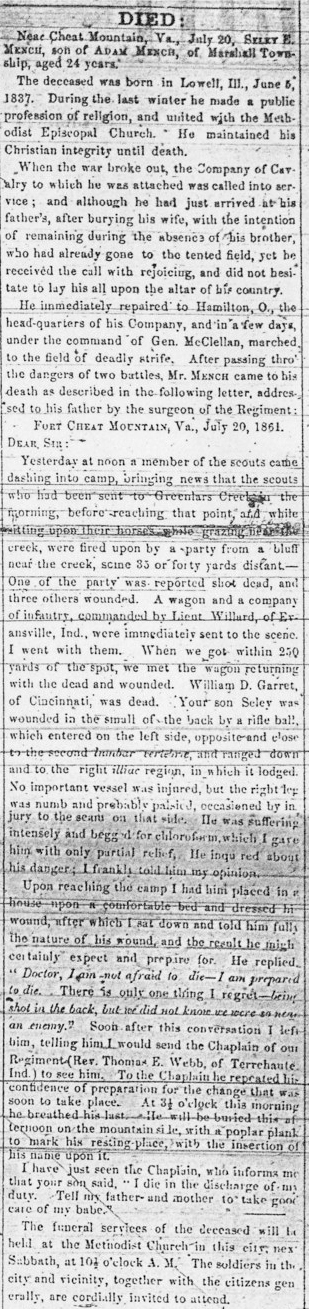
Marshall Statesman (Marshall, MI) 7 August 1861.
Reports and Letters
- July 19th Report of Brig. Gen. Henry R. Jackson
- July 20th Report of Brig. Gen. Henry R. Jackson (1st)
- July 20th Report of Brig. Gen. Henry R. Jackson (2nd)
Secondary Sources
Landon, William, ed. “The Fourteenth Indiana Regiment on Cheat Mountain.” Indiana Magazine of History 29, no. 4 (1933): 350-371.
Lesser, W. Hunter. Rebels at the Gate: Lee and McClellan on the Front Line of a Nation Divided. Naperville: Sourcebooks, Inc., 2004.
Price, William T. “Guerrilla Warfare: The Ambush on Greenbrier River in Which Seven Troopers were Killed.” The West Virginia Historical Magazine Quarterly 4, no. 3 (1904): 241-249.
Zinn, Jack. R.E. Lee’s Cheat Mountain Campaign. Parsons: McClain Printing Co., 1974.
Updated: 9 March 2025
Created: 25 April 2021
 Spirit of '61