Tuesday, May 28, 1861
At the end of May 1861, a Union detachment confronted secessionist militia at Glover’s Gap, resulting in the death of its defiant leader, Stephen Roberts. Whether Roberts was a Confederate officer or simply a rogue partisan remains unclear, but his death was among the first in the Union effort to control Northwest Virginia.
Narrative
The Action at Glover’s Gap occurred on Tuesday, May 28, 1861 between irregular secessionist militia commanded by Stephen Roberts and a detachment of Company A, 2nd Virginia Infantry (U.S.) commanded by 2nd Lt. Oliver R. West in Marion County, West Virginia.
On April 17, 1861, the Virginia Convention in Richmond adopted an ordinance of secession by a vote of 88 to 55, subject to ratification by popular referendum on May 23. Delegates from the trans-Allegheny counties who voted “no,” led by Congressman John S. Carlile, an early advocate of West Virginia statehood, quickly organized in opposition.
When Virginia Governor John Letcher sent a letter to Andrew J. Sweeney, mayor of Wheeling in Virginia’s northwestern panhandle, requesting that he seize federal buildings for the Commonwealth, Sweeney replied that he had already taken them “in the name of Abraham Lincoln, President of the United States, whose property they are.”
Undaunted, Maj. Gen. Robert E. Lee, commander of all Virginia forces, ordered Maj. Alonzo Loring and Maj. Francis M. Boykin, Jr. to muster volunteer companies into state service in Wheeling and Grafton, respectively, and to cooperate in securing the Baltimore & Ohio (B&O) Railroad. Strong Union sentiment in the region prevented either man from carrying out the mission.
Lee then directed Col. George A. Porterfield to proceed to Grafton and organize the state (secessionist) volunteers reportedly assembling in northwestern Virginia. When Porterfield arrived in the region, however, he found only several hundred poorly armed and equipped recruits.
Meanwhile, on May 3, U.S. General Orders No. 14 created the Department of the Ohio, encompassing Illinois, Indiana, and Ohio under the command of Maj. Gen. George B. McClellan. Ohio Governor William Dennison urged swift action, pressing McClellan to “defend Ohio beyond, rather than on her border.” McClellan, however, was reluctant to violate Virginia’s sovereignty and risk influencing the upcoming secession referendum.
When President Abraham Lincoln called for 75,000 volunteers to serve a 90-day term, Ohio and Pennsylvania quickly filled their quotas. Governor Letcher refused to comply, and as the government in Richmond moved toward secession, John S. Carlile and other unionists in northwestern Virginia began recruiting “loyal” regiments. Men from Ohio and Pennsylvania sidestepped their states’ quotas by joining these units.
Captain Albert C. Hayes and the Washington Rifle Guards, organized in Pittsburgh and Allegheny County, found themselves in that position. They arrived in Wheeling by steamboat on May 10 and mustered into three-year service eleven days later, becoming Company A of the Second Virginia Infantry (U.S.).
On May 22, pickets from Porterfield’s command exchanged fire with members of a Union company known as the Grafton Guards at a bridge over the Tygart Valley River. Thornsbury Bailey Brown of the Grafton Guards was shot and killed. By the time Virginians went to the polls the next day, the prospect of war seemed inevitable. Statewide, white male voters approved secession by a wide margin. In northwestern Virginia, however, the result was reversed.
In Wheeling, the First Virginia Infantry (U.S.) mustered into federal service on May 23. The next day, as Union troops crossed the Potomac River opposite Washington, DC and occupied Alexandria and Arlington Heights, the Union Home Guard seized control of Clarksburg, Congressman Carlile’s hometown, patrolling the streets with pistols, shotguns, knives, and other improvised weapons.
On the 25th, after the Grafton Guards departed for Wheeling, Porterfield moved his entire force of several hundred infantry and cavalry into Grafton. Fearing an invasion by overwhelming numbers from Ohio, he ordered Col. William J. Willey to target bridges along the B&O Railroad. That evening Willey partially carried out the order with a small squad, destroying two bridges over Buffalo Creek between Farmington and Mannington.
In response, Maj. Gen. George B. McClellan ordered a multi-pronged advance to secure and repair the railroads in northwestern Virginia and seize the key junction at Grafton. He directed the First Virginia Infantry (U.S.) and the 16th Ohio Infantry to approach from Wheeling along the B&O Railroad. At the same time, the 14th Ohio Infantry was to advance from Parkersburg on the Northwestern Virginia Railroad, with the 18th Ohio in support. The Washington Rifle Guards accompanied the First Virginia.
As the Union army advanced, Porterfield withdrew to the town of Philippi, a pro-secession stronghold sixteen miles south of Grafton along the Tygart Valley River. In Marion County, 65-year-old Capt. Stephen Roberts, sometimes misnamed Christian, organized an irregular band of secessionists who cut telegraph lines and threatened further disruption of the railroad behind the Union line of advance.
Roberts’ small company caused enough mischief that Col. Benjamin F. Kelley, commanding the First Virginia (U.S.) and the federal expedition, detailed the Washington Rifle Guards to guard Glover’s Gap Tunnel, seven and a half miles north of Mannington.
Before daybreak on May 28, the Guards reached Glover’s Gap, captured a handful of insurgents, and sent 2nd Lt. Oliver R. West with five men to break up Roberts’ band. West soon stumbled upon Stephen Roberts and his men in camp. Roberts swore he would not be captured “by all the Federal troops in western Virginia” and raised his rifle, but it misfired. West’s men returned fire, killing Roberts, and the rest of his company scattered into the hills.
Some sources claim Stephen Roberts was the first Confederate officer killed during the Civil War. At a time when volunteer officers were often elected by their men, he may well have regarded himself as captain of a company. Yet the surviving primary sources describe Roberts simply as the leader of a local band of Marion County secessionists that disbanded after his death. Porterfield may have been in contact with them, but they were never formally sworn into service, making it likely that Roberts was a civilian when he was killed.
Regardless, Union engineers and railroad workers quickly repaired the telegraph lines and the railroad. On Thursday, May 30, five days after crossing the Ohio River, the First Virginia (U.S.) and the 16th Ohio entered Grafton without opposition.
Opposing Forces
Confederate
Capt. Stephen Roberts, Commanding
| Unit | Commander(s) | Strength | Killed | Wounded | Captured |
|---|---|---|---|---|---|
| Irregulars | Capt. Stephen Roberts | ? | 1 | 0 | 2+ |
Union
Capt. Albert C. Hayes, Commanding
| Unit | Commander(s) | Strength | Killed | Wounded | Captured |
|---|---|---|---|---|---|
| Company A, 2nd Virginia Infantry (U.S.) “Washington Rifle Guards” | 2nd Lt. Oliver R. West | 6 | 0 | 0 | 0 |
Timeline
May 23, 1861: Virginia voters ratify their state’s Ordinance of Secession.
May 25, 1861: Virginia Col. George A. Porterfield orders the destruction of railroad bridges along the B&O Railroad and Northwestern Virginia Railroad.
May 26, 1861: Union Maj. Gen. George B. McClellan orders Union troops under his command to invade northwestern Virginia, converging on Grafton.
May 27, 1861: The 1st Virginia Regiment (Union) and Company A, 2nd Virginia (U.S.) reach Mannington and search the area for secessionists that cut telegraph wires and threatened nearby railroad bridges.
Location
GPS Coordinates — 39.61433, -80.41019
Primary Sources
News Articles
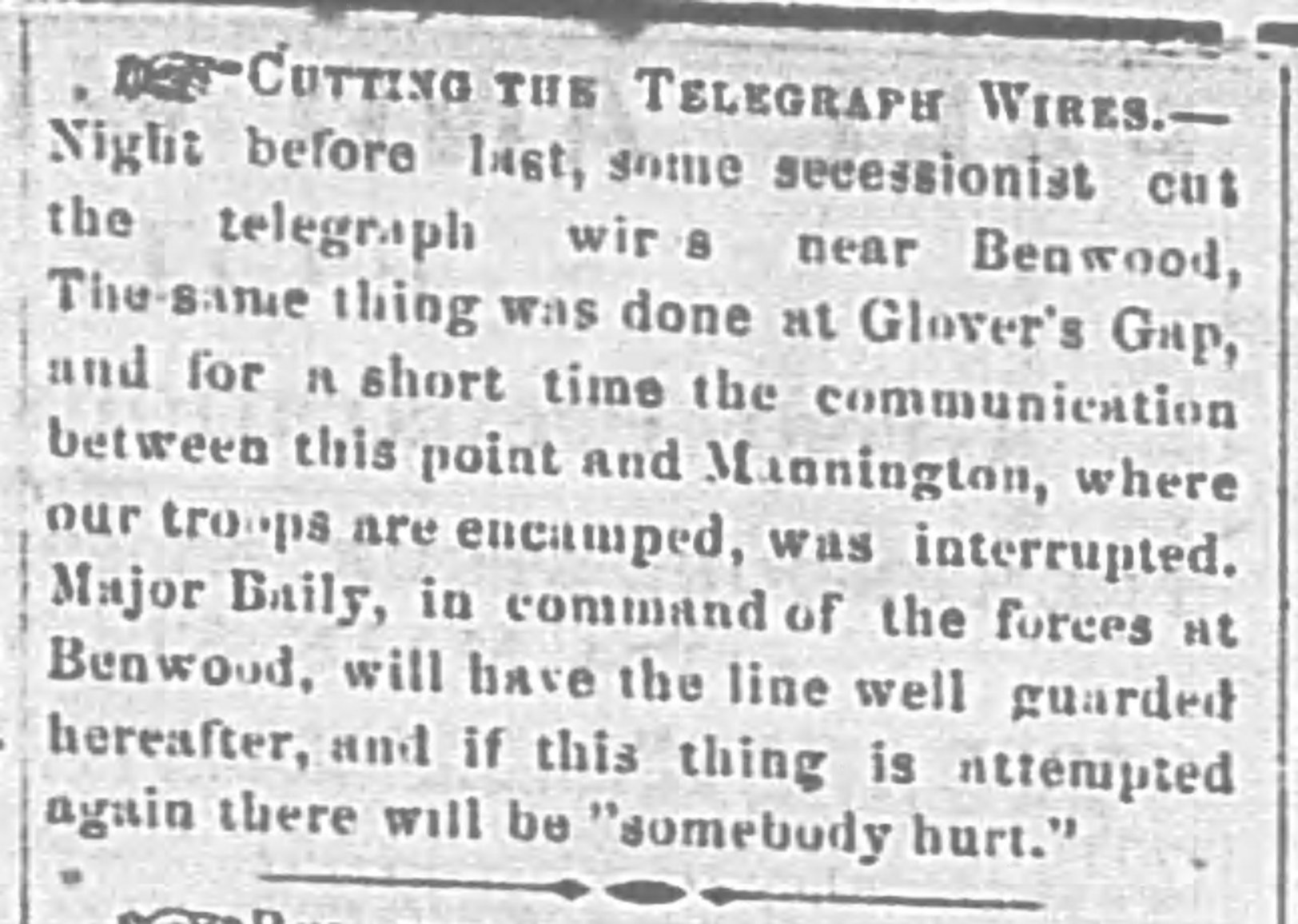
Wheeling Daily Intelligencer (Wheeling) 29 May 1861.
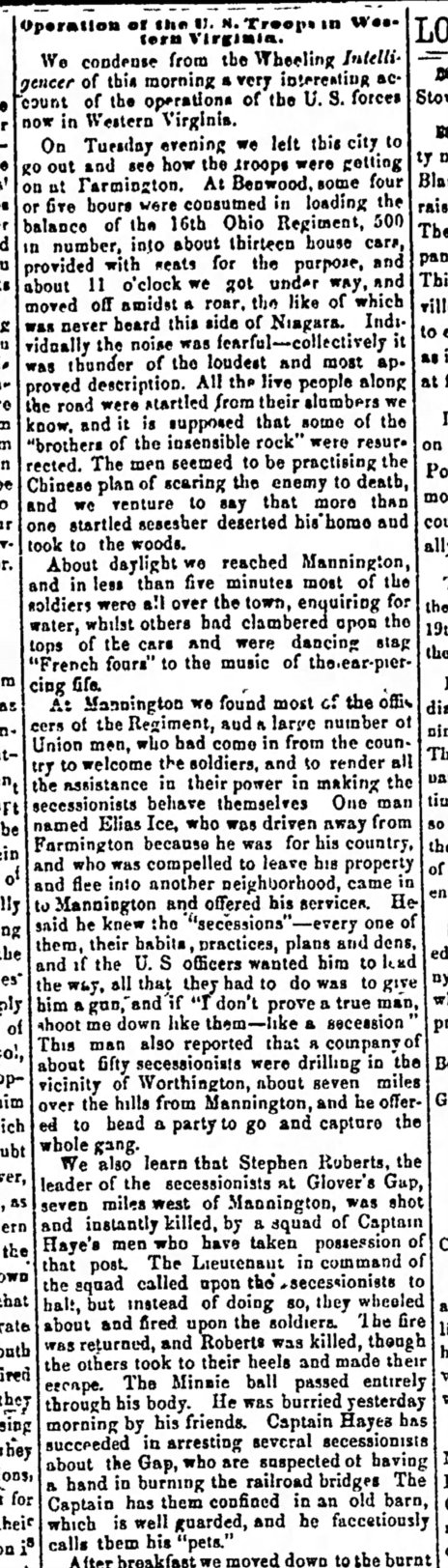
Zanesville Daily Courier (Zanesville) 30 May 1861.
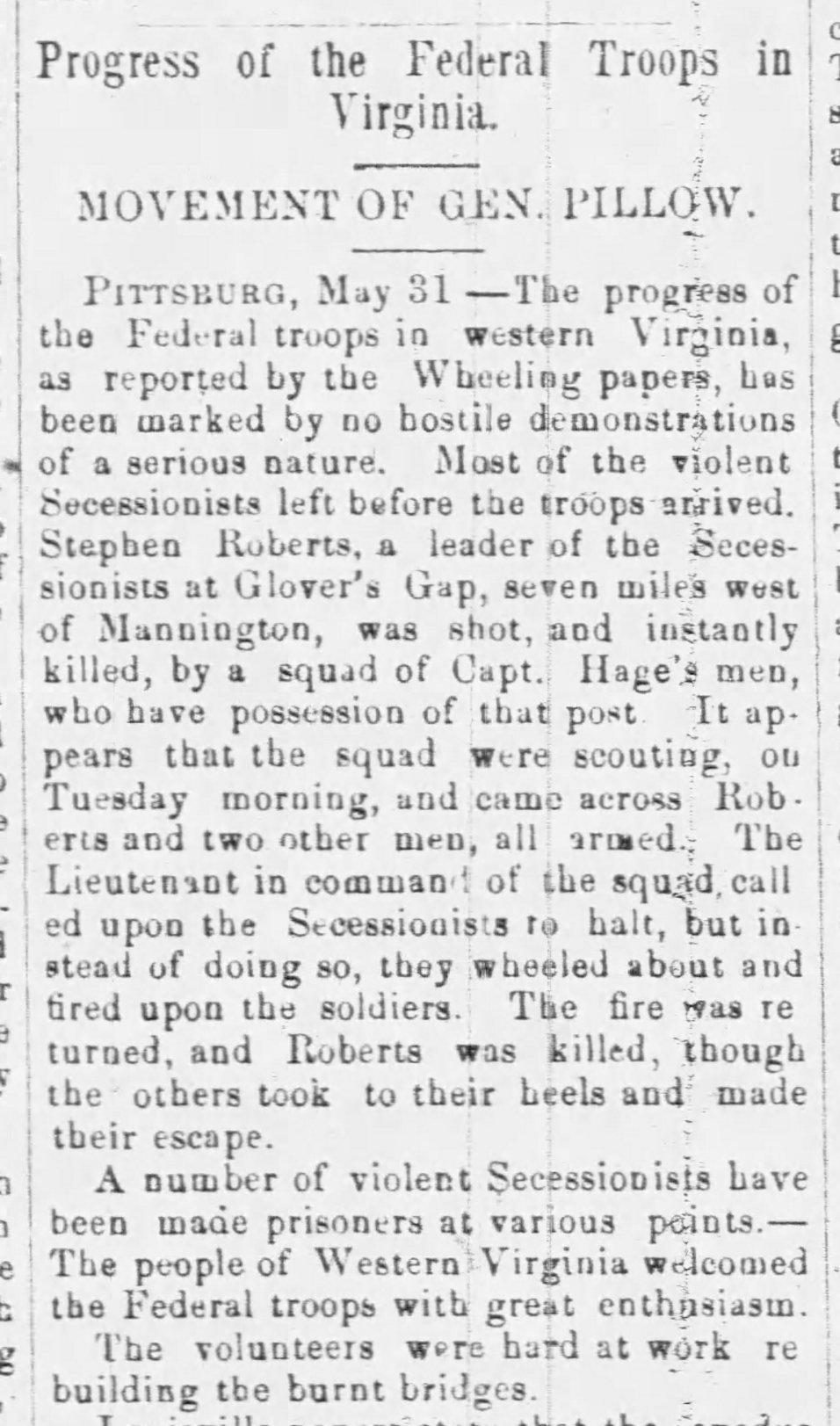
York Gazette (York) 4 June 1861.
Reports and Letters
- May 26 Address to the Soldiers of the Expedition
- May 26 Letter from Michael G. Harman, Quartermaster
- May 26 Instructions to Brigadier General T. A. Morris
- May 26 Instructions to Colonel B. F. Kelley, First Virginia Infantry
- May 26 Instructions to Colonel J. B. Steedman, Fourteenth Regiment Ohio Infantry
- May 26 Instructions to Colonel J. Irvine, Sixteenth Ohio Infantry
- May 26 Proclamation to the People of Western Virginia
- May 27 Report of Maj. Gen. George B. McClellan
- May 27 Telegram to Gen. Winfield Scott
Memoirs
Leib, Charles. Nine Months in the Quartermaster’s Department; or the Chances for Making a Million. Cincinnati: Moore, Wilstach, Keys & Co., 1862.
Secondary Sources
Haselberger, Fritz. Yanks from the South! The First Land Campaign of the Civil War. Baltimore: Past Glories, 1987.
Lang, Theodore F. Loyal West Virginia from 1861 to 1865. Baltimore: Deutsch Publishing Co., 1895.
Reader, Frank S. History of the Fifth West Virginia Cavalry, formerly the Second Virginia Infantry, and of Battery G, First West Va. Light Artillery. New Brighton: Daily News, 1890.
Updated: 16 March 2026
Created: 9 October 2023
 Spirit of '61