Wednesday, June 5, 1861
On June 5, 1861, the USS Harriet Lane engaged a Confederate battery at Pig Point in an early naval skirmish of the Civil War. Unable to get close enough for effective fire, the Union gunboat suffered minor damage and withdrew, marking a small but impactful Confederate defensive success.
Narrative
The Engagement at Pig Point was fought on Wednesday, June 5, 1861 between a Union gunboat commanded by Capt. John Faunce and a Confederate battery commanded by Capt. Robert Pegram in Suffolk, Virginia.
As May gave way to June, there was no longer any doubt about what shape the American Civil War would take. George McClellan had invaded Virginia from the northwest, Irvin McDowell pressed in from the northeast, and on the Virginia Peninsula Maj. Gen. Benjamin F. Butler was plotting his next move from the safety of Fort Monroe at Old Point Comfort, at the mouth of the Chesapeake Bay.
Since April 27, 1861, the U.S. Navy had enforced an economic and military blockade of Virginia’s ports, and small flotillas of Navy ships, along with converted civilian vessels, had already traded fire with Confederate shore batteries on the Potomac and James rivers. The 619-ton, dual side-wheel steamer USS Harriet Lane, commanded by 54-year-old Capt. John Faunce (1807–1891), joined the Atlantic Blockading Squadron on May 24.
Three days later, Harriet Lane was placed at Butler’s disposal and helped cover the occupation of Newport News Point. Roughly 2,000 Union infantrymen, including the 1st Vermont, 4th Massachusetts, and 7th New York regiments, landed without opposition and immediately began constructing Camp Butler and building embrasures for heavy artillery. The expedition was led by Col. John W. Phelps, a U.S. Army veteran, abolitionist, and commander of the 1st Vermont.
Meanwhile, Flag-Officer French Forrest of the Virginia Navy was erecting fortifications at Pig Point, across Hampton Roads from Newport News. Together, Pig Point and Barrel Point commanded the entrance to the Nansemond River. On May 30, Forrest placed Capt. Robert B. Pegram in command of the seven-gun battery, which was manned by the Portsmouth Rifles, an infantry company.
Benjamin Butler had an ambitious plan to neutralize this threat. “My next point of operation I propose shall be Pig Point, which is exactly opposite the News, commanding the Nansemond River,” he wrote. “Once in command of that battery, which I believe may be easily turned, I can then advance along the Nansemond River and easily take Suffolk, and there either hold or destroy the railroad…”
To accomplish this, he tasked Capt. Faunce and Harriet Lane with conducting a reconnaissance by fire against the point. On June 4, Faunce scoured several miles of shoreline, reporting on Confederate defenses and concluding that the battery at Pig Point was unfinished. That assessment changed the following morning, when he again steamed toward the point and observed “a number of men apparently engaged in transporting guns by means of ox teams and wheel carriages, while others were seen near the embrasures of the battery with the secession flag flying over them.”
At 8:30 a.m., Harriet Lane closed to within about 1,800 yards and opened fire.
A member of the Portsmouth Rifles, commanded by Capt. John C. Owens, later recalled, “They opened up on us first… we planted our flag on the ramparts and every man mounted them and gave three cheers before we fired a gun. We then replied, and gave it to them hot…”
The Confederate battery, armed with four 32-pounders and three 8-inch naval guns, struck Harriet Lane twice, wounding five sailors. The exchange lasted about thirty minutes, but shallow water prevented the vessel from closing to effective range. One Confederate cannon was damaged, though none of the gunners were injured.
With her mission to gauge the battery’s strength complete, Harriet Lane broke off the action and returned to port for repairs. The Pig Point battery proved too formidable, and Butler’s ambitious plan was never carried out.
Opposing Forces
Confederate
Flag-Officer French Forrest, Commanding Navy-Yard, Gosport
| Unit | Commander(s) | Strength | Killed | Wounded | Captured |
|---|---|---|---|---|---|
| Portsmouth Rifles | Capt. Robert B. Pegram Capt. John C. Owens | 7 guns | 0 | 0 | 0 |
Union
Flag-Officer Garrett J. Pendergrast, Commanding West India Squadron
| Unit | Commander(s) | Strength | Killed | Wounded | Captured |
|---|---|---|---|---|---|
| USS Harriet Lane | Capt. John Faunce | 100 men, 5 guns | 0 | 5 | 0 |
Timeline
May 21, 1861: Virginia Col. John B. Magruder takes command at Yorktown.
May 22, 1861: Massachusetts Maj. Gen. Benjamin F. Butler assumes command of the Union garrison at Fort Monroe in Hampton Roads.
May 27, 1861: Union troops occupy Newport News Point and establish Camp Butler.
June 5, 1861: The converted revenue cutter USS Harriet Lane exchanges fire with Confederate shore batteries at Pig Point at the mouth of the James River.
Battlefield
Like nearby Sewell’s Point, Pig Point in Suffolk, Virginia, looks very different today than it did more than 165 years ago. During the First World War, the site housed the Pig Point Ordnance Depot; today it is largely a mixed-use area of residential and commercial development. The Harbour View community includes upscale housing and the Riverfront Golf Club. No visible traces of the Confederate fortifications remain, though a roadside marker commemorating the Pig Point Battery stands along U.S. Route 58, roughly ten miles south of the point.
Location
GPS Coordinates — 36.90584, -76.44209
Primary Sources
News Articles
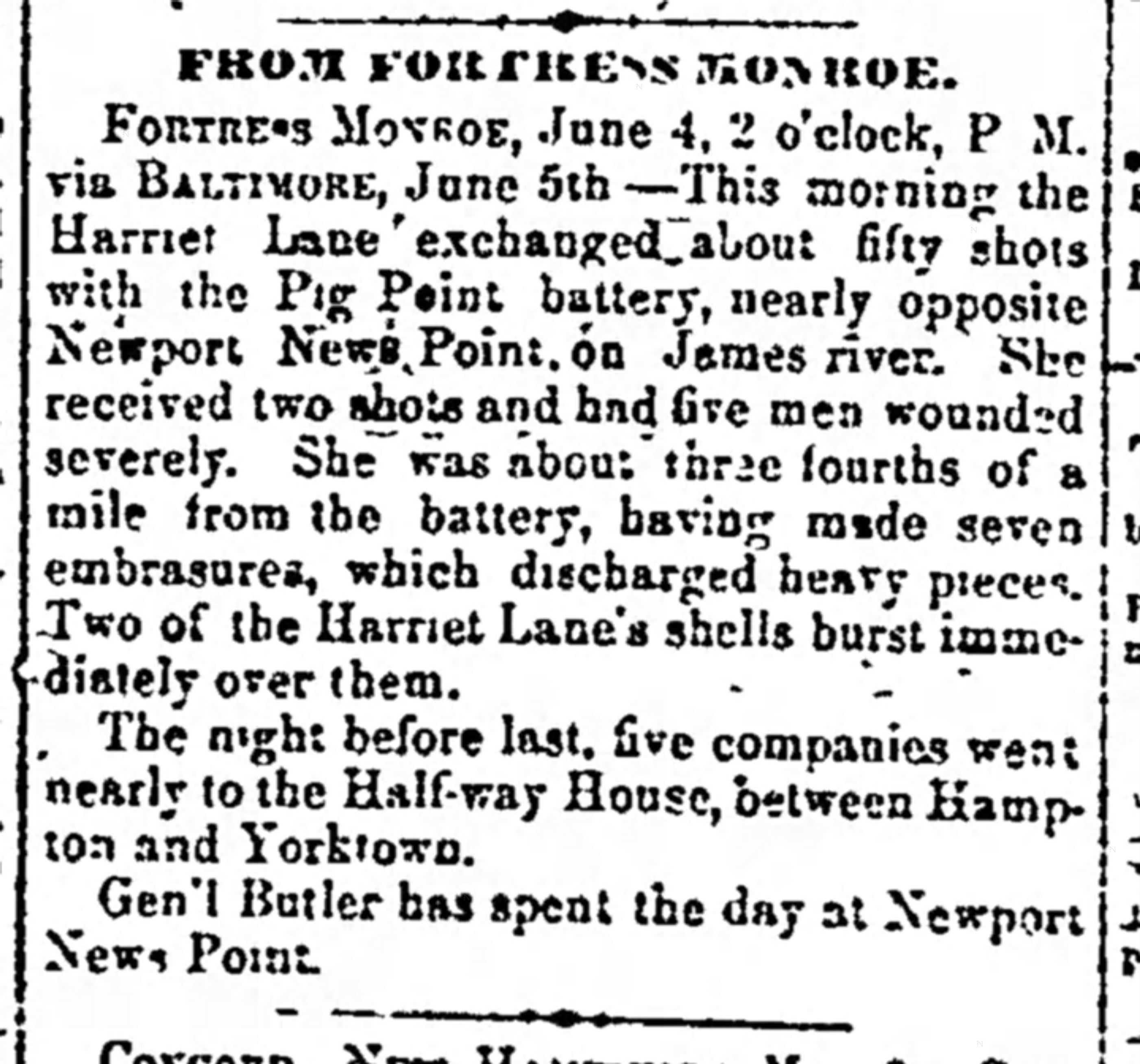
Zanesville Daily Courier (Zanesville, OH) 5 June 1861.
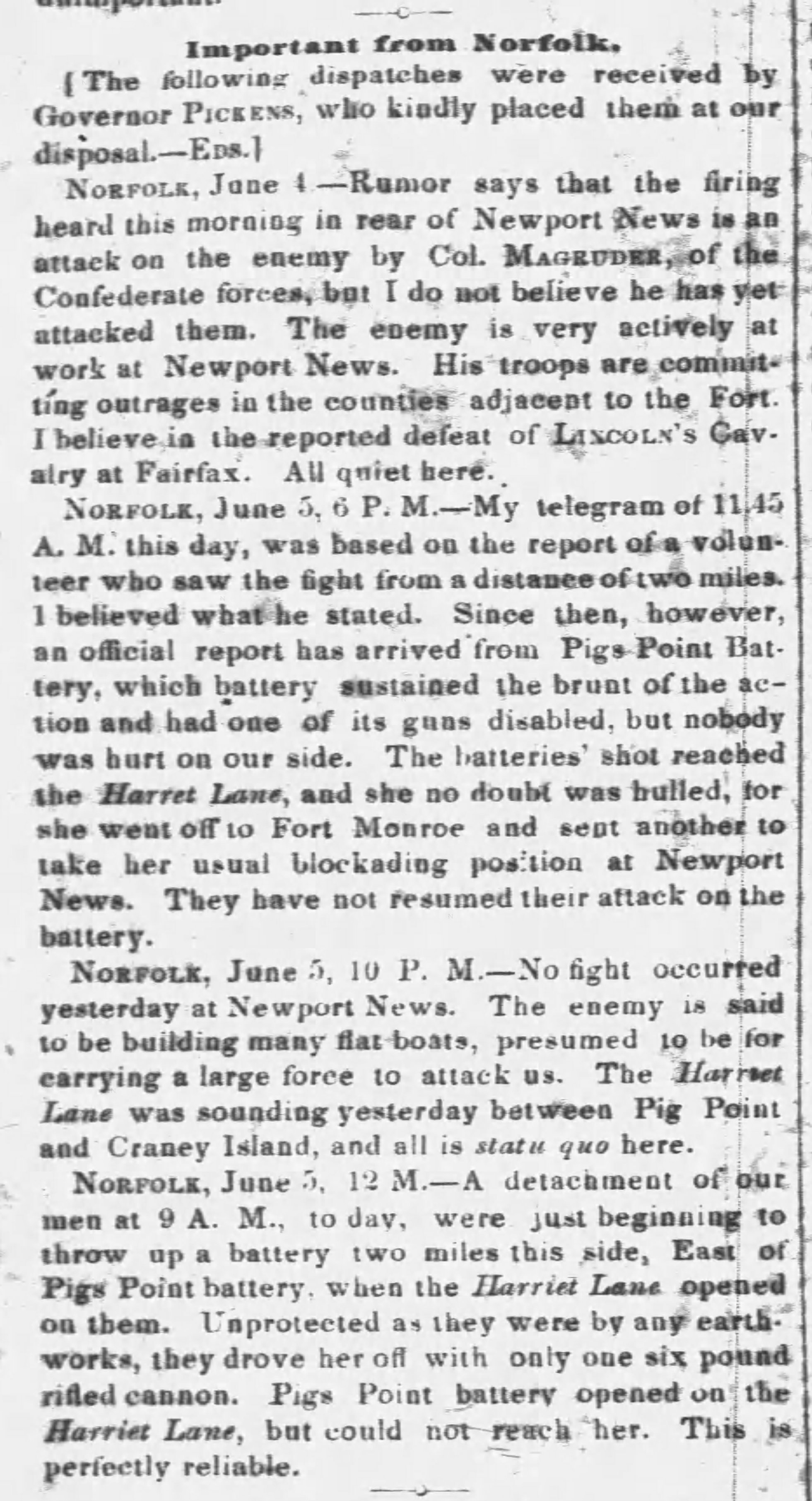
Charleston Daily Courier (Charleston, SC) 6 June 1861.
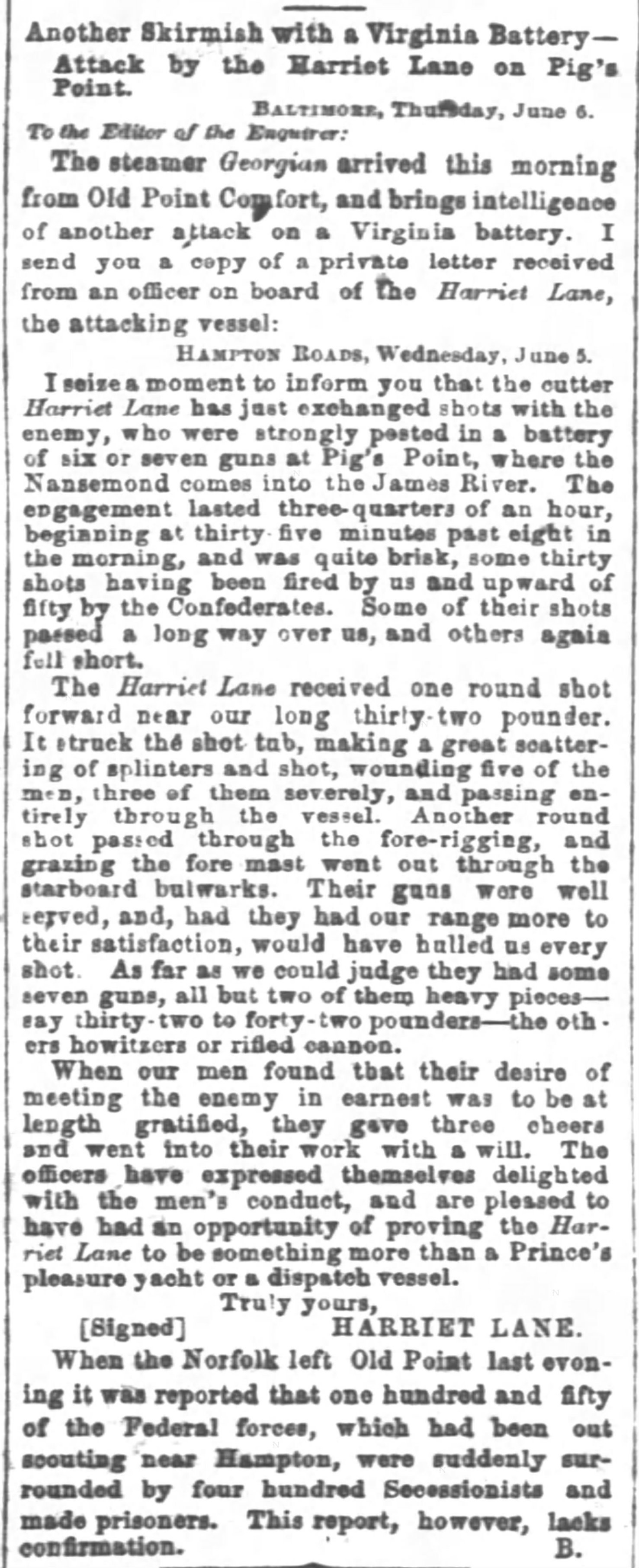
Cincinnati Enquirer (Cincinnati, OH) 7 June 1861.
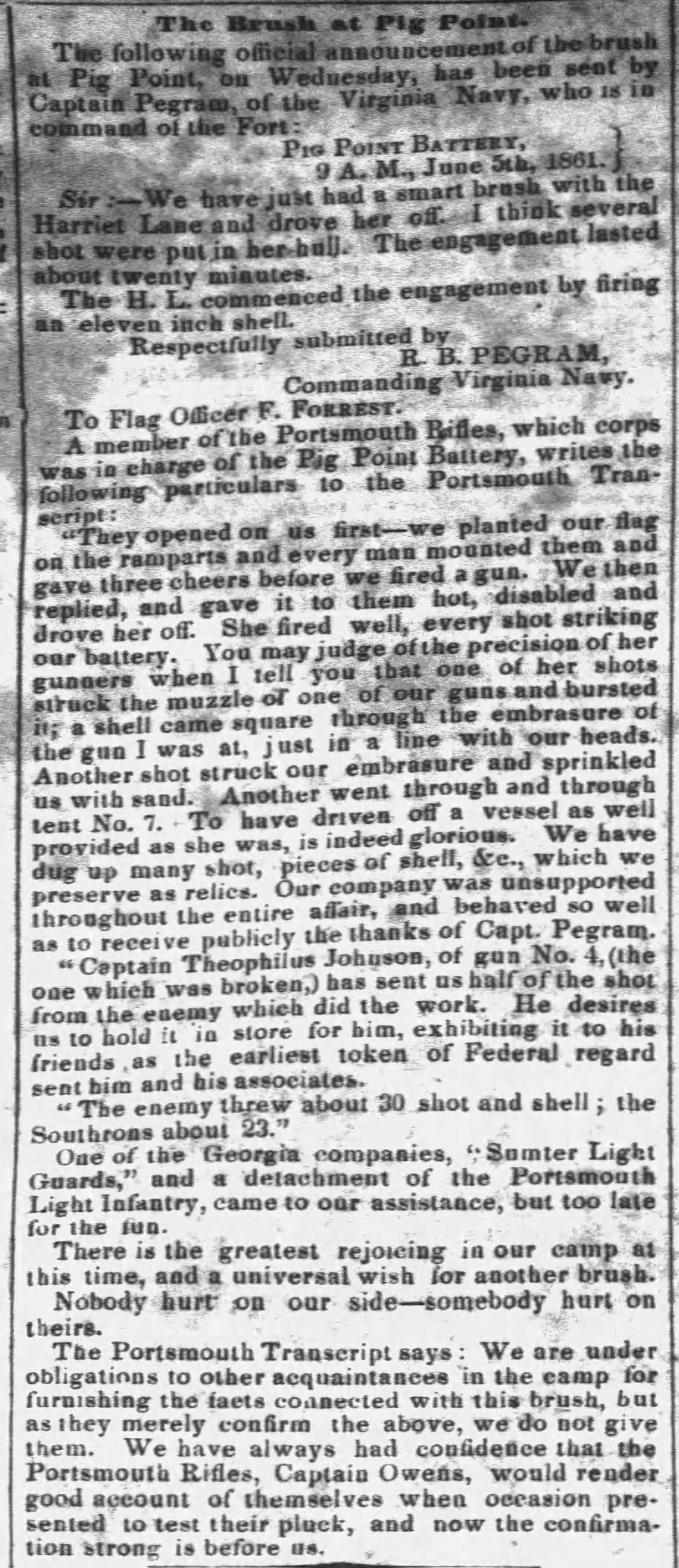
Charleston Daily Courier (Charleston, SC) 10 June 1861.
Reports and Letters
- May 1st Letter from Commandant French Forrest to Maj. Gen. Walter Gwynn
- May 1st Letter from Maj. Gen. Walter Gwynn to Commandant French Forrest
- June 4th report of Captain Faunce, commanding U.S.S. Harriet Lane
- June 5th report of Captain Faunce, commanding U.S.S. Harriet Lane
- June 5th Report of Commander Pegram, Virginia Navy, Commanding Pig Point battery
- June 5th Report of Commander Pegram, Virginia Navy, Commanding Pig Point battery (2nd)
- June 5th Report of Brigadier-General Huger, Commanding at Norfolk
- June 7th Report of Brigadier-General Huger, Commanding at Norfolk
Secondary Sources
Cobb, J. Michael, Edward B. Hicks, and Wythe Holt. Battle of Big Bethel: Crucial Clash in Early Civil War Virginia. El Dorado Hills: Savas Beatie LLC, 1997.
Trask, Benjamin H. 9th Virginia Infantry. Lynchburg: H.E. Howard, Inc., 1984.
Updated: 21 February 2026
Created: 12 February 2021
 Spirit of '61