Monday, June 10, 1861
Though small in comparison to later battles, Big Bethel was significant because it was the first unambiguous Confederate military victory in Virginia.
Narrative
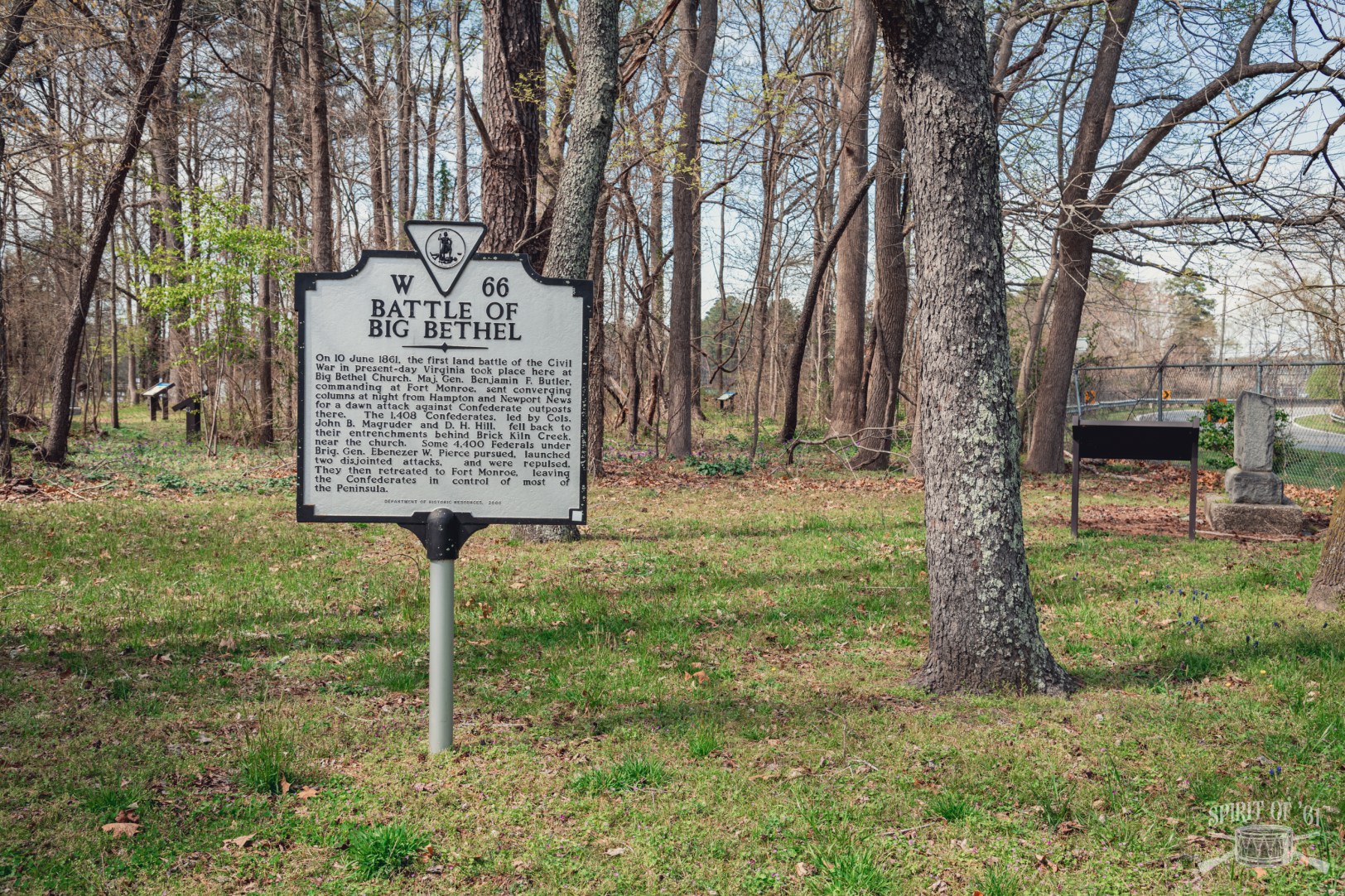
The Battle of Big Bethel was fought on Monday, June 10, 1861 between Union forces commanded by Brig. Gen. Ebenezer Peirce and Confederate forces commanded by Col. John B. Magruder and Col. Daniel Harvey Hill in Hampton, Virginia. It resulted in a Confederate victory with 86 total casualties.
Big Bethel was one of the first pitched battles of the American Civil War. After the Virginia Secession Convention passed its ordinance of secession in May 1861, Union forces steadily reinforced Fort Monroe, a federal stronghold located at the tip of the Virginia Peninsula between the James and York rivers. Fort Monroe remained the only federal property in Virginia not seized by the Confederates, and President Abraham Lincoln was determined to avoid another loss like that of Fort Sumter in South Carolina.
On May 22, Maj. Gen. Benjamin F. Butler of Massachusetts was assigned command of the Union troops at Fort Monroe. Known for his aggressive leadership, Butler quickly sought to expand the Union’s foothold on the Virginia Peninsula. By the end of May, his forces had occupied the nearby towns of Hampton and Newport News. In response, Confederate forces under Colonel John B. Magruder constructed a mile-long line of entrenchments along the Northwest Branch of the Back River, near the churches of Big and Little Bethel, to block further Union advances.
Butler and his aide, Major Theodore Winthrop, devised a plan for a nighttime surprise attack, to be led by Brigadier General Ebenezer Peirce. Colonel Abram Duryee’s 5th New York Infantry Regiment was ordered to march from Camp Hamilton in Hampton after midnight, with Colonel Frederick Townsend’s 3rd New York Infantry Regiment providing support. Additional forces, including the 1st Vermont, 4th Massachusetts, and 7th New York regiments, moved out from Newport News along with several artillery pieces.
To prevent confusion during the night operation, Butler designated “Boston” as the watchword for all Union columns and instructed the troops to wear white rags or handkerchiefs on their left arms for identification in the darkness. However, a key miscommunication occurred: Captain Haggerty, the messenger responsible for relaying these orders, failed to inform Colonel John W. Phelps at Newport News of these precautions.
Early on the morning of June 10, Townsend’s regiment, led by General Peirce, advanced as planned and approached the 7th New York from behind. Unfortunately, Colonel John A. Bendix of the 7th New York mistook Peirce’s men for Confederate cavalry, and the situation was worsened by the fact that the 3rd New York regiment wore gray uniforms, similar to Confederate forces. In the confusion, the 7th New York opened fire, causing 21 casualties and sending many soldiers into a panicked retreat. This friendly-fire incident was exactly the disaster Butler had hoped to avoid.
Although Union forces eventually regained order, the gunfire had alerted the Confederate troops to the impending attack. The Confederate defense, commanded by Colonel Daniel Harvey Hill’s 1st North Carolina Regiment and supported by the Richmond Howitzers under Major George W. Randolph, withdrew to their trenches, bracing for the assault.
The battle continued throughout the morning and into the afternoon, with Union forces launching several attacks on the Confederate earthworks. However, the Union troops—demoralized by the earlier friendly-fire incident—were inexperienced, exhausted, and facing a well-entrenched enemy. Major Winthrop was shot and killed while leading one of the final charges, and Lieutenant John Trout Greble, a regular Army officer, was killed while preparing to withdraw his artillery.
Before the Battle of Big Bethel, Confederate forces in Virginia had largely been on the defensive, retreating from Union advances. The capture of Alexandria and the hasty Confederate retreat from Philippi had been widely reported in the press, boosting Union morale. However, the Confederate victory at Big Bethel marked a turning point, as they decisively repelled the Union forces. The Union suffered 18 killed, 53 wounded, and five missing, while Confederate casualties were much lighter, with only one killed and nine wounded.
After Big Bethel, only a few small skirmishes occurred on the Virginia Peninsula that summer, and major military operations in the area ceased until the following year.
Opposing Forces
Confederate
Colonel John B. Magruder, Commanding
| Unit | Commander(s) | Strength | Killed | Wounded | Captured |
|---|---|---|---|---|---|
| 1st NC Infantry Regiment (6 mo.) | Col. Daniel Harvey Hill | 800 | 1 | 6 | 0 |
| 3rd (15th) VA Infantry Regiment, 4 companies | Lt. Col. William D. Stuart | 208 | 0 | 0 | 0 |
| Montague’s Battalion | Maj. Edgar B. Montague | 215 | 0 | 0 | 0 |
| Wythe Rifles | Capt. William R. Willis Lt. Samuel R. Chisman | 70 | 0 | 0 | 0 |
| 2nd Co., Richmond Howitzers | Capt. John T. Brown | 3 guns, 60 men | 0 | 3 | 0 |
| 3rd Co., Richmond Howitzers | Maj. George J. Randolph | 4 guns, 95 men | 0 | 0 | 0 |
| Charles City Troop | Capt. Robert Douthat | 84 | 0 | 0 | 0 |
| Old Dominion Dragoons | Capt. Jefferson C. Phillips | 80 | 0 | 0 | 0 |
| Nottoway Troop | John E. Jones | 58 | 0 | 0 | 0 |
| 1,670 | 1 | 9 | 0 |
Union
Brig. Gen. Ebenezer W. Pierce, Commanding
| Unit | Commander(s) | Strength | Killed | Wounded | Captured |
|---|---|---|---|---|---|
| 1st NY Infantry Regiment | Col William H. Allen | 822 | 2 | 1 | 0 |
| 2nd NY Infantry Regiment | Col. Joseph B. Carr | 786 | 0 | 2 | 1 |
| 3rd NY Infantry Regiment | Col. Frederick Townsend | 700 | 2 | 27 | 1 |
| 5th NY Infantry Regiment | Col. Abram Duryée | 850 | 6 | 13 | 0 |
| 7th NY Infantry Regiment | Col. John F. Bendix | 780 | 3 | 7 | 2 |
| 1st VT Infantry Regiment, 5 companies | Lt. Col. Peter T. Washburn | 275 | 2 | 3 | 1 |
| 4th MA Infantry Regiment, 5 companies | Maj. Horace O. Whittemore | 269 | 1 | 0 | 0 |
| 2nd Artillery | Lt. John Greble | 4* guns, 36 men | 1 | 0 | 0 |
| 4,518 | 18** | 53 | 5 |
Timeline
May 21, 1861: Virginia Col. John B. Magruder takes command at Yorktown.
May 22, 1861: Massachusetts Maj. Gen. Benjamin F. Butler assumes command of the Union garrison at Fort Monroe in Hampton Roads.
May 27, 1861: Union troops occupy Newport News Point and establish Camp Butler.
June 5, 1861: The converted revenue cutter USS Harriet Lane exchanges fire with Confederate shore batteries at Pig Point at the mouth of the James River.
June 7, 1861: Capt. William H. Werth and the Chatham Grays make a reconnaissance on the Union fortifications at Newport News.
Battlefield
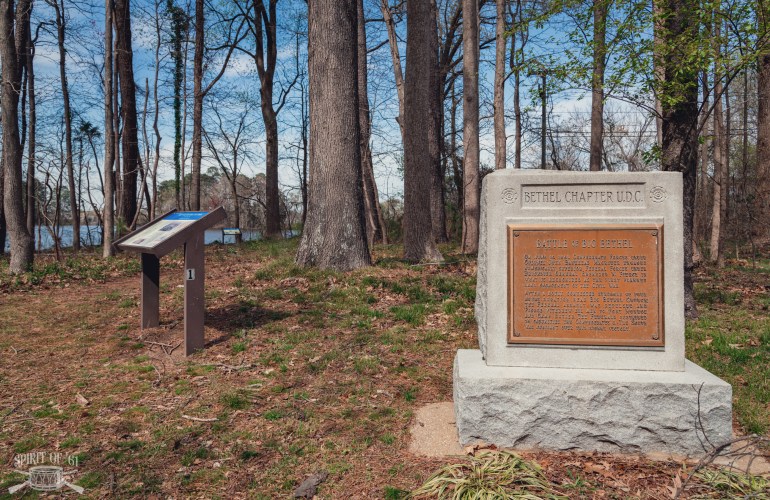
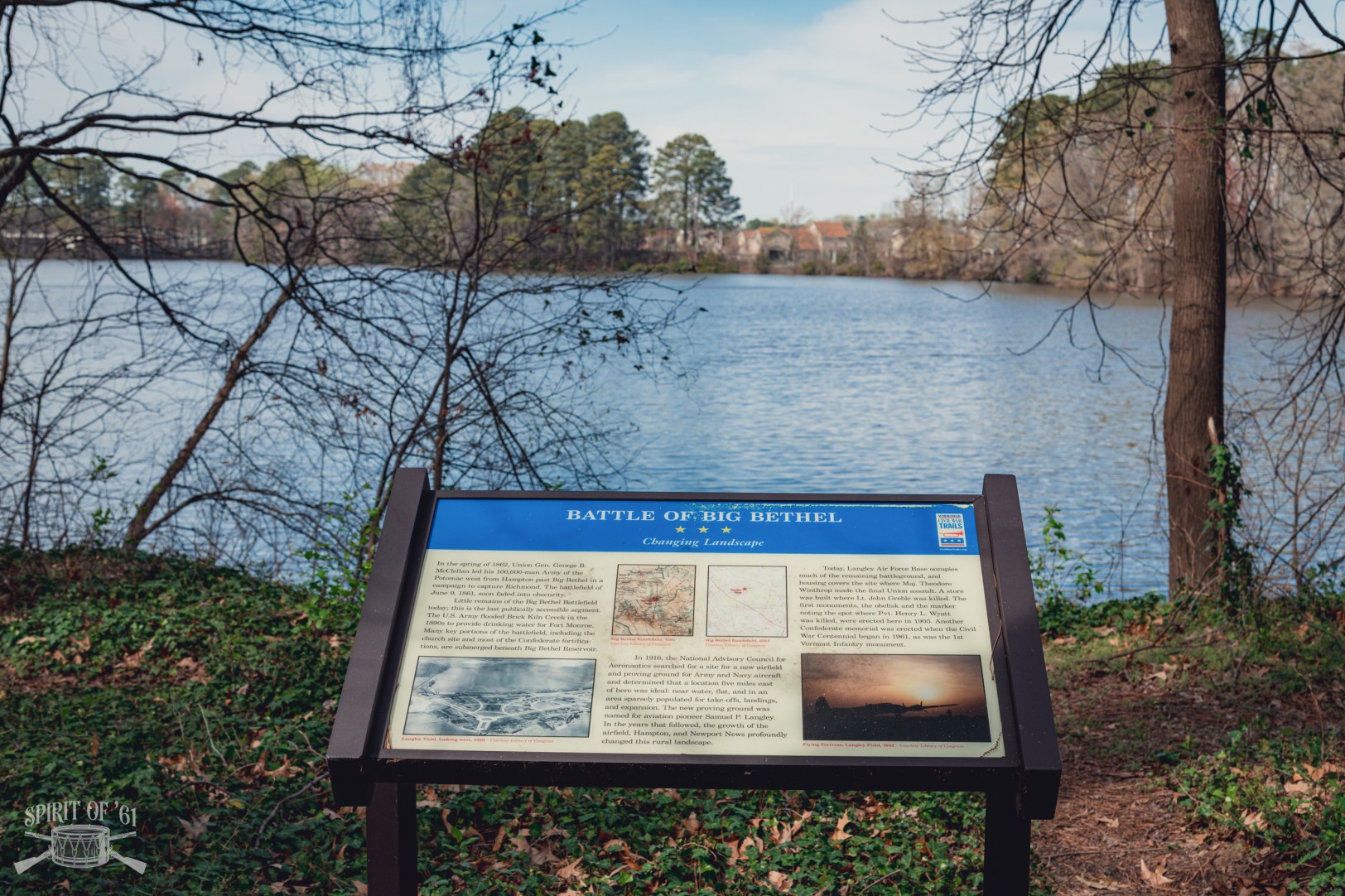
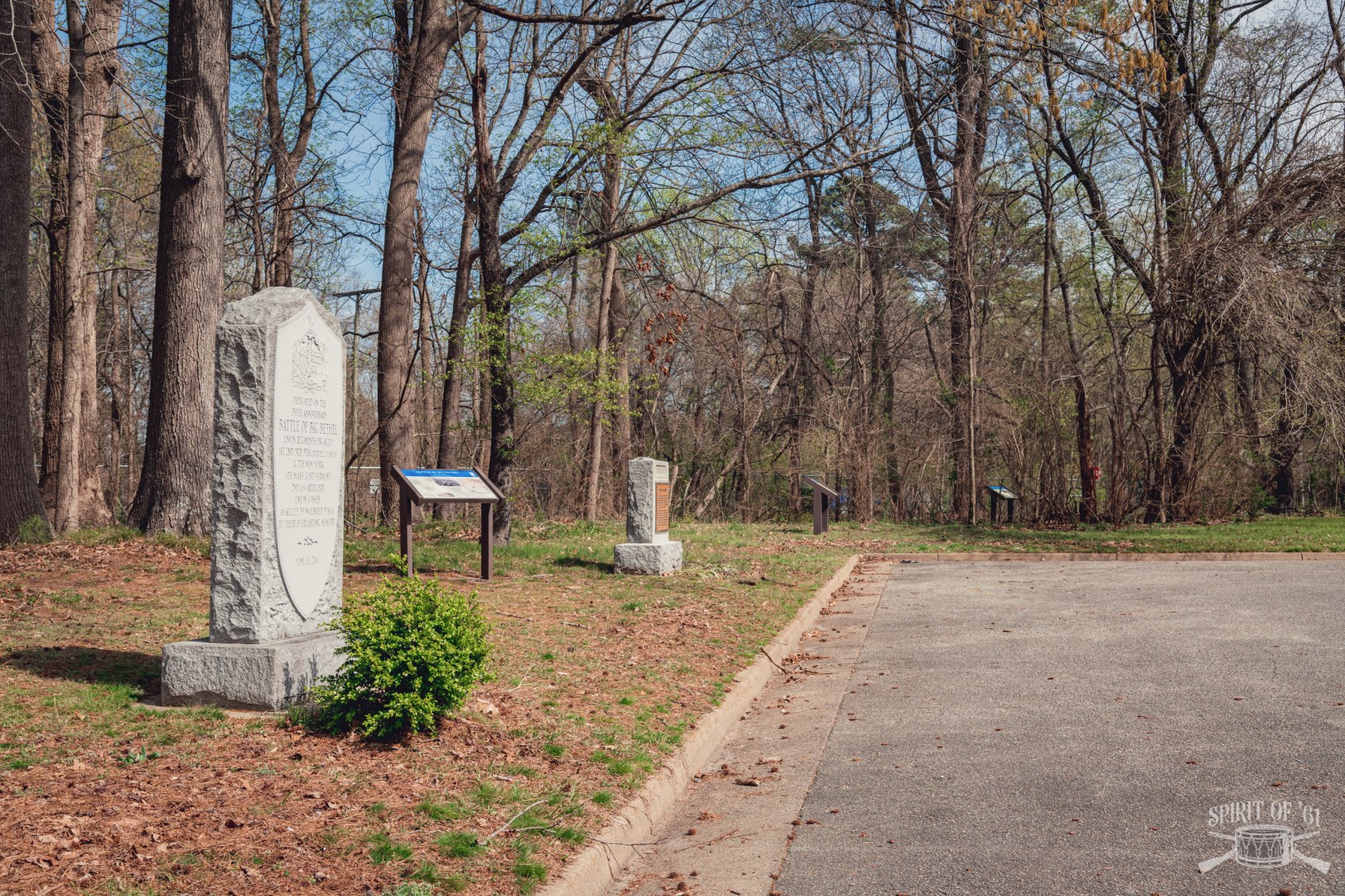
Today, the Virginia Peninsula is much different than over 160 years ago. Much of the battlefield has been covered by the Big Bethel Reservoir or is enclosed in Langley Air Force Base. Bethel Park, 123 Saunders Rd. in Hampton, Virginia, is the only public land on the battlefield, but only a small portion of it has information on the battle. It’s called “Spot Park” on Google Maps, with an entrance off Big Bethel Road. There is a parking lot and short trail with Civil War Trail signs telling the story of the battle and a few granite monuments.
Location
GPS Coordinates — 37.09351, -76.42524
Primary Sources
Reports and Letters
- May 27th Report of Major General B. F. Butler, U. S. Army, Commanding Department of Virginia
- May 29th Report of Major General B. F. Butler, U. S. Army, Commanding Department of Virginia
- June 7th Report of Captain W. H. Werth, Chatham Grays, Virginia Cavalry
- June 8 Report of Colonel J. B. Magruder, C. S. Army
- June 10th Report of Major General B. F. Butler, U. S. Army
- June 10th Report of Colonel J. B. Magruder, C. S. Army, 1st
- June 10th Report of Colonel J. B. Magruder, C. S. Army, 2nd
- June 11 Letter of Colonel Daniel Harvey Hill to Governor John W. Ellis
- June 11th Report of Captain Judson Kilpatrick, Fifth New York Infantry
- June 11th Report of Lieut. Col. Peter T. Washburn, First Vermont Infantry
- June 11 Report of Colonel William H. Allen, First New York Regiment
- June 11 Report of Colonel Abram Duryee, Fifth New York Volunteers
- June 12th Report of Brigadier General E. W. Pierce, Massachusetts Militia
- June 12th Report of Colonel Frederick Townsend, Third New York Infantry
- June 12th Report of Colonel John E. Bendix, Seventh New York Infantry
- June 12th Report of Colonel J. B. Magruder, C. S. Army
- Report of Colonel D. H. Hill, First North Carolina Infantry, on Big Bethel
- Report of Lieut. Col. William D. Stuart, Third Virginia Infantry, on Big Bethel
- June 12th Report of Major George W. Randolph, Commanding Howitzer Battalion
- Report of Major E. B. Montague, commanding Virginia Battalion, on Big Bethel
- June 12th Report of Captain W. H. Werth, Commanding Chatham Grays, Virginia Cavalry
- June 13th Report of Captain W. H. Werth, Commanding Chatham Grays, Virginia Cavalry
- June 16th Report of Major General B. F. Butler, U. S. Army
Memoirs
Gordon, E.C. “The Battle of Bethel” in Contributions to a History of the Richmond Howitzer Battalion, Pamphlet No. 1. Richmond: Carlton McCarthy & Co., 1883.
Southwick, Thomas Paine. A Duryee Zouave. Brookneal: Patrick A. Schroeder Publications, 1995.
Secondary Sources
Chapman, Craig S. More Terrible than Victory: North Carolina’s Bloody Bethel Regiment, 1861-1865. Dulles: Brassey’s, 1999.
Cobb, J. Michael, Edward B. Hicks, and Wythe Holt. Battle of Big Bethel: Crucial Clash in Early Civil War Virginia. El Dorado Hills: Savas Beatie LLC, 1997.
Ivy, Dick. Fact Sheets of York County History. Yorktown: The York County Historical Committee, 2005.
Moore, John W., ed. Roster of North Carolina Troops in the War Between the States, Vol. 1. Raleigh: Ash & Gatling, 1882.
Quarstein, John V. Hampton and Newport News in the Civil War: War Comes to the Peninsula. Lynchburg: H.E. Howard, Inc., 1998.
Updated: 10 March 2025
Created: 18 March 2021
 Spirit of '61