Saturday, June 8, 1861
Before the Battle of Big Bethel, a pair of small skirmishes played a key role in shaping Union strategy and setting the stage for their defeat. Learn how these early encounters influenced the course of the larger conflict on the Virginia Peninsula.
Narrative
The Skirmish at New Market Bridge was fought on Saturday, June 8, 1861 between Union forces commanded by Capt. George W. Wilson and Confederate forces commanded by Lt. Col. Charles C. Lee and Maj. James H. Lane in present-day Hampton, Virginia. Though relatively minor, it played a crucial role in shaping Union General Benjamin Butler’s flawed understanding of Confederate positions on the Peninsula, leading to missteps in the subsequent Battle of Big Bethel.
After the Virginia Secession Convention passed its ordinance of secession in May 1861, Union forces steadily reinforced Fort Monroe, a federal stronghold located at the tip of the Virginia Peninsula between the James and York rivers. Fort Monroe remained the only federal property in Virginia not seized by the Confederates, and President Abraham Lincoln was determined to avoid another loss like that of Fort Sumter in South Carolina.
On May 22, Brigadier General Benjamin F. Butler of Massachusetts assumed command of the Union troops at Fort Monroe. Known for his aggressive leadership, Butler quickly sought to expand the Union’s foothold on the Virginia Peninsula. By the end of May, his forces had occupied the nearby towns of Hampton and Newport News. In response, Confederate Colonel John B. Magruder ordered Montague’s Battalion, supported by artillery and cavalry, to occupy the area around Big Bethel Church, along the road from Hampton to Yorktown.
Major Edgar B. Montague became concerned that a Union force was planning to outflank him. He relayed his fears to Magruder, then fell back to a Colonial-Era tavern called the Halfway House. Magruder responded by sending Colonel Daniel Harvey Hill’s 1st North Carolina Infantry Regiment to meet this potential threat. Although Montague’s fears were unfounded, when Hill began fortifying around Big Bethel Church along the Northwest Branch of the Back River on June 7, he inadvertently set the stage for a Confederate victory in the Battle of Big Bethel three days later.
Meanwhile, Union Colonel Joseph B. Carr’s 2nd New York Infantry Regiment was foraging for supplies outside Hampton, venturing up to New Market Bridge over the Southwest Branch of the Back River, about five miles from Hill’s fortifications. Some of Carr’s men were baking bread at an abandoned house when they received word that Confederate cavalry were in the area. Carr dispatched two companies, led by Captain George W. Wilson, to investigate. The group split into two: Company E, under Wilson, advanced toward Little Bethel Church, while Company G took the Back River Road.
Hill’s scouts reported that a group of Union soldiers was ransacking the house of Henry C. Whiting, located a short distance east of Little Bethel. Hill called for volunteers to address the threat, and Lieutenant Frank N. Roberts of Company F stepped forward. Hill also directed Major George W. Randolph of the 3rd Company, Richmond Howitzers, to support Roberts’ 34-man detachment with a single cannon and placed Lieutenant Colonel Charles C. Lee in command of the group.
Shortly after Lee’s group set out, a local citizen rushed into the Confederate camp and informed Hill of a second Union party, this time spotted on the Back River Road. Hill dispatched Major James H. Lane, along with Company E of the 1st North Carolina and one cannon from the Richmond Howitzers, to confront them.
The Old Dominion Dragoons (likely the cavalry Carr’s men had spotted) joined Lee’s group along the road. From a distance, they observed Wilson’s company of New Yorkers at Whiting’s farm. Lee ordered the cannon forward. Private Edward C. Gordon of the Richmond Howitzers wrote in his diary: “They saw us pretty soon and started to run! We pursued them until we got within about 400 yards… Venable sighted, and gave the command, ‘fire.’ The shell struck right by the side of the retreating part, but, O! horrors, it didn’t burst.”
The Dragoons chased down one New Yorker, Daniel A. Mooney, and captured him. Mooney’s name later appeared on casualty lists for the Battle of Big Bethel, but he was, in fact, alive. Wilson’s company retreated across New Market Bridge and rejoined the rest of their regiment.
Major Lane’s group skirmished with Company G of the 2nd New York along the Back River Road. This encounter, though brief, was more of a stand-up fight than the earlier engagement, with Confederates firing “in real squirrel hunting style.” Lieutenant John M. West, commanding the howitzer, had a bullet pierce his hat. The Confederates captured Private George Mason as the New Yorkers again retreated across New Market Bridge. A civilian later reported helping transport a cart full of wounded Union soldiers into Hampton, though no Union accounts corroborate this claim.
The presence of the 2nd New York discouraged any further Confederate pursuit, and both sides returned to their camps. Colonel Hill credited this skirmish with provoking the Union attack at Big Bethel. Butler, possibly due to confusion from the skirmish, mistakenly believed that the Confederate headquarters was at Little Bethel, which contributed to the failure of his plan two days later.
Opposing Forces
Confederate
Lt. Col. Charles C. Lee and Maj. James H. Lane, Commanding
| Unit | Commander(s) | Strength | Killed | Wounded | Captured |
|---|---|---|---|---|---|
| 1st NC Infantry Regiment (6 mo.), Company F | Lt. Frank N. Roberts | 34 | 0 | 0 | 0 |
| 3rd Co., Richmond Howitzers | Maj. George W. Randolph | 1 gun, 14 men | 0 | 0 | 0 |
| Old Dominion Dragoons | Capt. Jefferson C. Phillips | 80 | 0 | 0 | 0 |
| 1st NC Infantry Regiment (6 mo.), Company E | Capt. William W. McDowell | 97 | 0 | 0 | 0 |
| 3rd Co., Richmond Howitzers | Lt. John M. West | 1 gun | 0 | 0 | 0 |
Union
Col. Joseph B. Carr, Commanding
| Unit | Commander(s) | Strength | Killed | Wounded | Captured |
|---|---|---|---|---|---|
| 2nd New York Infantry Regiment, Company E, G | Capt. George W. Wilson | 154 | 0 | 0 | 2 |
Timeline
May 27, 1861: Union troops occupy Newport News Point and establish Camp Butler.
June 5, 1861: The converted revenue cutter USS Harriet Lane exchanges fire with Confederate shore batteries at Pig Point at the mouth of the James River.
June 7, 1861: Capt. William H. Werth and the Chatham Grays make a reconnaissance on the Union fortifications at Newport News.
June 8, 1861: A squad of men from the 2nd New York visit a house to bake bread. Confederates in the area are alerted to their presence.
Location
GPS Coordinates — 37.0439, -76.3637
Primary Sources
News Articles
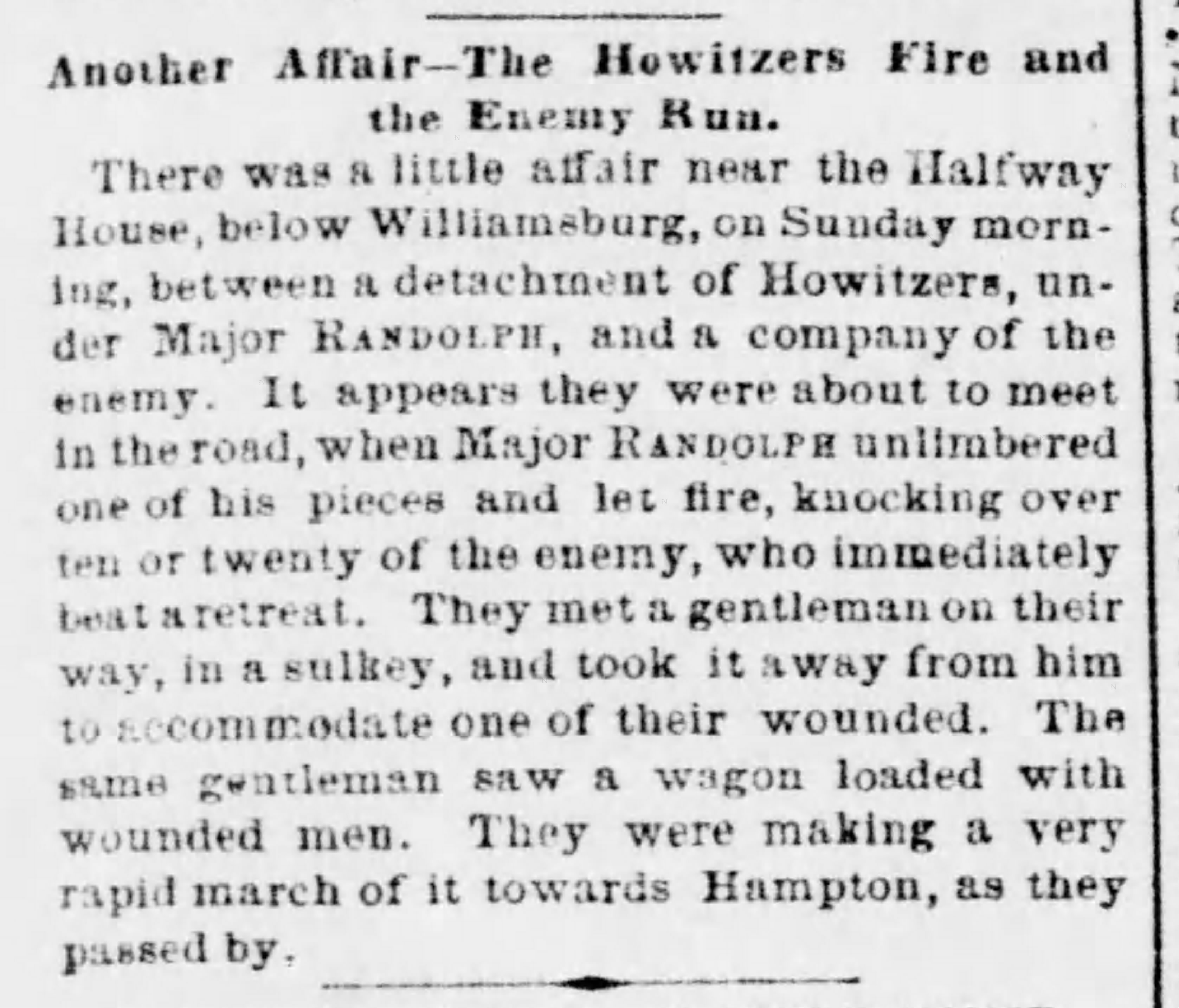
Richmond Dispatch (Richmond, VA) 11 June 1861.
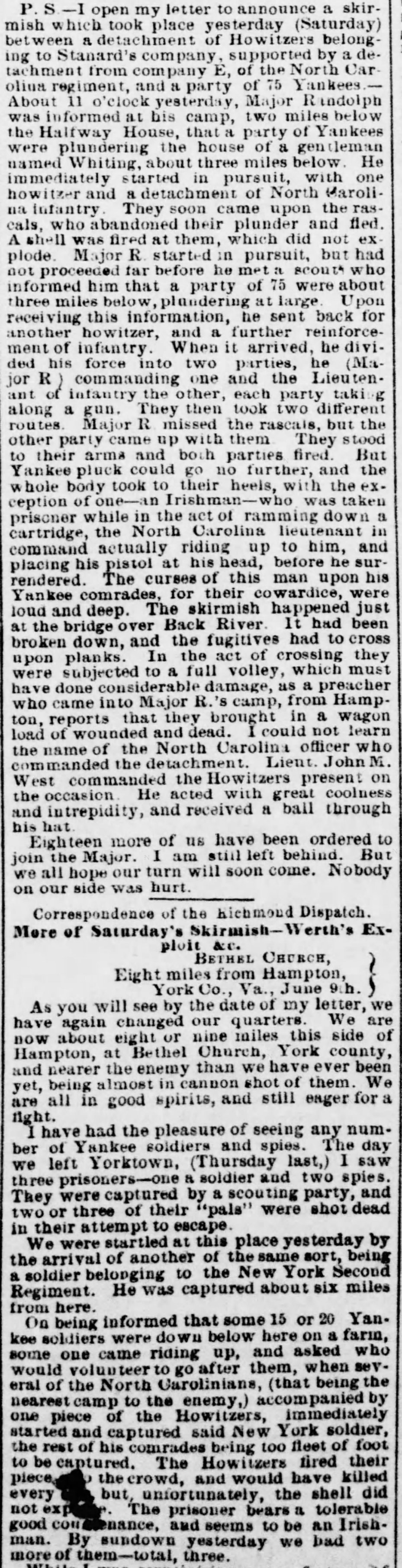
Richmond Dispatch (Richmond, VA) 12 June 1861.
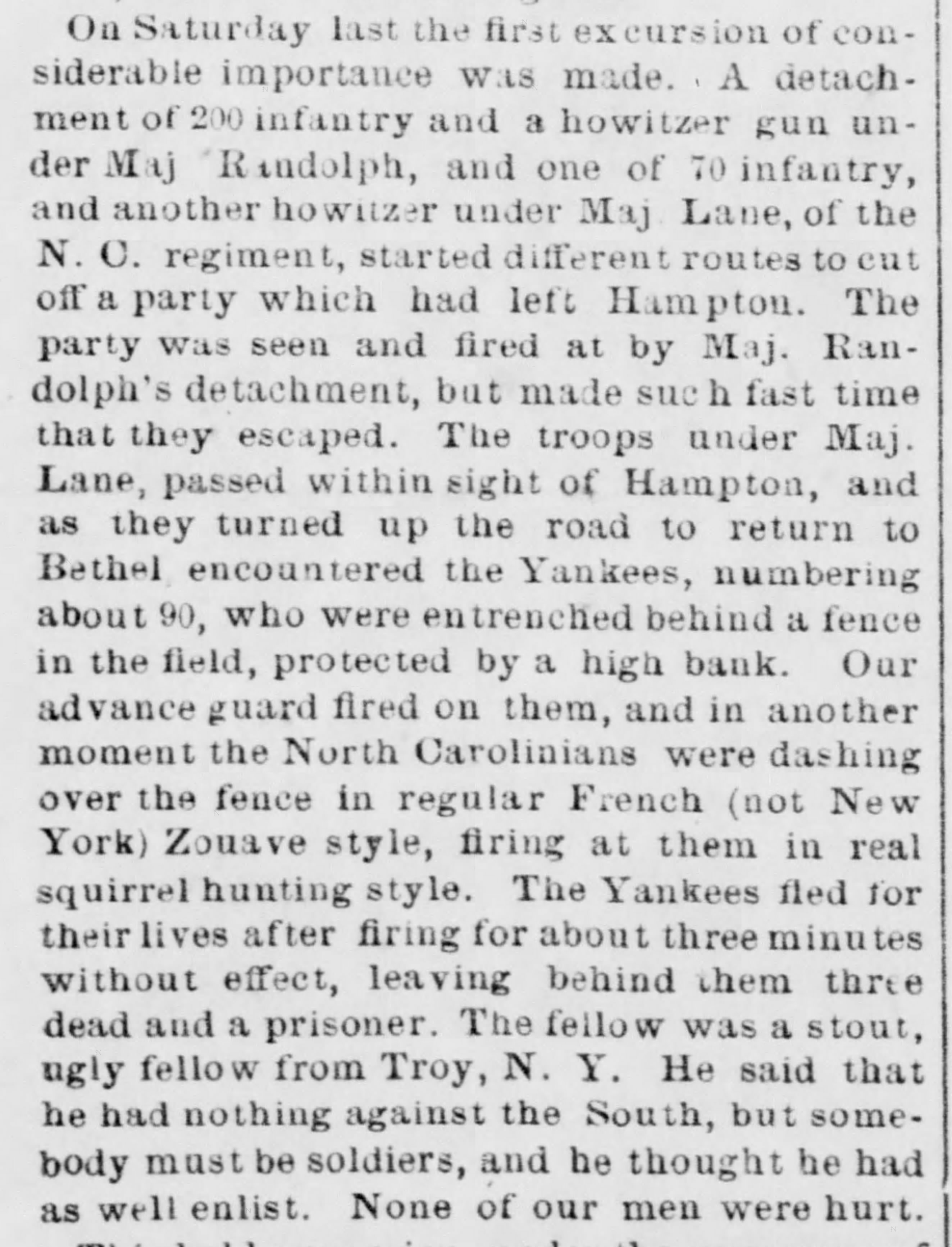
Richmond Dispatch (Richmond, VA) 13 June 1861.
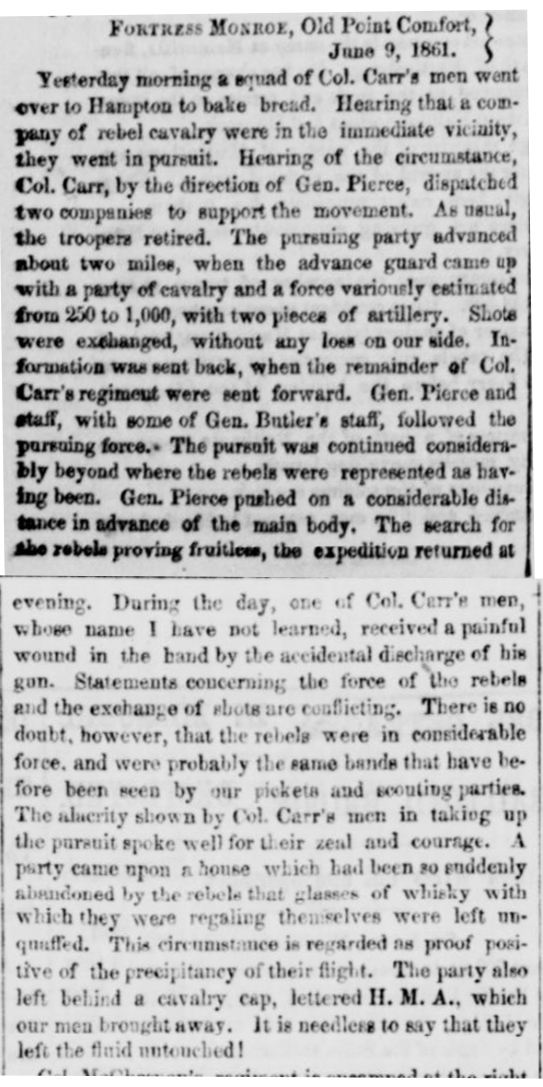
New York Daily Tribune (New York, NY) 13 June 1861.
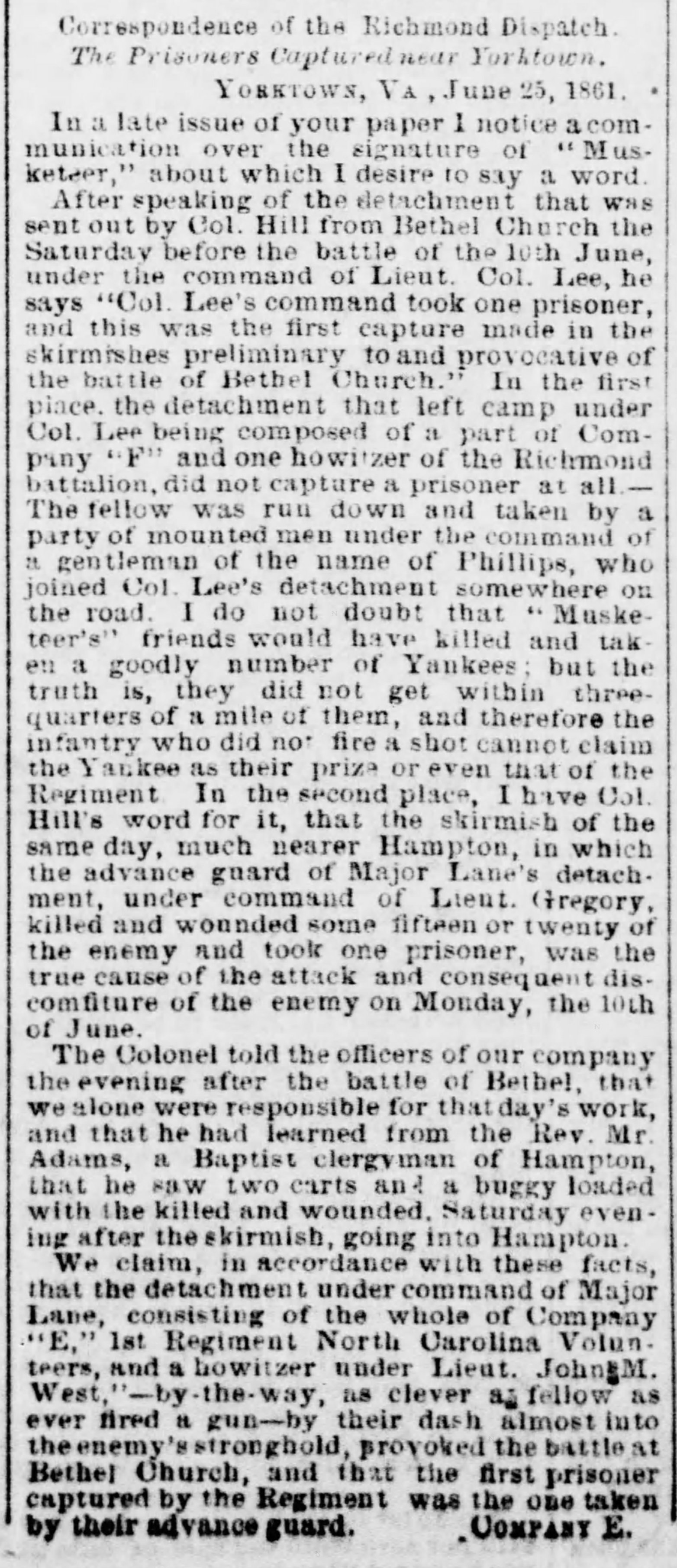
Richmond Dispatch (Richmond, VA) 28 June 1861.
Reports and Letters
- June 8 Report of Colonel J. B. Magruder, C. S. Army
- Report of Colonel D. H. Hill, First North Carolina Infantry, on Big Bethel
Secondary Sources
Chapman, Craig S. More Terrible than Victory: North Carolina’s Bloody Bethel Regiment, 1861-1865. Dulles: Brassey’s, 1999.
Cobb, J. Michael, Edward B. Hicks, and Wythe Holt. Battle of Big Bethel: Crucial Clash in Early Civil War Virginia. El Dorado Hills: Savas Beatie LLC, 1997.
Gordon, E.C. “The Battle of Bethel” in Contributions to a History of the Richmond Howitzer Battalion, Pamphlet No. 1. Richmond: Carlton McCarthy & Co., 1883.
Moore, John W., ed. Roster of North Carolina Troops in the War Between the States, Vol. 1. Raleigh: Ash & Gatling, 1882.
Phisterer, Frederick. New York in the War of Rebellion, 1861-1865, Vol 1, 3rd ed. Albany: J.B. Lyon Company, 1912.
Wallace, Lee A., Jr. The Richmond Howitzers. Lynchburg: H.E. Howard, Inc., 1993.
Updated: 6 March 2025
Created: 25 September 2024
 Spirit of '61